
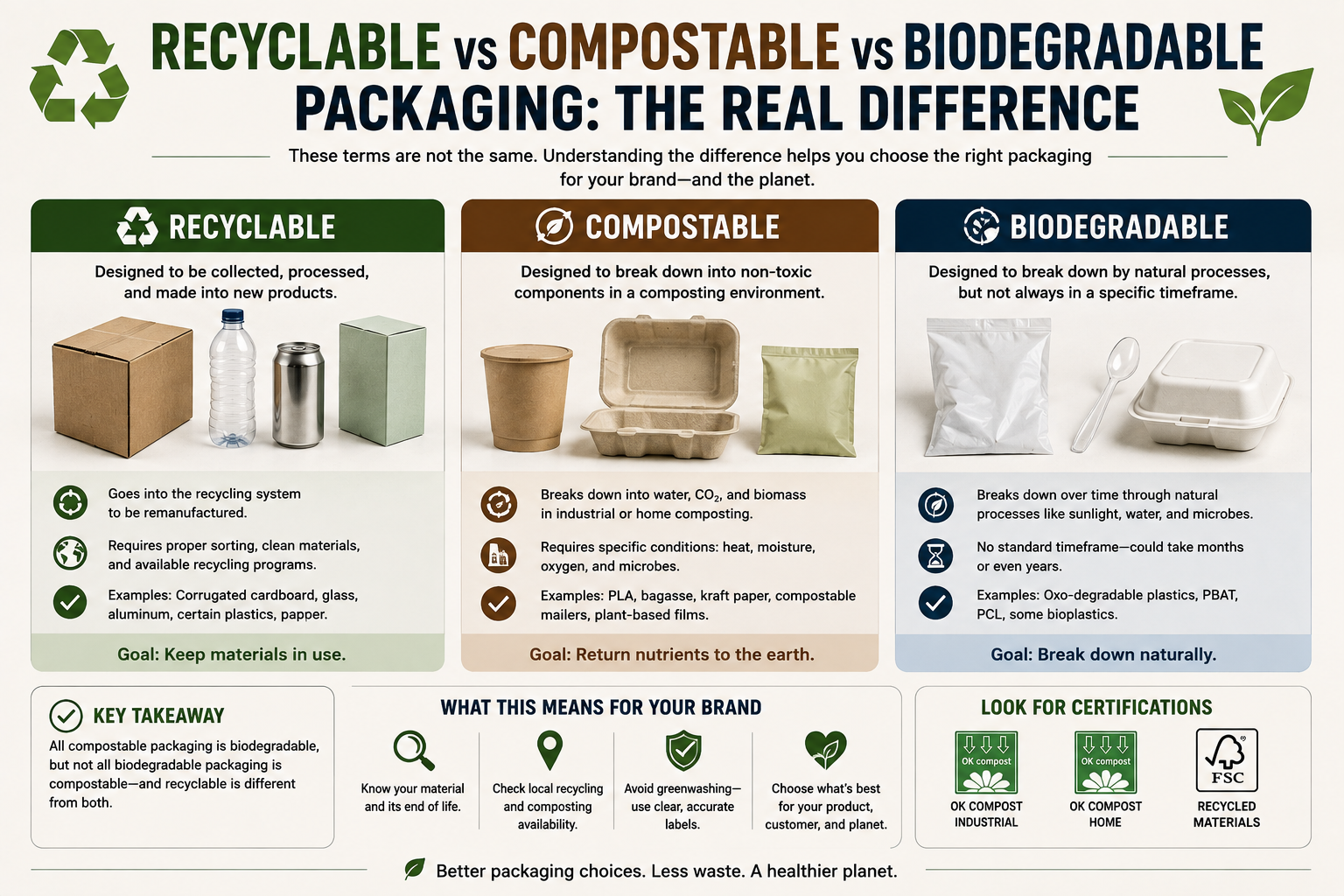
Recyclable vs compostable packaging isn’t just marketing language. Each term describes a different disposal path. Picking the wrong one creates real problems. Recyclable means the material can go through a recycling system, if one exists where your buyer lives. Compostable means it breaks down in compost. That’s usually an industrial facility, not a backyard bin. Biodegradable has no clear rule in the US. It’s mostly a marketing word. Mixing these three up is the biggest mistake brands make when picking “eco-friendly” packaging.
This article covers recyclable vs compostable packaging, what each term actually requires, and which choice fits your product.
What Recyclable Packaging Actually Means
Recyclable packaging can be processed by a recycling system. That’s the whole definition. It doesn’t mean it will get recycled. That depends on your buyer’s local collection program.
Most curbside programs accept corrugated cardboard. Many accept paperboard too. Coated or laminated boxes are trickier. A plastic-coated paperboard box may not be accepted everywhere. The box can be technically recyclable and still get rejected locally.
Recyclability also depends on what else ends up in the box. A recyclable box with food residue or grease can get turned away at a sort plant. A non-recyclable plastic window causes the same issue. Being recyclable on paper doesn’t mean it gets recycled in real life.
What Compostable Packaging Requires
Compostable packaging breaks down into usable compost under the right conditions. That phrase matters: the right conditions. Most compostable packaging carries a standard like ASTM D6400. That standard calls for commercial compost plants. Those plants control heat, moisture, and microbe activity.
Home compost bins rarely hit those marks. A box tagged “compostable” often won’t break down in a backyard pile. It might do fine at a real plant instead. Your buyer may have no access to one. If so, the compostable tag doesn’t help them get rid of the box the right way. This is the core tension in the recyclable vs compostable packaging call.
This gap between labeled compostable and truly composted is where most green claims fall apart.
The Biodegradable Problem
Biodegradable is the weakest of these three terms. In the US, it has no firm rule like ASTM D6400 sets for compost. The FTC’s Green Guides warn against vague biodegradable claims. Almost anything breaks down given enough time.
Most plant-based stock is biodegradable over a long span. That makes the term nearly empty without a stated time limit. A box that “biodegrades” over 50 years in a dump isn’t a real win. The tag still sounds nice, though.
If you see “biodegradable” with no proof and no time limit, treat it as ad talk. It’s not a verified path for the box’s end life.
The Recyclable vs Compostable Packaging Mismatch
Here’s what most guides miss on recyclable vs compostable packaging. These aren’t points on one “how green is it” scale. Each term needs a specific disposal path to deliver its benefit. Pick the wrong one for your buyers. You get a real failure, not just a missed marketing angle.
A compostable mailer sent to buyers with no plant nearby usually ends up in the trash. Some buyers even put it in curbside recycling by mistake. Compostable stock can spoil a recycling batch and get the whole load tossed.
I’ve seen a brand switch to compostable mailers because the story tested well with shoppers. Most of their buyers had no compost plant nearby. Some threw the mailers in the trash, which was the right call. Others tossed them in recycling bins instead, thinking “eco-friendly” meant recyclable too. The fix was a widely recyclable kraft mailer with a clear disposal line printed on the box. That truly helped, even though compostable sounded greener on the label.
The table below lays out the recyclable vs compostable packaging tradeoffs. It also shows where biodegradable fits in.
Comparison Table: Recyclable vs Compostable vs Biodegradable
| Factor | Recyclable | Compostable | Biodegradable |
|---|---|---|---|
| Definition | Can be processed by a recycling system | Breaks down in compost conditions | Breaks down eventually, no set timeframe |
| What it needs to work | Local recycling collection | Usually industrial composting access | No enforced US standard |
| US consumer access | Widespread for paper and cardboard | Limited outside certain cities | Not a verifiable path |
| Cost premium | Low to none | Moderate | Varies, often unverified |
Which Is Right for Your Product?
If most of your buyers have solid curbside recycling access, choose a clearly recyclable material. Corrugated cardboard and uncoated paperboard are the safer bet here. This is also usually the lowest-cost option. Our guide to kraft paper covers one of the most widely recyclable stock choices available.
Do you ship to a place with a real compost plant nearby? If you can back the claim with an ASTM D6400 mark, compostable packaging can work as planned. Confirm the exact standard with your vendor first. Don’t trust the word “compostable” alone.
Avoid leaning on “biodegradable” as your main green claim. Without a set standard and time limit, the term does little to guide waste choices. The FTC’s Green Guides spell out what a solid claim needs.
Common Mistakes on Recyclable vs Compostable Packaging
The first mistake is picking compostable packaging based on the tag alone. Check first whether your buyers have a real compost plant nearby. The stock can carry a full mark and still end up in a dump.
The second mistake is treating “eco-friendly” and “recyclable” as the same thing. A box can be sold as eco-friendly while it holds a plastic film layer. That film makes it hard to recycle in most bins.
The third mistake is putting a compostable claim on a box with no proof behind it. That’s a vague claim. It draws the same heat that loose biodegradable tags get.
A fourth mistake is skipping the mix-and-match risk. Pair a recyclable box with a compostable window film, and you confuse the end user. It also makes the whole box harder to sort right. Our guide to cardstock, cardboard, and corrugated stock breaks down which base stock sorts most easily.
A fifth mistake is skipping a disposal line on the box itself. A short line like “widely recyclable — check local rules” helps more than a vague green claim ever will.
FAQ
Is recyclable packaging always better than compostable packaging? Not always. It depends on what waste systems your buyers actually have. Recyclable stock has far wider US support than compost plants do.
Can I call my packaging biodegradable? Only with care. A vague biodegradable claim can draw FTC scrutiny under the Green Guides. Most plant-based stock breaks down given enough time. That makes the term easy to overstate with no real standard behind it.
Does EBP offer certified compostable or FSC packaging? Ask about stock options in your quote request. Confirm the exact standard with your vendor first — ASTM D6400 for compost, or FSC chain-of-custody for sourcing. Do this before you make a green claim of your own. Our guide to eco-friendly custom packaging costs covers what these choices typically add to your budget.
Get a free quote — dieline and design support included.