
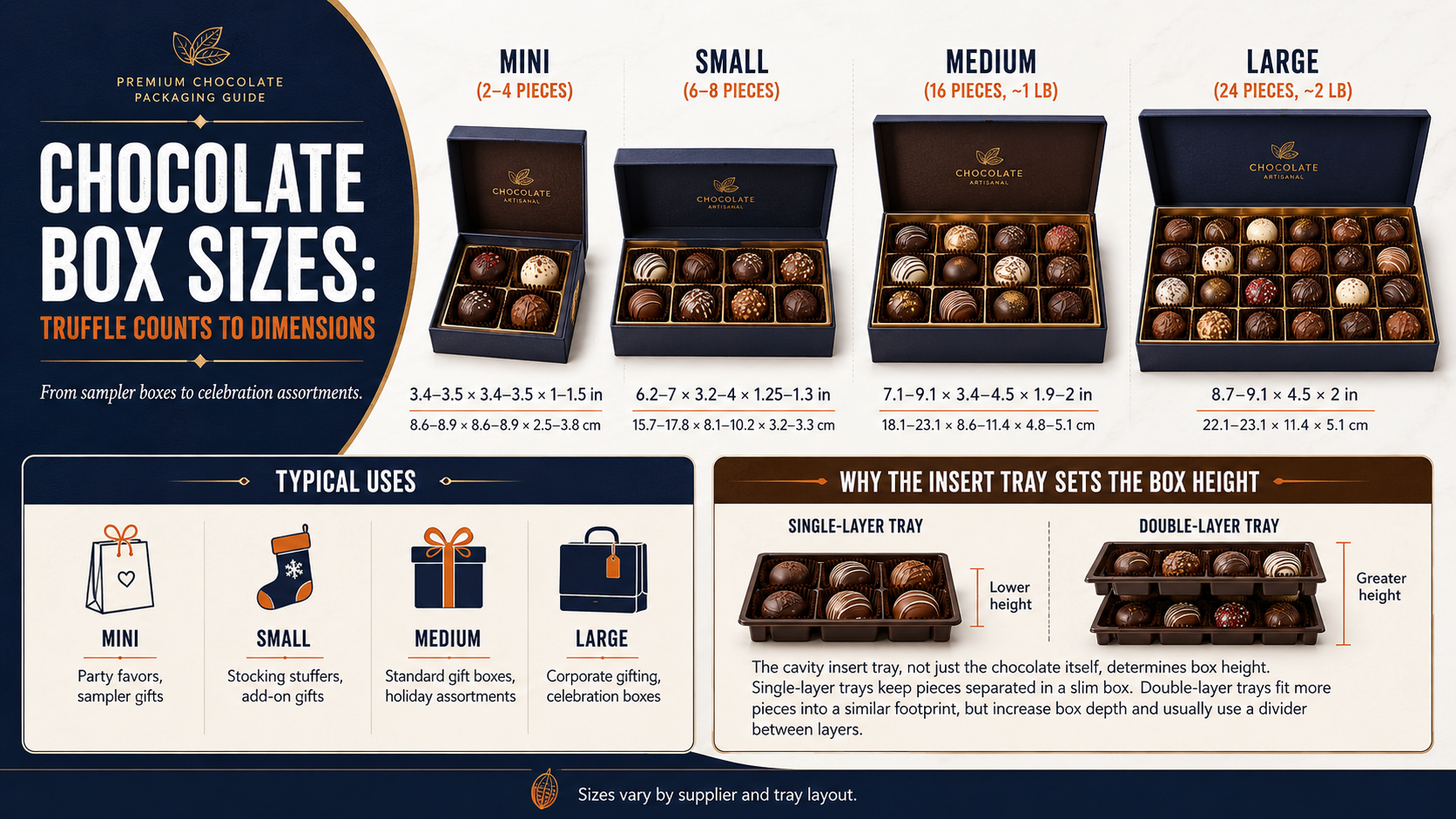
Chocolate box sizes run by piece count more than by weight. A 4-piece sampler measures around 3.5 × 3.5 × 1 inches. A 16-piece assortment closer to 1 pound runs 7 to 9 inches long. A 24-piece gift box tops out near 9 inches long and 2 inches deep. This guide charts all four common tiers. It also explains why the insert tray, not the chocolate itself, is what actually sets the box height. It’s part of our size guide series alongside our gift box sizes and cupcake box sizes guides. For everything else, our full box size guide covers the rest.
Chocolate Box Sizes Chart
| Chocolate Box Size | Dimensions (L×W×H, inches) | Dimensions (cm) | Typical Use |
|---|---|---|---|
| Mini (2–4 pieces) | 3.4–3.5 × 3.4–3.5 × 1–1.5 in | 8.6–8.9 × 8.6–8.9 × 2.5–3.8 cm | Party favors, sampler gifts |
| Small (6–8 pieces) | 6.2–7 × 3.2–4 × 1.25–1.3 in | 15.7–17.8 × 8.1–10.2 × 3.2–3.3 cm | Stocking stuffers, add-on gifts |
| Medium (16 pieces, ~1 lb) | 7.1–9.1 × 3.4–4.5 × 1.9–2 in | 18.1–23.1 × 8.6–11.4 × 4.8–5.1 cm | Standard gift boxes, holiday assortments |
| Large (24 pieces, ~2 lb) | 8.7–9.1 × 4.5 × 2 in | 22.1–23.1 × 11.4 × 5.1 cm | Corporate gifting, celebration boxes |
These chocolate box sizes vary across suppliers depending on tray layout. The ranges above reflect that real spread rather than one fixed spec.
Why the Insert Tray Sets the Box Height, Not the Chocolate
Most people assume a bigger chocolate needs a bigger box. That’s only half true. The real driver is the cavity insert tray sitting inside the box. A single-layer tray holds pieces upright and separated. It keeps truffles from touching or sticking together in transit. That tray caps the piece count for a given footprint, though, since there’s only one layer to fill.
A double-layer tray stacks twice the pieces into roughly the same footprint. It adds real height to the box instead. Two layers stacked directly on each other risk the bottom layer’s chocolate sticking to the tray above it. A thin paper divider between layers usually solves that, and most suppliers already build it into a double-layer design.
This tray choice is the actual reason chocolate box sizes don’t scale in a straight line with piece count. A 16-piece box isn’t simply double an 8-piece box’s footprint. It’s often closer to the same footprint with a second tray layer added instead. That’s why the height jumps more than the length or width does moving up a tier.
How to Choose a Chocolate Box Size
Start with the actual truffle diameter, not a generic “medium chocolate” assumption. A standard round truffle runs close to 1.25 inches across. A square-cut caramel or a filled bonbon often runs slightly larger. Measure the widest piece in the assortment. The tray cavity has to clear every shape in the box, not just the average one.
Mixed assortments add a wrinkle worth planning for. A box pairing round truffles with flat-cut bark pieces needs a tray with two different cavity depths. One uniform grid won’t hold both shapes well. Forcing a flat piece into a deep round cavity leaves it rattling loose. Forcing a round truffle into a shallow cavity built for bark risks it sitting proud of the lid.
Weight matters here too, even before the seasonal-volume question below. A 4-piece sampler box can get away with a lighter board since there’s barely any load on the panels. A 16-piece assortment carrying real weight needs a board that won’t flex under it. That matters even more once the box gets stacked with others in a shipping carton.
Seasonal gifting volume matters too. A holiday assortment box built for 24 pieces needs a sturdier board than a 4-piece sampler. A filled box that heavy can sag at the corners if the board weight doesn’t match the load. I’ve seen holiday runs shipped in board too light for the piece count. The corners showed it by the time the box reached the shelf.
Rigid vs. Folding Chocolate Box: A Real Trade-off
A rigid, lid-and-base chocolate box reads as premium the second it’s picked up. That weight matters more here than in most categories, since chocolate gifting leans hard on presentation. Rigid boxes cost more per unit, though, and they don’t collapse flat for storage the way a folding carton does.
Boxed chocolate has carried this kind of presentation weight since well before modern packaging existed. Folding chocolate boxes ship flat and cost less at real volume, which matters for a brand moving seasonal quantities. They read a notch less premium in the hand. I’d reach for rigid on a holiday flagship line. Folding works better for everyday retail chocolate, where margin carries more weight than the unboxing moment. Either way, the tray insert inside matters more to the customer’s actual experience than which box style holds it.
Custom Chocolate Box Sizes
The chart above covers the four common piece-count tiers. A chocolatier selling a mixed box, like truffles paired with a full chocolate bar, often needs a custom tray layout. Forcing that mix into one standard grid rarely fits well. Standard sizes are the starting point. A custom footprint is where a chocolate box actually protects an odd assortment instead of fighting it.
Easy Box Packaging builds chocolate boxes to the exact piece count and tray layout a brand needs. Our candy and sweets packaging category covers general confectionery boxes beyond chocolate specifically, for brands selling a mixed lineup.
Frequently Asked Questions
What size box do I need for a 16-piece chocolate assortment? Most 16-piece boxes run 7 to 9 inches long, 3.4 to 4.5 inches wide, and close to 2 inches tall. The exact height depends on whether the tray uses one or two layers.
Do chocolate boxes need a different tray for mixed shapes? Usually, yes. A tray built for round truffles won’t cleanly hold a flat bark piece or a square caramel. Mixed assortments generally need a tray with more than one cavity depth.
The Bottom Line
Chocolate box sizes track piece count and tray layout more than raw chocolate weight. The insert tray, not the box itself, is what actually determines height once you move past a single layer. Measure the widest piece in the assortment and match the board weight to the load. Then pick rigid or folding based on how much the unboxing moment matters. Get a quote and get a chocolate box sized to your actual assortment.