
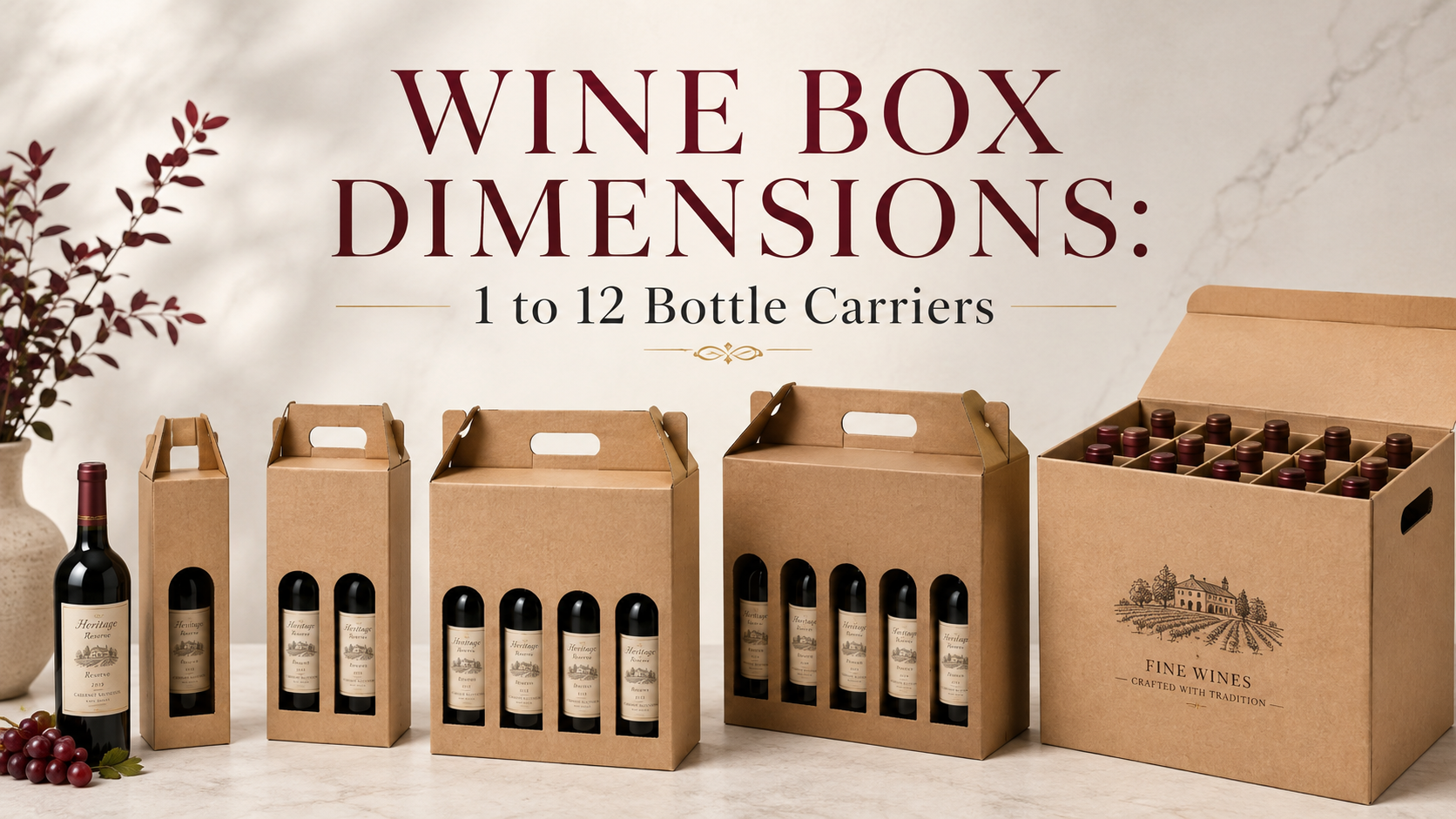
Wine box dimensions split into two builds that don’t scale the same way. A single-bottle shipper stands the bottle upright, running about 3.5 × 3.5 × 12 inches. A multi-bottle carrier lays bottles on their side instead. It runs from 14.25 × 8 × 3.5 inches for two bottles. A full 12-bottle case reaches 18 × 13 × 15 inches. This guide charts all five common counts. It also explains why a single bottle stands up while everything larger lies down. It’s part of our size guide series alongside our shipping box sizes and mailer box sizes guides. For everything else, our full box size guide covers the rest.
Wine Box Dimensions Chart
| Bottle Count | Dimensions (L×W×H, inches) | Dimensions (cm) | Typical Use |
|---|---|---|---|
| 1 Bottle (upright shipper) | 3.5 × 3.5 × 12 in | 8.9 × 8.9 × 30.5 cm | Single-bottle gifts and shipments |
| 2 Bottle (lay-flat carrier) | 14.25 × 8 × 3.5 in | 36.2 × 20.3 × 8.9 cm | Pairs, small gift sets |
| 3 Bottle (lay-flat carrier) | 14–14.3 × 8–11.8 × 4 in | 35.6–36.3 × 20.3–30 × 10.2 cm | Trios, tasting sets |
| 6 Bottle (lay-flat carrier) | 16 × 10.5 × 7 in | 40.6 × 26.7 × 17.8 cm | Half-case gifts and shipments |
| 12 Bottle (case carrier) | 18–18.1 × 13–13.9 × 15–15.5 in | 45.7–46 × 33–35.3 × 38.1–39.4 cm | Full-case shipping and storage |
Three-bottle carriers show the widest spread of any tier here. The range above reflects that real variance across suppliers rather than one fixed spec.
Why a Single Bottle Stands Up While Everything Larger Lies Down
A one-bottle shipper stands the bottle on its base. The box tracks bottle height directly. That’s why it runs tall and narrow at roughly 3.5 inches square and a full 12 inches tall. There’s no row of bottles to arrange side by side, so height is the only dimension that matters much.
Everything from two bottles up flips that logic. A multi-bottle carrier lays each bottle on its side in a row. The box tracks bottle diameter times bottle count instead of bottle height. This is why a 2-bottle box runs wide and shallow at 14.25 × 8 × 3.5 inches. It doesn’t run tall and narrow like the single-bottle version.
The 12-bottle case carrier breaks from both patterns. It stacks bottles in rows rather than laying them flat in a single layer. A full case at 3.5 inches tall per row would run absurdly long otherwise. That’s why the case dimension jumps to 15 inches tall, instead of staying shallow like the 2- and 6-bottle carriers. A case carrier typically stacks two rows of six bottles. That’s a cleaner split than trying to fit twelve bottles into one long row.
How to Choose the Right Wine Box Dimensions
Start with the bottle shape, not just the count. A standard 750ml Bordeaux-style bottle runs a different diameter than a wider Burgundy-style bottle. A champagne bottle adds a thicker punt at the base on top of that. Wine bottle shapes vary by region and grape tradition more than most people expect. A carrier built around a slim Bordeaux bottle can run tight around a wider Burgundy bottle in the same slot.
Mixed cases complicate the math further. A case pairing champagne bottles with standard wine bottles needs slots sized for the widest bottle. Don’t size to the average bottle. Sizing every slot to the narrowest bottle risks cracking a wider bottle forced into a too-tight compartment.
Shipping adds a separate consideration on top of the fit itself. I’ve seen wine shippers built with a snug foam or pulp insert that holds each bottle rigid. Loose bottles clinking against each other in transit is one of the more common damage claims in this category. A box sized correctly on paper still needs that internal bracing to actually protect the bottles.
Weight adds up faster than people expect too. A full 12-bottle case at roughly 3 pounds a bottle pushes close to 40 pounds once packaging is included. That weight needs a board thick enough to hold its shape at the bottom seams. A box that only measures out correctly on a tape measure isn’t enough on its own.
Corrugated flute choice matters here too, more than in most of the lighter categories in this cluster. A double-wall board holds up better under a stacked case than a standard single-wall flute does. That matters most once several cases get palletized for freight rather than shipped one at a time. Double-wall costs more per box. It cuts down on crushed corners that show up by the time a case reaches a distributor’s warehouse. That difference tends to pay for itself on freight-heavy accounts.
Custom Wine Box Dimensions
The chart above covers the five common bottle counts. A mixed case, an oversized magnum bottle, or a count outside the standard 1-2-3-6-12 lineup often needs a custom insert. Forcing it into a standard carrier rarely fits well.
Easy Box Packaging builds wine and bottle boxes to the exact bottle count and shape a brand needs. That includes custom inserts for mixed or oversized bottles.
Frequently Asked Questions
Why is a single-bottle wine box so much taller than a 2-bottle box? A single-bottle box stands the bottle upright, so it tracks bottle height. A 2-bottle box lays both bottles on their side instead. It tracks bottle diameter and count, which keeps it shallow but wider.
Do champagne bottles need a different wine box size? Often, yes. Champagne bottles run a wider diameter at the base than standard wine bottles. A carrier sized tight around a standard bottle can crack a champagne bottle forced into the same slot.
The Bottom Line
Wine box dimensions come down to bottle orientation as much as bottle count. A single bottle stands up and tracks height. Everything larger lies down and tracks diameter times count, until a full case forces a stacked, taller build again. Measure the actual bottle shape before ordering. Make sure the internal bracing matches the box, not just the outer dimensions. Get a quote and get a wine box sized to your actual bottles.