
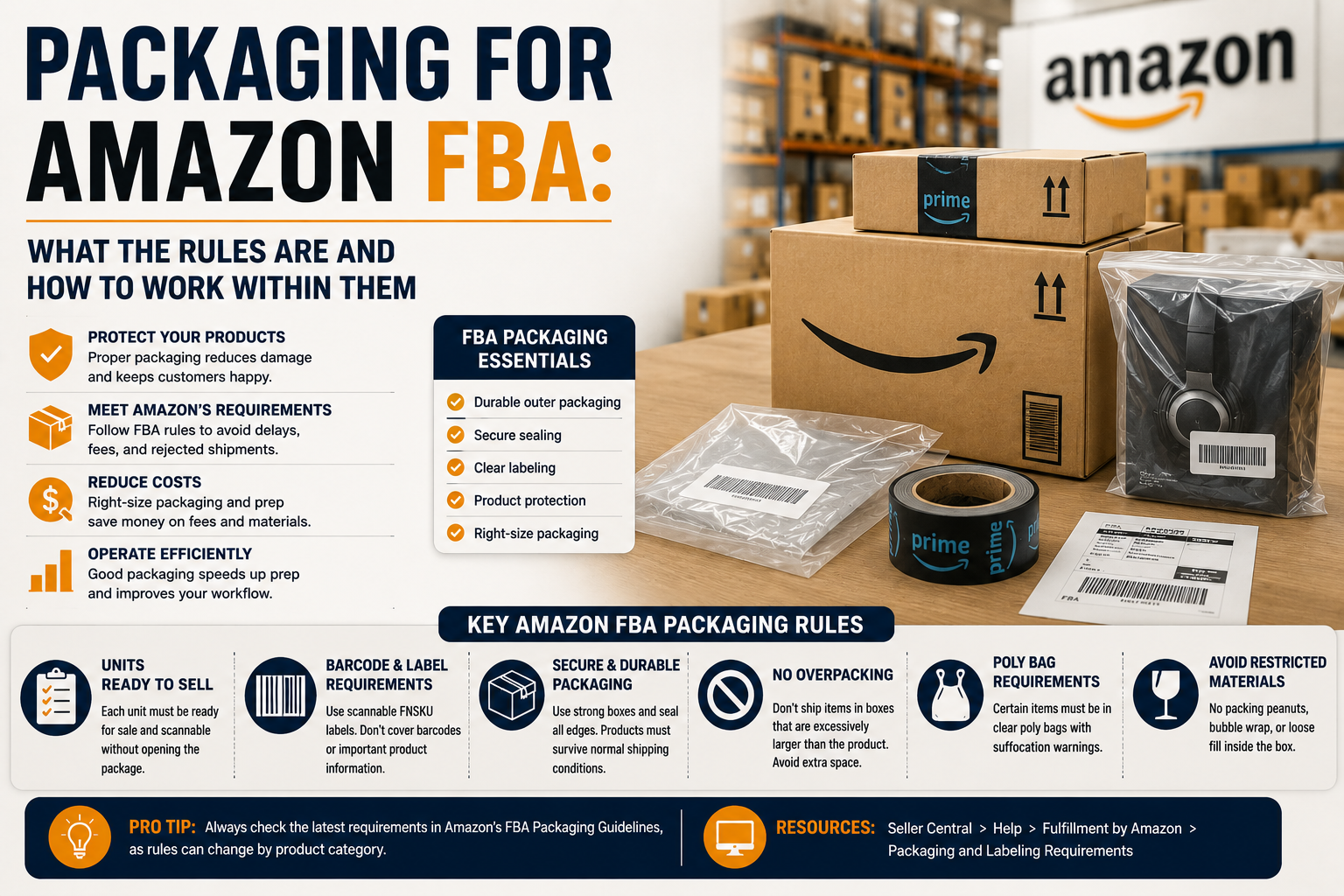
Selling on Amazon FBA changes the packaging equation in ways most brands don’t expect. Your custom packaging for Amazon FBA has to pass Amazon’s prep requirements before it ever reaches a customer — and Amazon’s rules about shipping box sizes, labeling, poly bagging, and taping don’t care about your brand strategy. What they do care about is whether your shipment gets accepted at the fulfillment center or flagged for non-compliance. Here’s what the rules actually are, what Amazon does to your packaging behind the scenes, and how to maintain a brand presence within the constraints that FBA imposes.
Most brands find this out the hard way: they invest in custom packaging, ship it to an Amazon fulfillment center, and discover that Amazon has applied an FNSKU sticker directly over their logo, poly-bagged their premium product in clear plastic, and placed it on a shelf next to generic competitors. The custom box is never seen by the customer. Understanding how FBA prep works before you design your packaging — not after — changes what you build.
Custom Packaging Amazon FBA: The Size Rules You Have to Know
Amazon classifies every FBA product into a size tier, and the tier determines storage fees, fulfillment fees, and the shipping box dimensions your product must fit within. Getting this wrong at the packaging design stage creates a cost problem that compounds across every unit you sell.
Standard size tier: Units must be under 18″ × 14″ × 8″ and weigh under 20 lbs when packaged. These are the most common shipping box sizes for consumer goods on Amazon — apparel, beauty, supplements, small electronics, books. Standard-size products have the lowest FBA fulfillment fees and the most favorable storage rates. If your packaged product fits inside standard shipping boxes dimensions of 18×14×8, you’re in the lowest-cost tier.
Large standard size tier: Units up to 59″ × 33″ × 33″ and under 50 lbs (or under 150 lbs for large bulky). These box sizes for shipping carry higher fees than standard but lower than oversized. Kitchen appliances, larger electronics, and bulky consumer goods typically land here.
Oversized / extra-large tiers: Anything exceeding large standard dimensions moves into oversized territory with significantly higher fees. The fee jump between standard and oversize is substantial enough that brands sometimes redesign their packaging specifically to keep products within standard box sizes for shipping and avoid the cost penalty.
Before finalizing any custom packaging spec for Amazon FBA, verify the exact dimensions with Amazon’s current fee schedule — size tier boundaries and fee structures do get updated. A standard shipping box size guide covers the general ranges, but Amazon’s published tier definitions are the binding spec for FBA compliance.
What this means practically: if your product currently ships in a box that puts it just inside the standard tier, adding a premium insert or thicker board without checking final dimensions can push you into the next tier. That’s a fee increase on every unit sold — sometimes $0.50–$1.50 per unit — indefinitely. Spec your custom packaging for Amazon FBA with the final packaged dimensions in mind, not just the product dimensions.
FBA Prep Requirements: What Amazon Checks at Receiving
Amazon’s receiving process is designed for speed and consistency, not brand presentation. When your inventory arrives at a fulfillment center, it goes through a prep and check-in process that may modify your packaging in ways you didn’t plan for.
FNSKU labeling. Every unit Amazon fulfills needs an FNSKU (Fulfillment Network Stock Keeping Unit) barcode that Amazon can scan. You have two options: apply the FNSKU label yourself before shipping to Amazon (seller-labeling), or pay Amazon to apply it (FBA label service, currently $0.55 per unit). Seller-labeling is almost always worth doing yourself. It also lets you control where the label goes — on a non-branded surface, on the bottom, anywhere that doesn’t cover your logo or key design elements.
Poly bag requirements. Any product that can be considered a suffocation hazard — typically items with openings larger than 5 inches in any dimension — must be poly bagged. Amazon is conservative about this. Apparel, textiles, plush items, and many soft goods get poly bagged at the fulfillment center if you don’t arrive with them pre-bagged. The poly bag goes over your custom packaging. Your branded mailer box arrives at the customer inside a clear plastic poly bag. Plan for this if you’re selling in these categories.
Bubble wrap requirements. Fragile items must arrive at the fulfillment center either already adequately protected or they get bubble-wrapped by Amazon (at a fee). If Amazon bubble-wraps your product, that layer goes over whatever packaging you have. For glass, ceramics, fragile electronics, and similar products, arriving pre-protected with adequate internal cushioning avoids Amazon adding a bubble-wrap layer you didn’t spec or pay for.
Tape sealing requirements. Amazon requires that corrugated boxes arriving at fulfillment centers be properly sealed. Pressure-sensitive tape applied in an H-pattern is the standard. If your custom box uses a self-locking tuck-top that doesn’t require tape, Amazon may add tape anyway to ensure the closure is secure. The packaging mistakes that generate the most FBA rejection issues are almost always prep oversights — FNSKU in the wrong place, inadequate sealing, or missing poly bag requirements — not design issues.
What Amazon Does to Your Custom Packaging
Here’s the honest version that most packaging guides skip: Amazon is not a brand presentation partner. For standard FBA, your custom packaging protects the product in transit and in storage. What the customer receives is determined by Amazon’s pick-and-pack process, which does not replicate the unboxing experience you designed.
For standard FBA units, Amazon picks your product off a shelf, scans it, and places it in an Amazon-branded shipping box (or poly mailer for smaller items). Your custom branded box becomes the inner packaging — the customer opens an Amazon brown box and finds your branded product inside. That’s not nothing; your product packaging is still the first thing they see and touch. But the outer presentation is Amazon’s, not yours.
I’ve talked with brand founders who were genuinely surprised by this. They’d invested in a premium corrugated mailer with soft-touch lamination, assumed customers would receive it as the outer shipping container, and discovered their premium box was being double-boxed inside Amazon’s generic shipper. For some categories and products, Amazon does use seller packaging as the outer shipping container (typically when the product itself is the box and is already shippable as-is). But for most consumer goods, the Amazon box is what arrives at the customer’s door.
Understanding how packaging drives repeat purchases helps clarify the FBA tradeoff: the brand moment shifts from the outer delivery experience to the inner product unboxing. Your custom branded box, the insert card, the tissue, the interior print — those all remain your brand touchpoints. The Amazon outer box is just the delivery vehicle.
Custom Packaging Amazon FBA: The Insert Card Strategy
The one brand touchpoint FBA sellers consistently underuse: the insert card. Amazon’s terms of service prohibit inserts that direct customers off Amazon to leave reviews on other platforms or include discounts for purchases made outside Amazon. What they don’t prohibit is a well-designed branded card inside the box that reinforces your product, tells your brand story, and includes care instructions, usage guidance, or a brand message.
A printed insert card at 4″ × 6″ or A5 costs $0.05–$0.15 per unit to produce at volume. It’s the one place your brand identity appears inside the Amazon fulfillment chain that Amazon doesn’t modify, poly bag, or sticker over. For custom packaging Amazon FBA strategies, this is where the brand investment goes when the outer box is Amazon’s — not into premium corrugated finishes that Amazon will never show the customer.
What makes a good FBA insert: your logo and brand colors, a brief product benefit statement (not a marketing pitch), clear care or use instructions if relevant, and a QR code linking to a how-to page, warranty registration, or brand website. The QR code drives customers to your owned channels without violating Amazon’s policies against off-platform solicitation. Keep it genuinely useful — the customer just opened your product, and an insert that helps them use it well creates goodwill that a promotional message doesn’t.
The custom mailer box with a well-designed printed interior is the format that works best for FBA sellers who want to maximize the inner unboxing moment. Even when the outer shipping container is Amazon’s, the mailer box itself creates a reveal moment that generic packaging doesn’t — and the interior lid print is visible the moment the customer opens it.
When FBA Packaging and DTC Packaging Should Be Different
Brands selling through both FBA and their own DTC channel face a real decision: use the same packaging for both, or spec separately.
The argument for separate specs: FBA packaging doesn’t need premium exterior finishes because Amazon hides them. The investment in soft-touch lamination, foil stamping, or high-end exterior print is wasted on FBA inventory. You’re paying for a surface Amazon will either sticker over or ship inside their own box. DTC packaging is where those investments pay off — the customer receives your box as the outer container, and the brand moment happens at the door.
The argument for one SKU: operational simplicity. Two packaging specs mean two inventory pools, two reorder cycles, and the constant risk of fulfilling DTC orders with FBA-spec packaging (or vice versa). For small-to-mid volume brands, the operational overhead of managing two packaging SKUs often costs more than the material savings from downgrading FBA packaging.
My read: brands doing under 500 FBA units per month should use one packaging spec — build it for DTC quality and accept the FBA efficiency loss. Brands doing 1,000+ FBA units per month should evaluate whether a separate FBA inner pack (simpler corrugated, no premium finish, FNSKU placement pre-printed) makes financial sense. At that volume, the per-unit savings on a simplified FBA spec can be meaningful over 12 months. The packaging budget breakdown by revenue stage is worth running with your specific FBA volume and product cost before making that call.
FBA Shipment Box Requirements: Sending Inventory to Amazon
Separate from your product packaging, Amazon has requirements for the master cartons you use to ship bulk inventory to fulfillment centers. These shipping boxes dimensions and weight limits are strict.
Standard master carton requirements for FBA shipments: no box may exceed 25″ on any single side, and weight must be under 50 lbs (with some exceptions for single-unit oversized items). These are the standard box sizes for shipping inventory to Amazon — not the product packaging, but the outer carton containing multiple units. Using non-standard shipping box sizes outside these limits risks rejection at the fulfillment center.
For fragile products: mark cartons “Fragile” and “This Side Up” as required by Amazon’s prep guidelines. Amazon’s receiving process does handle marked cartons with more care — the labeling matters.
For liquid products: all liquids must arrive in sealed, leak-proof packaging. If a product leaks in transit or in storage, Amazon charges the seller for clean-up and damage to other inventory. Seal integrity is a compliance requirement, not a suggestion.
FAQ: Custom Packaging for Amazon FBA
Will Amazon use my custom box as the outer shipping container?
Sometimes, but not usually. For products that are already “shippable as-is” — meaning the product packaging is itself the outer shipping container with no additional box required — Amazon may ship it in your packaging. This applies to some branded polybags and certain corrugated products with proper exterior labeling. For most consumer goods, Amazon places your product in their own branded shipper. Your custom packaging becomes the inner packaging the customer sees after opening the Amazon box.
What are Amazon FBA’s standard shipping box size requirements?
For product packaging, FBA’s standard size tier covers units under 18″ × 14″ × 8″ and under 20 lbs. For master cartons shipping inventory to Amazon, no side may exceed 25″ and weight must stay under 50 lbs. These are the standard box sizes for shipping to and through FBA — both product packaging and inbound shipment cartons must comply with their respective limits.
Can I include branded inserts in Amazon FBA orders?
Yes. Amazon permits branded inserts that are genuinely useful — care instructions, how-to guides, warranty cards, brand story cards with QR codes to your website. What’s prohibited: inserts asking for reviews on platforms other than Amazon, discount codes for purchases made off Amazon, and anything that redirects customers away from Amazon for the primary transaction. Stay on the right side of that line and inserts are a legitimate brand touchpoint inside every FBA order.
What happens if my packaging doesn’t meet FBA prep requirements?
Amazon will either prep it for you (at a per-unit fee that’s usually higher than doing it yourself) or reject the shipment. Rejection means the shipment is returned to you or disposed of — both options cost money. Common rejection triggers: missing or incorrect FNSKU labels, unbagged items that require poly bagging, inadequate sealing, and master cartons exceeding size or weight limits. Check Amazon’s current prep requirements for your product category before finalizing your packaging spec.
Should I build separate packaging for FBA vs my DTC channel?
It depends on volume. Under 500 FBA units per month, one packaging spec is simpler and the operational savings from separate specs don’t offset the complexity. Above 1,000 FBA units per month, a separate simplified FBA inner pack (standard corrugated, no premium finish, FNSKU placement pre-printed) may save enough per-unit to justify the additional SKU management. Run the math on your specific volume before deciding.
Does FBA packaging affect my Amazon seller rating?
Indirectly yes. Products that arrive damaged — due to inadequate packaging for FBA storage and fulfillment conditions — generate negative reviews and returns that affect seller metrics. Amazon warehouses are not climate-controlled storage facilities: temperature and humidity variation, forklift handling, and multi-unit stacking in fulfillment centers all stress packaging. Under-spec’d packaging for the FBA environment generates damage claims that well-spec’d packaging doesn’t.
What is FBA’s poly bag requirement and does it apply to my product?
Amazon requires poly bagging for any product with an opening larger than 5 inches in any dimension, any product that could be considered a suffocation hazard, and specific categories including apparel, textiles, and soft goods. The poly bag must be transparent, have a suffocation warning label (for bags with openings larger than 5 inches), and be sealed. If your product falls into these categories and you don’t arrive pre-bagged, Amazon bags it at the fulfillment center — at your cost.
FBA Is a Distribution Channel. Your Brand Has to Work Within It.
The brands that handle custom packaging for Amazon FBA well are the ones that stop trying to replicate their DTC unboxing experience inside the FBA system and instead build for where FBA actually allows brand expression: the product packaging the customer opens, the insert card inside it, and the product itself. Amazon controls the outer box. You control everything inside it.
That’s where the repeat purchase relationship gets built or lost. A customer who opens an Amazon shipper, pulls out your cleanly branded product in a well-constructed box with a useful insert card, has a brand experience that Amazon’s outer packaging doesn’t undercut. Build for that moment instead of fighting the constraints around it.
See our ecommerce packaging options for specs that work within FBA prep requirements — standard shipping box sizes, correct board weights for fulfillment center storage conditions, and insert card formats that pass Amazon’s policies. Getting the spec right before you print saves a rejection and a reorder.