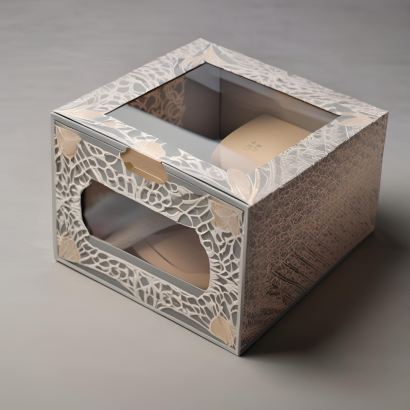

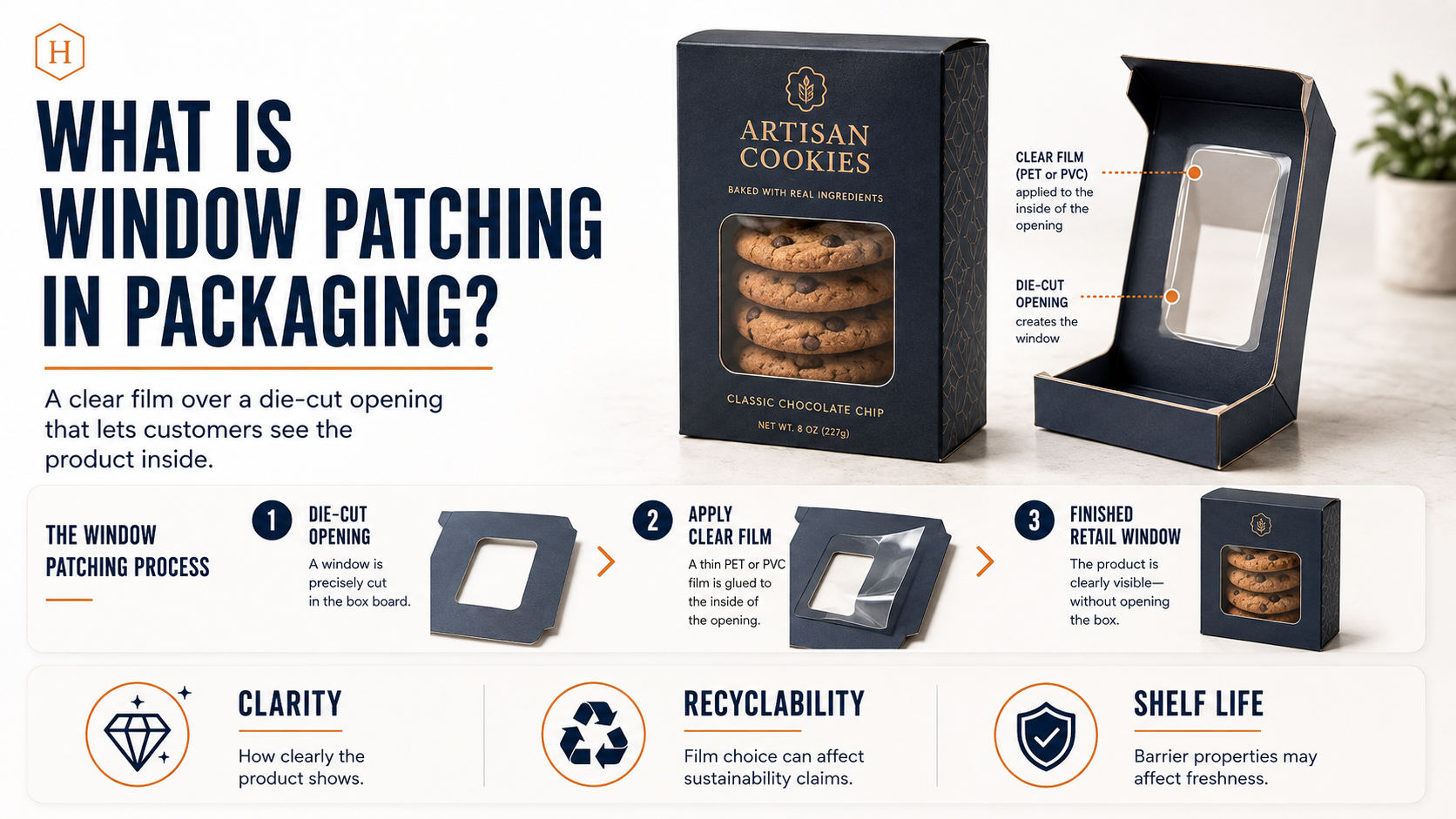
Window patching is the process of applying a thin, clear film over a die-cut opening in a box. That opening lets a customer see the product inside without opening the package. The window gets cut first. Window patching happens after, at the finishing stage, when a machine glues the film in place. It sounds simple. The film choice behind window patching actually affects your recyclability, your clarity, and sometimes your product’s shelf life.
That’s the short version. Most guides stop at “it’s a window with film on it.” There’s a real material decision hiding behind that description. It can quietly work against a sustainability claim you’re already making elsewhere on the box.
How Window Patching Actually Works
The box gets die-cut first, cutting a clean opening into the paperboard or corrugated sheet. Window patching happens next, as a separate finishing step. A machine feeds a roll of film, usually PET or PVC, over the cut opening. Adhesive, either cold glue or hot-melt, bonds the film to the inside edge of the window.
This all happens fast. Window patching is usually built into the same production run as gluing the rest of the box. It doesn’t add much time to a standard job. The film bonds almost instantly once it’s applied, with no separate drying stage needed.
PET, PVC, and Cellophane: What’s the Difference
PET film is clear, rigid, and holds up well over time. It’s also more compatible with standard plastics recycling than the alternatives.
PVC film is cheaper and flexible. That’s why many printers default to it for window patching unless a customer specifies otherwise. It has a real downside, though, covered in the next section.
Cellophane is a plant-derived, breathable film. That breathability matters for products like baked goods that need some airflow inside the package. It’s not the right choice for anything that needs a fully sealed barrier.
The Recycling Problem Most Printers Won’t Mention
Here’s the part that rarely comes up when a printer quotes window patching. PVC film is a genuine contaminant in PET recycling streams, even in trace amounts. Just 50 parts per million of PVC in a PET batch can degrade the recycling run. PVC releases hydrogen chloride when heated during reprocessing, which causes that damage.
Most U.S. municipal recycling programs don’t accept PVC at all. A fully recyclable corrugated box can still undercut its own “recyclable packaging” claim. That happens whenever the window patching on it uses PVC film instead of PET.
I’ve seen a brand build their entire packaging story around recyclability, right down to the ink they chose. Their printer quietly used PVC for the window patch by default. Nobody had specified otherwise, so the printer used their standard stock. It got caught during a sample review, before the full print run. They switched to PET, and the recyclability claim on the box finally matched the box itself.
If sustainability matters to your packaging, ask your printer directly which film they use for window patching. Don’t assume “a window” means the same material every time.
Window Patching for Pet Food and Pet Products
Pet food and treat packaging leans on window patching constantly. It lets a customer see the actual kibble or treat shape inside. Film choice matters here too. A fully sealed PET or PVC window works fine for dry, shelf-stable products. Anything with more moisture or a need for airflow may call for a different approach entirely. That’s closer to how cellophane gets used on food packaging.
Window patching also earns its cost on pet products specifically. Buyers want visual confirmation before they trust a new brand with something their pet eats. A solid box with no window asks for more trust upfront. Most first-time buyers aren’t ready to give that trust yet.
Where Window Patching Earns Its Cost
Window patching works best when seeing the product genuinely helps sell it. Toys, food, and hardware all benefit from that visual confirmation before checkout. So does anything with a distinct shape or color.
It’s a weaker fit for products that don’t benefit from being seen. That’s also true for anything where the added film cost doesn’t translate into a real buying signal. Adding window patching purely because “it looks nice” is a cost with no clear return. That’s especially true if the product itself isn’t the selling point.
Window Shape and Placement Matter Too
Window patching gets most of the attention on film type. The window’s shape and position on the box play a role too. A window placed too close to a fold can weaken that part of the box in transit. A window cut too large removes structural support the box needed for stacking.
Round or die-cut custom shapes cost more to tool than a simple rectangle. Window patching machines simply run faster on standard shapes. If budget matters more than a specific silhouette, a rectangle or oval keeps window patching costs down. You won’t sacrifice much of the visual effect either.
Window Patching Film Comparison
| Film Type | Clarity | Recyclability | Typical Use |
|---|---|---|---|
| PET | High | Good, compatible with PET streams | Most retail window patching |
| PVC | High | Poor, contaminates PET recycling | Budget window patching |
| Cellophane | Moderate | Good, plant-derived | Breathable food packaging |
Common Mistakes When Specifying Window Patching
The first mistake is not specifying a film type at all. Your printer will default to whatever’s cheapest, usually PVC, unless you ask for something else.
The second mistake is claiming “recyclable packaging” without checking whether the window patching film actually supports that claim. PVC quietly breaks that promise.
The third mistake is choosing a sealed PET or PVC window for a product that needs airflow. Certain baked goods fall into that category. That mismatch can shorten shelf life.
A fourth mistake is adding window patching to a product where seeing it inside doesn’t help sell it. That’s added cost without a clear return.
Which Should You Choose?
Building a window packaging box around a sustainability claim? Specify PET for your window patching, not PVC. The clarity is comparable, and it won’t undercut your recyclability story.
Packaging something that needs airflow, like fresh baked goods? Cellophane is the better fit for window patching there, even though it’s less rigid than PET or PVC.
Building pet food or pet product packaging where buyers want to see what’s inside first? Standard PET window patching does the job well for dry, shelf-stable products. Our complete guide to custom window packaging boxes covers window placement and sizing in more depth.
Not sure which film fits your product and your sustainability goals? Easy Box Packaging can walk through window patching options and run a sample first. That’s before you commit to a full production order.
A window is one of the simplest features you can add to a box. The film behind it, though, is a real decision, not an afterthought.
Window Patching: FAQ
What film is used for window patching? PET and PVC are the most common choices. Cellophane gets used for breathable food packaging instead.
Is window patching recyclable? It depends entirely on the film. PET window patching is generally recyclable-compatible. PVC is not, and it can contaminate a PET recycling stream.
Does window patching add much cost to a box? Some, for the film and machine time. It’s a standard finishing step for most printers, though, not a specialty process.
Get a free quote — dieline and design support included.