
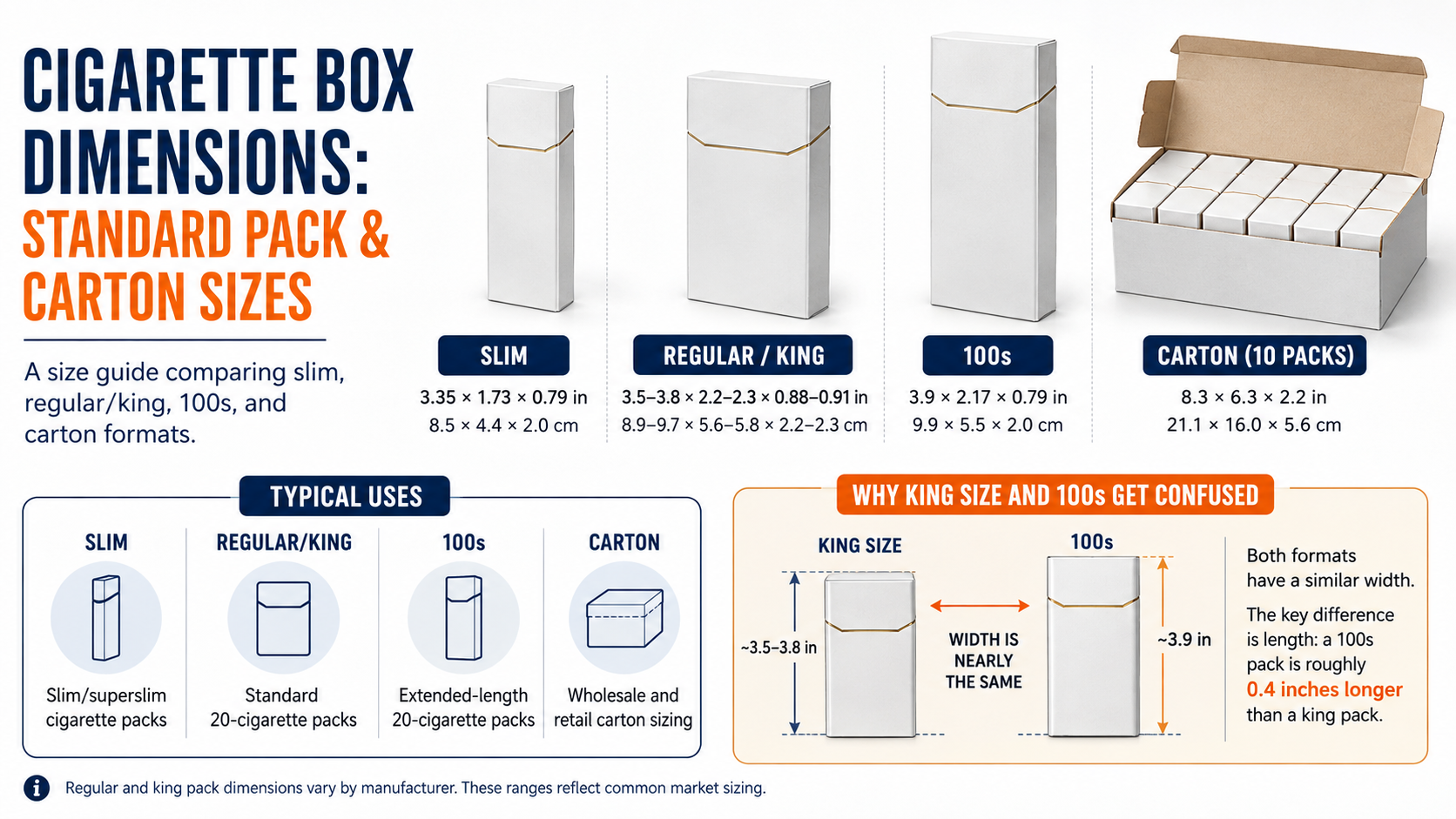
Cigarette box dimensions fall into four common tiers. A slim pack measures around 3.35 × 1.73 × 0.79 inches. A regular or king pack runs closer to 3.5 to 3.8 × 2.2 to 2.3 × 0.9 inches. A 100s pack keeps a similar width but adds roughly 0.4 inches of extra length. A full carton holding ten packs measures about 8.3 × 6.3 × 2.2 inches. This guide charts all four tiers. It also explains why king size and 100s cigarette box dimensions get confused so often. The two look nearly identical from the side. It’s part of our size guide series alongside our mylar bag sizes and shipping box sizes guides. For everything else, our full box size guide covers the rest.
Cigarette Box Dimensions Chart
| Pack Type | Dimensions (L×W×H, inches) | Dimensions (cm) | Typical Use |
|---|---|---|---|
| Slim | 3.35 × 1.73 × 0.79 in | 8.5 × 4.4 × 2.0 cm | Slim/superslim cigarette packs |
| Regular/King | 3.5–3.8 × 2.2–2.3 × 0.88–0.91 in | 8.9–9.7 × 5.6–5.8 × 2.2–2.3 cm | Standard 20-cigarette packs |
| 100s | 3.9 × 2.17 × 0.79 in | 9.9 × 5.5 × 2.0 cm | Extended-length 20-cigarette packs |
| Carton (10 packs) | 8.3 × 6.3 × 2.2 in | 21.1 × 16.0 × 5.6 cm | Wholesale and retail carton sizing |
Regular and king pack dimensions carry some real spread across manufacturers. The range above reflects that variance rather than a single fixed spec.
Why King Size and 100s Get Confused So Often
King size and 100s packs share nearly the same footprint. Both run close to 2.2 inches wide. The difference that actually matters sits in length, not width. A 100s pack runs roughly 0.4 inches longer than a king pack. The cigarettes themselves are longer, not the pack’s cross-section.
That extra length changes how the pack sits in a carton slot built for king size product. A carton designed around king pack length can leave a 100s pack sitting slightly proud of the opening. Or it can rattle if the slot was cut generously to fit both. This is the detail that trips up a lot of packaging orders. The width similarity makes it easy to assume the two sizes are interchangeable when they aren’t.
Slim packs solve a different problem entirely. They trade width for length, running narrower than either king or 100s while staying close to king-pack height. That narrower footprint is a design choice tied to the product inside, not a packaging shortcut. A slim box built off a king-size die will run too wide and too short at once. Neither dimension carries over cleanly between the two formats. That’s why suppliers keep separate dies for slim product rather than adapting a king-size die on the fly.
How to Choose the Right Cigarette Box Dimensions
Start with the exact pack length the product uses, since that’s the dimension most likely to cause a fit problem. A box cut a few millimeters short on length will crush the top of a 100s pack. This happens even when the width and depth are correct. Confirm the manufacturer’s exact pack spec before finalizing box dimensions. Don’t rely on a generic “king size” assumption.
Carton-level packaging adds its own wrinkle. A carton built to snugly hold ten regular packs will run tight around ten 100s packs. That extra length compounds across every pack in the row. I’ve seen carton dies built off a king-size template get reused for a 100s product without adjustment. The fit showed it immediately on the packaging line.
Retail shelf depth matters too, separate from the pack dimensions themselves. A display box built around the standard carton footprint needs enough shelf depth to hold the full 8.3-inch length. Otherwise the front pack overhangs the edge. This shows up more with countertop displays than with under-counter storage. A countertop unit sits at eye level. An overhanging pack is far more noticeable to a customer standing at the register. It tends to look sloppy even when the box itself is well built.
Compliance and Labeling Considerations
Cigarette packaging in the US carries labeling requirements that affect usable panel space, not just the box’s outer dimensions. Required warning text and other mandated disclosures take up a fixed percentage of the pack face on most products. That narrows how much room is left for branding on a given panel. Check current federal and state labeling requirements before finalizing artwork, since specific requirements vary and change over time. This guide covers dimensions only, not labeling compliance. A compliance review should happen separately before any packaging goes to print.
Custom Cigarette Box Dimensions
The chart above covers the four common pack and carton tiers. A product using a nonstandard filter length or a specialty pack style often needs a custom die. Forcing it into a standard slim, king, or 100s template rarely fits well.
Easy Box Packaging builds custom packaging to the exact pack dimensions a brand needs. That includes cartons sized around a specific pack length rather than a generic template. Plain tobacco packaging rules vary significantly by country. Any brand selling across multiple markets should confirm dimension and labeling requirements separately for each one. A die built for US pack specs won’t necessarily match another country’s standard.
Frequently Asked Questions
What’s the actual size difference between king size and 100s? Both run close to 2.2 inches wide, but a 100s pack is roughly 0.4 inches longer than a king pack. The width is nearly identical.
How many packs fit in a standard cigarette carton? A standard carton holds ten packs, running about 8.3 × 6.3 × 2.2 inches for regular or king packs. A 100s carton runs slightly longer to match the extra pack length. A slim carton often runs narrower across the same ten-pack row.
The Bottom Line
Cigarette box dimensions hinge on pack length more than most people expect. That’s where king size and 100s actually diverge. Confirm the exact pack spec before cutting a carton die. Check labeling space separately from the outer box dimensions before anything goes to print. Get a quote and get packaging sized to your exact pack spec.