
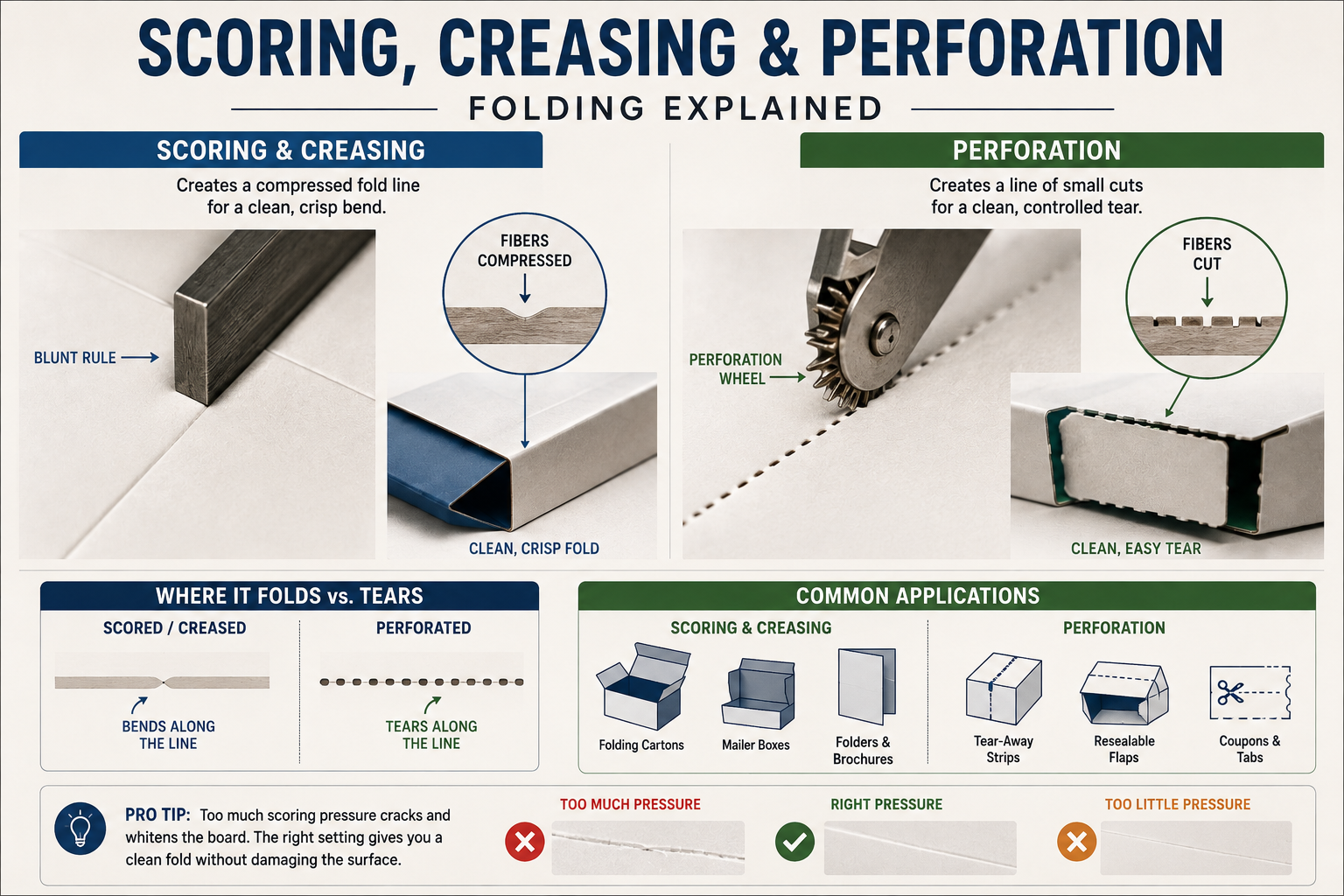
Scoring and creasing prepare a box to fold cleanly along an exact line. A blunt rule presses into the board. It compresses the fibers right along that line. The board bends there instead of cracking wherever it feels like. Perforation does something different. It cuts a row of small, closely spaced slits. It doesn’t compress anything. That line tears instead of folding. Both processes shape how a box behaves. One controls the fold. The other controls the tear.
Getting scoring and creasing right separates a crisp, clean fold from a cracked, whitened one. Getting perforation right separates a tab that tears away cleanly from one that rips through the wrong spot. This article covers what each process does. It covers where each one belongs. It covers the one setting mistake behind most visible fold damage. That mistake shows up again and again on a bad run.
What Is Scoring and Creasing?
Scoring presses a crease line into board with a blunt metal or rubber rule. That rule doesn’t cut through the board. It compresses the fibers along a narrow line instead. Once that line is compressed, the board wants to bend right there. It won’t bend anywhere else nearby.
Creasing does essentially the same job. The terms get used somewhat interchangeably. General converting-industry descriptions note a pattern here. “Creasing” shows up more often for thinner folding-carton stock. “Scoring” gets used more for heavier corrugated board. Either way, the goal is identical. Scoring and creasing exist to give a fold a clean, controlled place to happen.
Without that compressed line, a fold happens wherever the board is weakest. That’s rarely a clean, straight line. It’s usually a rough, uneven crack instead.
What Is Perforation?
Perforation works on the opposite principle. Instead of compressing the board, it cuts a line of small, closely spaced slits through it. Those slits weaken the material along a specific path. The board doesn’t bend along that line. It tears there instead, cleanly and predictably.
That’s exactly why perforation shows up on tear-away panels, resealable tuck flaps, and coupon or tab sections. A shipping box with a perforated strip opens along that exact line. No knife or scissors needed. Scoring and creasing would be the wrong tool here entirely. The goal isn’t a fold. It’s a controlled tear.
The Depth Problem Most Guides Skip
Here’s the part that decides whether a fold looks clean or damaged. The score depth has to match the board’s thickness. Score too shallow on a thick board, and the fold cracks. It whitens right at the bend instead of folding cleanly. Score too deep on a thin board, and the fold can split open. The panel can even tear off entirely under normal handling.
Most guides describe scoring and creasing as one fixed technique. They rarely mention that the depth setting itself determines the outcome. The same rule, at the wrong depth, produces a completely different result depending on the board underneath it.
I’ve seen a brand switch stock for a repeat order. They moved from a lighter folding carton to a heavier corrugated board. They kept the exact same scoring settings from the original run, though. The heavier board’s fold lines came out cracked. They looked visibly whitened instead of clean. The score depth had simply been set for the lighter stock, not the new one. A quick sample check caught it. Adjusting the depth for the heavier board fixed it completely on the reprint.
Where Scoring and Creasing Matter Most
Scoring and creasing matter anywhere a box needs a clean fold line. Rigid boxes, folding cartons, and any panel that needs to close flat all depend on it. A folding carton or rigid box only closes cleanly under one condition. Every fold line has to be scored correctly for that specific board weight.
Retail display panels benefit from the same care. A display box built for a retail shelf often folds flat for shipping. It then pops back open on the shelf. Every fold line on that panel needs a clean score. Otherwise the display looks damaged before it ever reaches a customer.
Point-of-sale and display packaging built around multiple fold-out panels depends on this even more. A single bad score line can throw off the whole assembled shape.
Where Perforation Matters Most
Perforation earns its place wherever something needs to tear away rather than fold. Tamper-evident strips, resealable closures, and coupon or business-card tabs built into a panel all rely on it. Subscription boxes sometimes use a perforated strip for a first-open experience. It feels deliberate rather than accidental.
It also shows up on shipping labels and return-shipping panels. A clean tear matters more there than a fold ever would. Choosing between scoring and creasing versus perforation comes down to one question. Does this line need to fold, or does it need to tear?
Scoring, Creasing & Perforation: Quick Comparison
| Factor | Scoring/Creasing | Perforation |
|---|---|---|
| Mechanism | Compresses fibers along a line | Cuts small slits along a line |
| Result | Clean, controlled fold | Clean, controlled tear |
| Common use | Rigid boxes, folding cartons, display panels | Tear-away panels, resealable flaps, coupon tabs |
| Failure mode | Cracking or whitening at wrong depth | Tearing in the wrong spot if misaligned |
Common Mistakes When Specifying Either Process
The first mistake is reusing scoring settings across different board weights. Depth that works for one stock can crack or split a heavier or lighter one. Always request a folded sample when the board changes.
The second mistake is using scoring where perforation belongs, or the reverse. A tear-away panel scored instead of perforated won’t separate cleanly. A fold line perforated instead of scored can tear open by accident during normal handling.
The third mistake is skipping a physical sample check before a full production run. Cracking and whitening are easy to catch on one sample. They’re expensive to catch across an entire batch instead.
A fourth mistake is assuming scoring and creasing mean the exact same thing on every spec sheet. Vendors sometimes use the terms loosely. Ask which board weight and rule depth they actually plan to run, not just which word they used.
A fifth mistake is skipping a tear-force test on a perforated feature. Too few slits, spaced too far apart, and the panel resists tearing along the line at all. It tears somewhere else instead, usually not where the design intended. Too many slits, spaced too close, and the panel can separate on its own. That can happen during normal shipping and handling, before anyone even tries to open it.
Which Should You Choose?
Building a box that needs to fold flat and close cleanly? Scoring and creasing is the right process. Match it carefully to the board weight you’re actually using.
Building a panel that needs to tear away, reseal, or separate on purpose? Perforation is the right call there instead. Scoring won’t create a clean tear line no matter how it’s adjusted.
Not sure which board weight and process combination fits your box? Our guide to rigid box vs folding carton covers how box structure affects fold behavior more broadly. Easy Box Packaging can also send a folded, assembled sample before a full production run. That’s the only real way to confirm the score depth is right for your specific board.
Scoring and creasing, and perforation, solve two completely different problems. One makes a fold line predictable. The other makes a tear line predictable. Match the process to the job, and the box behaves exactly the way it looked in the sample.
Scoring and Creasing: FAQ
What’s the difference between scoring and creasing? They’re closely related. Creasing is more common on lighter folding-carton stock. Scoring shows up more on heavier corrugated board. Both compress the material along a line so it folds cleanly there.
Why does my box crack along the fold line? That usually means the score depth was wrong. It didn’t match the board’s actual thickness. Too shallow on a thick board causes cracking and whitening right at the bend.
Can perforation be used on a fold line instead of scoring? No. Perforation weakens the material so it tears, not folds. A fold line needs scoring or creasing instead, or it risks tearing open during normal handling.
Get a free quote — dieline and design support included.