
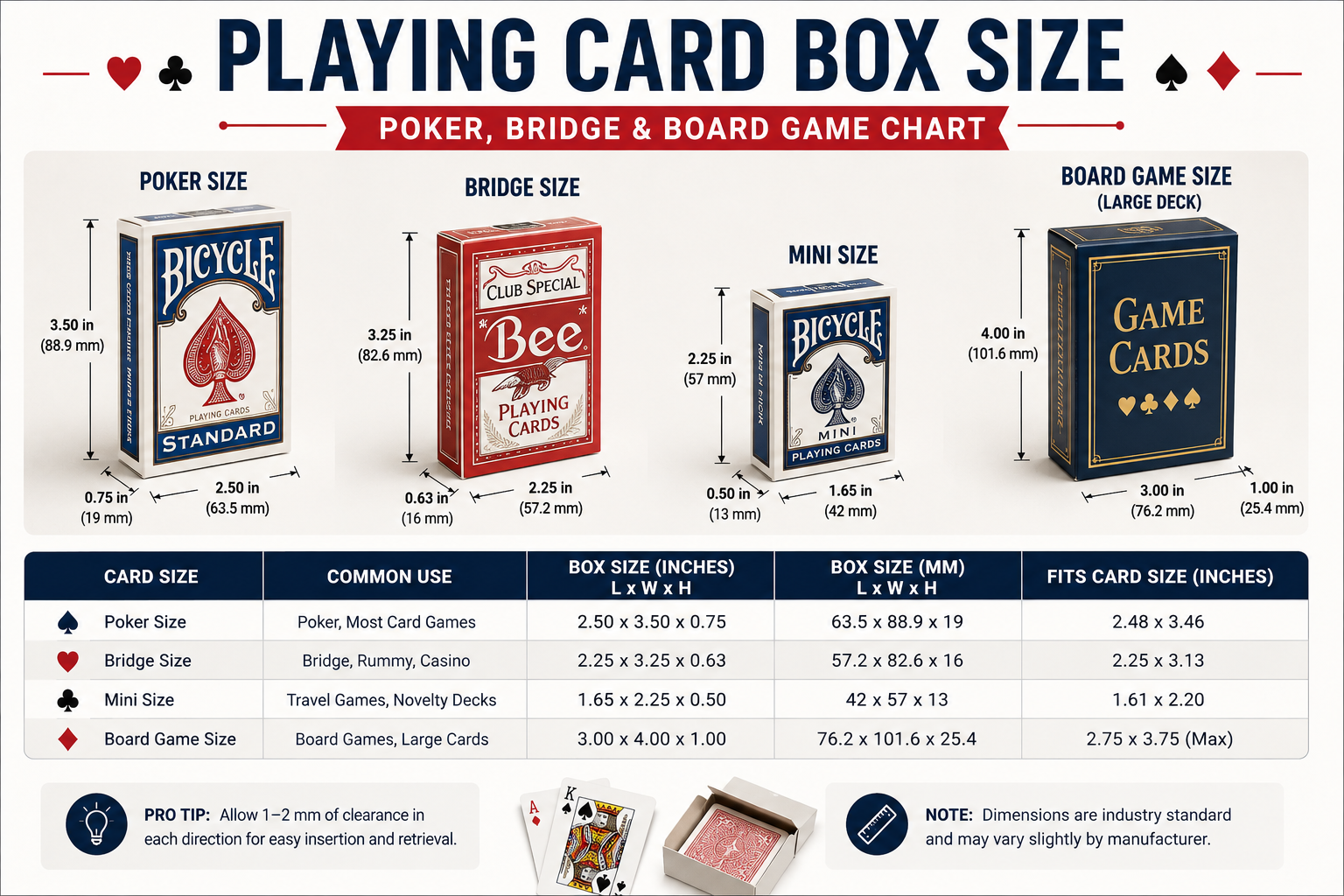
A playing card box size splits into two families that don’t scale the same way. A poker tuck box runs about 3.5 × 2.6 × 0.75 inches. A bridge tuck box runs narrower at 3.5 × 2.25 × 0.75 inches, matching the narrower bridge card. Board game boxes work on a completely different logic. They run anywhere from a compact 4 × 2.75 × 1.2 inches for a small card game. A large strategy title can reach 15.75 × 11.8 × 3.15 inches. This guide charts both families. It also explains why poker and bridge tuck boxes share the same depth. The cards inside them aren’t the same width, yet the box depth barely changes. It’s part of our size guide series alongside our gift box sizes and chocolate box sizes guides. For everything else, our full box size guide covers the rest.
Playing Card Box Size Chart
| Box Type | Dimensions (L×W×H, inches) | Dimensions (cm) | Typical Use |
|---|---|---|---|
| Poker Tuck Box | 3.5–3.6 × 2.5–2.6 × 0.7–0.75 in | 8.9–9.1 × 6.4–6.6 × 1.8–1.9 cm | Standard 52-card poker decks |
| Bridge Tuck Box | 3.5 × 2.25 × 0.75 in | 8.9 × 5.7 × 1.9 cm | Narrow 52-card bridge decks |
| Small Card Game Box | 4 × 2.75 × 1.2 in | 10.2 × 7.0 × 3.0 cm | Compact card-only games |
| Medium Board Game Box | 11–11.8 × 11–11.8 × 2.75–3.15 in | 28–30 × 28–30 × 7 cm | Square-format strategy and family games |
| Large Board Game Box | 15.75 × 11.8 × 3.15 in | 40 × 30 × 8 cm | Component-heavy strategy titles |
Board game box dimensions carry the widest spread of any tier here. The ranges above reflect that real variance across publishers rather than one fixed spec.
Why Poker and Bridge Boxes Share the Same Depth
A poker card measures 2.5 inches wide. A bridge card measures 2.25 inches wide. That quarter-inch difference shows up directly in the box width. Depth doesn’t follow the same logic, though. Both tuck boxes run about 0.75 inches deep, since depth is set by deck thickness, not card width.
A standard 52-card deck stacks to roughly the same thickness whether the individual cards are poker or bridge width. The box depth tracks the stack, not the card’s footprint. This is why a bridge box looks narrower than a poker box side by side. It isn’t noticeably thinner front to back, though, since the depth barely moves. Card stock thickness introduces a small amount of variance here too. A heavier laminated card stacks slightly taller than a thin uncoated one, even at the same count.
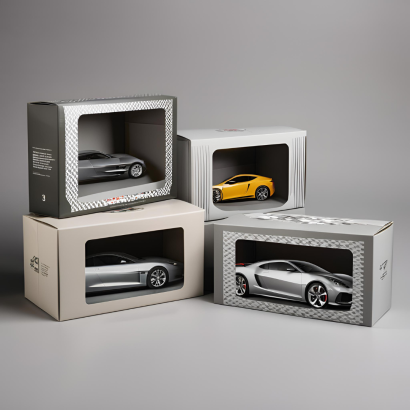
Board game boxes break from this logic entirely. Their footprint tracks the board and component volume inside, not a card count. A card-only game with no board can fit in a box barely bigger than a deck of cards. A strategy title with miniatures, tiles, and a folding board needs a footprint several times larger. That holds true even if both games technically use playing cards somewhere in the mix.
How to Choose the Right Playing Card Box Size
Start with the card width, not a generic “standard deck” assumption. Poker and bridge decks look nearly identical from a distance. A bridge deck in a poker-width box will rattle side to side, though. Confirm which card width the deck actually uses before finalizing box dimensions. Guessing from the box art alone isn’t reliable.
Deck count changes the math for multi-deck sets. A two-deck bridge set needs roughly double the depth of a single deck. A thin divider card between decks adds a small amount beyond a simple doubling. Measure an actual stacked sample rather than assuming the math works out to a clean multiple. A three- or four-deck canasta set compounds that same rounding error further. Checking the physical stack once beats trusting a multiplication, especially once a fourth deck gets added to the count.
Board games need a different starting point altogether. Measure the largest single component first, usually the folded board or the tallest game piece. That dimension sets the box’s minimum footprint. A box sized around the rulebook alone will come up short. That gap shows up the moment the board and pieces get packed in around it. Compact travel formats, sometimes called a pocket box, solve this by shrinking the board itself. They shrink the actual game rather than shrinking the box around a full-size one.
Custom Playing Card Box Sizes
The chart above covers standard poker, bridge, and common board game tiers. A tarot deck, a square-format card game, or a game with an unusual insert tray often needs a custom die. A standard tuck box or square board game box won’t fit those shapes cleanly.
Easy Box Packaging builds card and game boxes to the exact deck width and component footprint a brand needs. Our toy packaging category covers adjacent game and toy formats for brands selling a mixed lineup beyond cards and boards.
Frequently Asked Questions
What’s the actual size difference between a poker and bridge tuck box? The width differs by about a quarter inch, matching the card width. Depth stays close to 0.75 inches on both, since that’s set by the deck’s thickness, not the card’s footprint.
How big of a box do I need for a board game with miniatures? Measure the folded board and the tallest miniature or piece first. Those two dimensions usually set the box’s minimum footprint more than the rulebook or card count does. Add a small allowance beyond the exact measurement too. A component that fits with zero clearance will still bind against the lid once printed board thickness and any protective sleeve get accounted for.
The Bottom Line
Playing card box size depends on which family you’re packaging. Tuck boxes track card width and deck thickness, while board game boxes track board and component volume instead. Measure the actual card width or the largest component before finalizing a box. Don’t assume a generic deck or game size will match. Get a quote and get a game box sized to your actual deck or components.