
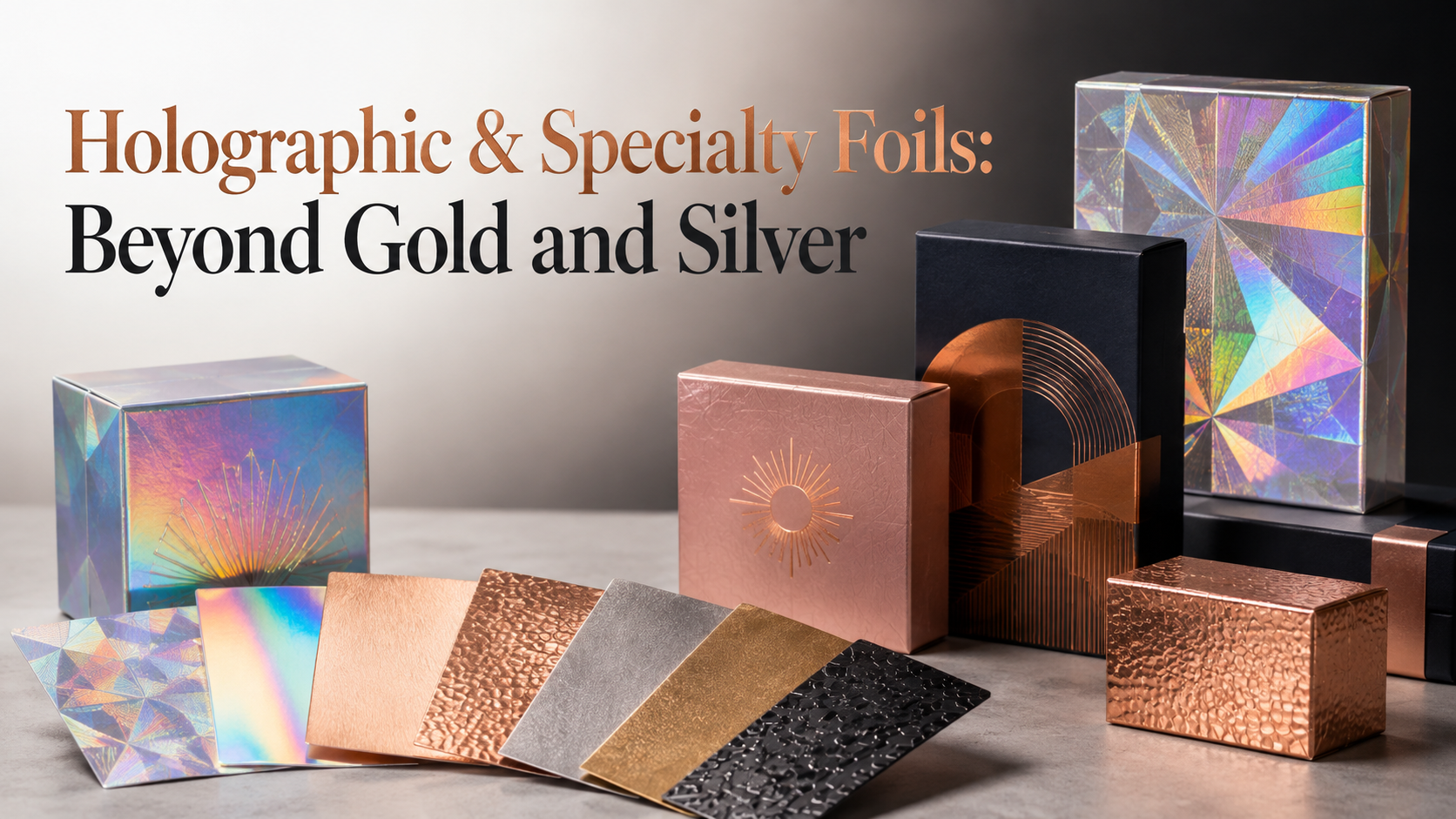
Holographic packaging uses a metallized film with a microscopic pattern embossed into it. That pattern splits light into a shifting rainbow effect. The effect changes as the viewing angle changes. Standard gold or silver foil reflects one consistent color no matter how you tilt it. Holographic foil looks different every time the box moves. That’s why holographic packaging grabs attention on a shelf. Flat foil rarely does the same.
Holographic isn’t the only specialty foil option, either. Color-shift, glow-in-the-dark, and clear or transparent foils all work the same basic way. Each swaps the standard gold or silver film for something that behaves differently under light. This article covers what holographic packaging actually is. It covers where specialty foils earn their place. It covers the one legibility mistake that turns a striking design into an unreadable one.
What Is Holographic Foil?
Holographic foil starts as a metallized film. A microscopic diffraction pattern gets embossed into that film during manufacturing. Light hits that pattern and splits apart. It’s the same way light splits through a prism. The result shifts color as the viewing angle changes. It doesn’t stay one flat shade.
Standard gold or silver foil doesn’t do this. It reflects one color, no matter the angle. Holographic packaging trades that consistency for movement and shimmer. Neither approach is better on its own. They just do different jobs.
The foil itself gets applied with the same hot-stamping process used for standard foil. A heated die presses the film onto the printed sheet under pressure. Holographic foil just brings a different visual result to that same mechanical process.
Beyond Holographic: Other Specialty Foils
Holographic isn’t the only specialty option. Color-shift foil changes color entirely depending on the angle, rather than splitting into a rainbow. It might look blue from one angle and green from another. Glow-in-the-dark foil absorbs light and releases it slowly in darkness. It’s a novelty effect suited to specific product categories. Clear or transparent foil adds a subtle sheen. It doesn’t add obvious color at all.
Each of these still relies on the same stamping process as standard foil. What changes is the film itself, not the machine or the technique. Holographic packaging just happens to be the most common and most requested of this specialty group.
The Legibility Problem Most Guides Skip
Here’s the part that decides whether holographic packaging looks striking or sloppy: text size. The diffraction pattern that creates the rainbow effect also breaks up fine detail. A bold logo or icon in holographic foil reads perfectly well. Small text stamped in that same foil can turn into a blurry smear under normal lighting.
That happens because the pattern splitting light also splits up thin letters. A large shape has enough room to hold its clarity. A small word doesn’t. Most guides talk about holographic foil purely as a trend. They rarely flag that size is what actually matters.
I’ve seen a brand stamp their full tagline in holographic foil. It ran across a small cosmetic box panel. They expected it to pop the same way their logo did. Once printed samples came in, the tagline turned into a hard-to-read smear under normal store lighting. The diffraction pattern had broken up the small letterforms completely. Switching the tagline to a standard flat foil fixed it entirely on the reprint. The logo stayed holographic.
Where Holographic Packaging Earns Its Place
Holographic packaging earns its spot on bold logos, icons, and large graphic elements. Limited-edition releases lean on it heavily. The shifting effect signals something special before a customer even reads the label. Retail shelf presence benefits too. A rigid box with a holographic logo catches light from across an aisle. Flat foil simply can’t match that.
Cosmetics and beauty packaging use holographic accents often, for exactly this reason. Anything in the cosmetic and beauty packaging category competing for shelf attention can benefit here. A well-placed holographic logo or icon does the work. Just keep the surrounding text in a more legible finish.
Where Standard Foil Still Wins
Standard foil still wins on small text, fine detail, and cost-sensitive runs. It reads cleanly at any size. There’s no diffraction pattern to distort thin letterforms. It’s also generally less expensive than holographic or specialty films. The material itself is simpler to produce.
Any panel with ingredient lists, fine print, or dense copy should stay in standard foil or ink instead. Save holographic packaging for the elements that can carry it. Logos, icons, and bold shapes with real surface area all qualify.
Holographic & Specialty Foils: Quick Comparison
| Factor | Holographic/Specialty Foil | Standard Foil |
|---|---|---|
| Visual effect | Shifts color, rainbow or color-change | Single consistent color |
| Best for | Logos, icons, bold shapes | Small text, fine detail |
| Legibility at small sizes | Poor, can blur | Strong |
| Relative cost | Higher | Lower |
Common Mistakes When Specifying Holographic or Specialty Foils
The first mistake is stamping small text in holographic foil. Buyers expect the same legibility as standard foil, and it rarely holds up. Request a folded, printed sample under real lighting before committing to a full run.
The second mistake is choosing holographic foil purely as a trend. Check whether the design elements actually suit it first. Bold shapes and icons carry it well. Dense copy doesn’t.
The third mistake is assuming every specialty foil behaves the same way. Color-shift, glow-in-the-dark, and holographic foils each have a different visual effect. Confirm which specific effect a vendor means before finalizing a spec.
A fourth mistake is skipping a lighting test entirely. Holographic packaging can look dramatically different under store fluorescents versus daylight. What looks perfect on a designer’s monitor can shift once it’s under real retail lighting.
A fifth mistake is treating every vendor’s “holographic” the same way. Some run a fine, tight diffraction pattern. Others run a coarser one with a more obvious rainbow effect. The two can look quite different side by side, even under the same label. Ask to see a physical sample of the exact pattern a vendor plans to run. A generic holographic swatch from their catalog isn’t enough.
Which Should You Choose?
Building a limited-edition release, or a box that needs to grab attention from across a shelf? Holographic packaging on a bold logo or icon is worth the extra cost. The legibility tradeoff barely matters, since the design elements carrying it are large enough to hold up.
Printing a box with dense copy, ingredient lists, or fine print? Standard foil is the safer choice there. It’s more legible and less expensive for those elements. That holds true even if a holographic accent shows up elsewhere on the same box.
Not sure which foil fits which part of your design? Our guide to rigid box vs folding carton covers how box structure and finish choices interact more broadly. Our guide to luxury rigid box packaging breaks down premium finish combinations in more depth. Easy Box Packaging can also send a printed sample under real lighting before a full production run. That’s the only reliable way to confirm legibility ahead of time.
Holographic packaging and standard foil solve two different problems. One grabs attention through movement and shimmer. The other holds up at any size, no matter how small the text gets. Match the foil to the element, and the finish works exactly the way it looked in the sample.
Holographic Packaging: FAQ
Does holographic foil work on small text? Not reliably. The diffraction pattern that creates the rainbow effect can blur fine letterforms. Reserve holographic foil for logos, icons, and bold shapes instead.
Is holographic foil more expensive than standard foil? Generally yes. The film itself is more complex to produce. It often requires more precise heat and pressure control during stamping too.
What other specialty foils exist besides holographic? Color-shift, glow-in-the-dark, and clear or transparent foil all exist. Each uses the same stamping process with a different film. Each produces a distinct visual effect.
Get a free quote — dieline and design support included.