
The Box That Keeps Winning
There are trendier packaging formats. Rigid boxes look more premium. Poly mailers weigh next to nothing.
And still, custom corrugated boxes ecommerce brands default to keep dominating — not out of habit, but because the structural physics are genuinely hard to beat at scale.
This guide covers what actually makes corrugated different, how to spec it correctly, when it’s the wrong answer, and what the sustainability numbers actually say — verified, not marketing copy.
What Makes Corrugated Different
Most people call it “cardboard.” Technically, that’s wrong — and the difference matters.
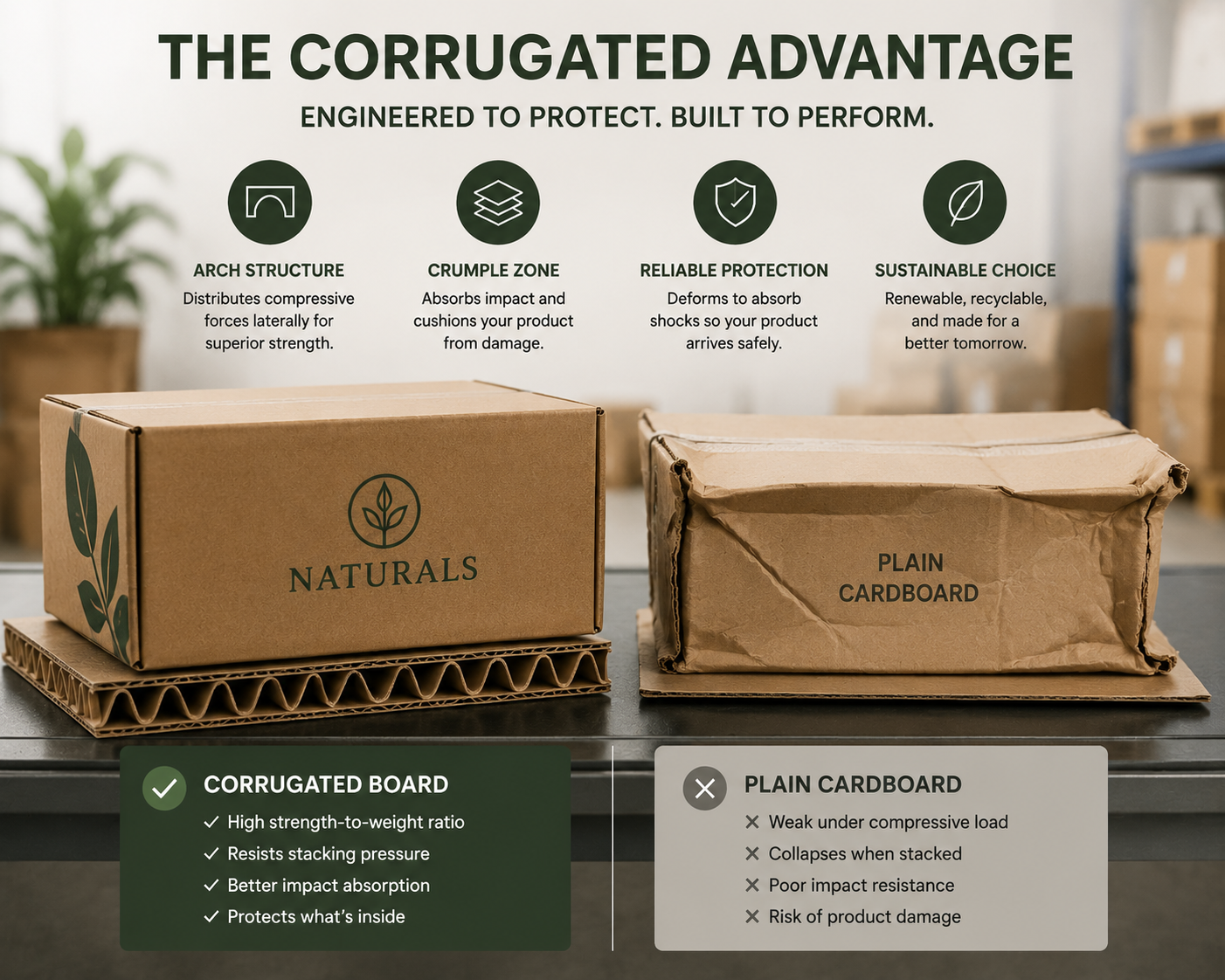
Plain cardboard is a single flat layer of compressed paper. Corrugated board is three layers: a flat outer liner, a wavy inner medium called the flute, and another flat inner liner. That flute is where the structural engineering lives.
The wavy flute creates an arch structure — one of the oldest and strongest geometric forms in load-bearing design. Arches distribute weight laterally across the structure instead of concentrating it at a single point, which is why Roman aqueducts are still standing and why corrugated handles compressive loads that would split plain cardboard in half. Each arch in the flute is deflecting and redistributing force rather than transmitting it directly to whatever’s inside.
There’s also a crumple zone effect. The space between the two liners gives the board somewhere to go under impact — absorbing the energy of a drop or bump instead of transferring it into the product. The board actually deforms to protect the product — which is why a box that arrives slightly dented at the corners has often done its job, not failed.
That’s not a flaw. That’s the mechanism working.
What You’ll Learn
What you’ll learn:
- The arch physics that make corrugated structurally superior to plain cardboard
- What ECT and BCT actually measure — and the moisture problem nobody tells you about
- An honest comparison: when poly mailers, rigid boxes, and padded mailers beat corrugated
- The right-sizing issue that’s quietly adding to your carrier costs
- Verified sustainability numbers — not marketing language
- Exactly when corrugated is the wrong answer
Time to read: 10 minutes
Custom Corrugated Boxes Ecommerce Specs: What Actually Matters
ECT vs. BCT — Two Different Tests
Most suppliers list boxes with an ECT rating (Edge Crush Test). Some list BCT (Box Crush Test). They measure different things, and confusing them leads to damaged shipments.
ECT measures how much force the corrugated board can withstand before the edge buckles under vertical compression. It’s measured in pounds per inch (lbs/in). A 32 ECT box can sustain 32 pounds of compressive force per inch of board edge. This is the number most ecommerce brands should care about — it determines how well boxes stack without crushing in transit.
BCT measures how much total force the assembled box (not just the board) can withstand before collapsing. It accounts for the box construction and the ECT of the board together. BCT is more relevant when you’re stacking pallets of product at a warehouse.
For most direct-to-consumer ecommerce — where boxes go through carrier networks and potentially get stacked under other parcels — ECT is the right spec to track.
Board Weight Guidelines
Standard corrugated board weights and what they actually mean for ecommerce:
- 32 ECT / 200#: Light products under 20 lbs — apparel, books, lightweight accessories
- 44 ECT / 275# : Medium products 20–50 lbs — home goods, hardware, multi-item orders
- 48–51 ECT / 350#: Heavy or fragile products over 50 lbs — tools, ceramics, glassware
- Double-wall corrugated: Products over 80 lbs or high-value fragile items requiring maximum protection
We’ve worked with 10,000+ brands across nearly every product category — and the most common spec mistake we see is under-rating board weight on the assumption that a shipping carrier will be gentle. They won’t be. Not optional.
The Moisture Problem Nobody Tells You About
ECT ratings are tested under controlled conditions: 50% relative humidity at 73°F. The real world is not that.
Corrugated loses compressive strength when it absorbs moisture. A 32 ECT box that tests at full strength in a lab may perform closer to a 20–22 ECT box after sitting in a humid delivery truck or a rainy loading dock for a few hours. The strength drop isn’t linear — it accelerates as moisture content increases.
What this means practically: if your product is shipping through regions with high humidity, or if your supply chain involves extended outdoor storage or open loading areas, spec up. The standard guidance of “add one board weight tier for humid climates” is a real rule of thumb, not industry overcaution.
Most brands have never thought about this. I hadn’t either until we started tracking damage claims by season and geography — and the pattern was obvious once we looked. Summer shipments to the Southeast had meaningfully higher damage rates than the same product going to the Mountain West in winter, same carrier, same spec. The box wasn’t failing; it was under-specced for where it was going.
Water-resistant coatings and moisture-barrier liners exist for extreme cases — but for most ecommerce brands, simply not under-speccing the board handles 90% of the moisture risk.
Flute Sizes and What They’re For
The flute — that wavy inner layer — comes in different sizes, and each behaves differently:
- A-flute: Thickest (almost 3/16″), best cushioning, most material. Good for fragile or heavy items.
- B-flute: Thinner (1/8″), better for flat-packed boxes, good puncture resistance, faster to stack.
- C-flute: The most common ecommerce flute. Middle ground between A and B on cushioning and compression.
- E-flute: Very thin (3/32″), used for outer packaging on retail items rather than shipping boxes.
- BC double-wall: B and C flutes combined — significantly stronger, used for heavy or high-value shipments.
For the vast majority of ecommerce shipping, C-flute corrugated is the default for good reason. It balances compression strength, cushioning, and box weight without over-engineering. I keep coming back to C-flute recommendations even for brands that initially want to go heavier — unless the product genuinely demands it, you’re often adding cost without adding meaningful protection.
Right-Sizing: The Cost You Can’t See
Oversized boxes are one of the most overlooked cost leaks in ecommerce operations. The problem isn’t just wasted cardboard — it’s dimensional weight.
Most major carriers (UPS, FedEx, USPS Priority) calculate shipping cost as the higher of actual weight or dimensional weight. Dimensional weight is calculated from the box’s external volume. A box that’s two inches too large in every dimension may be charged as though it weighs twice as much as it actually does — even if the product inside is light. Sound familiar? Most brands don’t notice this until they pull a carrier invoice and start doing the math.
So size your box so there’s roughly half an inch of clearance around the product for infill or protective padding, and no more. That’s enough space to protect the product without generating dimensional weight charges.
Every brand I’ve talked to that fixed their box sizing was surprised by how much it moved the needle on carrier costs. It’s the most boring packaging decision and also one of the most impactful. Right-sizing also reduces your corrugated usage, which brings the per-box cost down. Easy Box Packaging builds boxes to your product dimensions rather than pulling from a standard size catalog — that spec work often pays for itself within a few reorders. If you’re watching budget closely, the affordable custom boxes guide for small brands covers where to push back on minimums and where it’s not worth it.
Corrugated vs. The Alternatives: An Honest Comparison
There’s no single right answer here. The right packaging format depends on your product’s fragility, value, weight, and how much the unboxing experience matters to your brand.
Poly Mailers
Honestly, I think a lot of brands use corrugated for apparel because it’s what they know, not because it’s what they need. If you’re shipping folded t-shirts, you’re paying for structural engineering that’s doing nothing for you.
Poly mailers exist for exactly this use case: soft goods with no fragility risk. Apparel, fabric accessories, lightweight non-breakable items. They’re the lightest weight option available, lowest per-unit cost, take up minimal warehouse space, and ship efficiently. For a high-volume apparel brand, the math is pretty clear.
Where they fall apart is everything else. Any product with edges, fragility, or rigid dimensions should not go in a poly mailer — they provide zero crush resistance. They also read as low-effort, which works fine for commoditized products where nobody cares about the unboxing moment. But if brand experience is part of what you’re selling, a poly mailer undercuts it. (See our packaging mistakes that kill the unboxing moment for the full breakdown.)
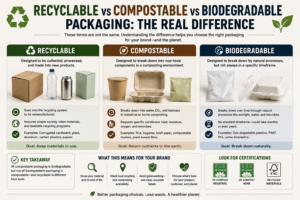
Sustainability note: standard poly mailers aren’t curbside recyclable in most municipalities. Some brands are switching to compostable alternatives — but review certifications carefully before making public claims about them. (More on this in our eco-friendly packaging guide.)
Rigid Boxes (Chipboard/Setup Boxes)
Best for: Premium and luxury products where the box is part of the purchase experience — jewelry, cosmetics, gift sets, high-end accessories.
A well-constructed rigid box communicates “this is worth something” before the customer opens it. That’s real brand value, and some customers genuinely keep and reuse them.
The trade-off is cost and weight. A rigid box typically runs $2–5+ per unit compared to $0.50–1.50 for corrugated, and they’re heavier, which pushes shipping costs up. For most functional ecommerce shipping — anything that isn’t specifically a luxury gift experience — rigid boxes are expensive insurance for something corrugated handles fine. Worth knowing: rigid boxes don’t have corrugated’s arch-based crush resistance. They’re designed for presentation protection, not transit abuse. If you’re shipping them through a standard carrier network without an outer corrugated shipper, factor in the damage risk.
Padded Mailers
Good for flat, lightweight items with minimal fragility — jewelry on cards, cosmetic samples, small accessories. They’re lighter than corrugated for those specific use cases and protect against surface scratches. For anything with three-dimensional shape or any meaningful crush risk, they don’t hold up. Carriers will stack things on top of them. That’s just how it works.
When Corrugated Is NOT the Right Answer
I’ll be honest: recommending competitors’ products isn’t great for our order volume. But a brand that ships t-shirts in corrugated boxes is wasting money, and we’d rather tell you that than watch you overspend.
Corrugated is the wrong answer in these situations:
Soft goods with no fragility. Apparel, fabric samples, linens, lightweight accessories — these don’t need crush resistance. A poly mailer or padded envelope gets them there safely at a fraction of the cost and dimensional weight. You’re paying for structural engineering you don’t need.
Very low-value items where the unboxing experience is irrelevant. If you’re fulfilling bulk commodity orders where the customer just wants the thing, not the experience, optimize for cost. Corrugated’s advantages are real but they come with cost. If your product is a $6 replacement part, the math may not work.
Products where dimensional weight is a killer. If a corrugated box’s minimum viable size generates expensive dimensional weight charges and the product isn’t fragile enough to need it, a flexible mailer may save more in shipping than the box costs.
When you’re shipping within another outer shipper. If a corrugated box is going inside a larger corrugated shipper anyway, the inner box only needs to handle presentation and light protection — a rigid box or folding carton may be the cleaner choice.
The honest framework: if your product is breakable, has edges, or is heavy, corrugated is almost certainly right. If it’s soft, flat, and low-fragility, run the numbers on alternatives first.
What the Sustainability Numbers Actually Say
Corrugated has a credible sustainability story — but it’s worth being specific rather than vague about it.
Recycled content: US corrugated boxes are made with a high proportion of recycled fiber — industry data from the American Forest & Paper Association consistently shows recycled content rates above 90% for corrugated medium and liner board. The exact percentage varies by manufacturer and specification, but it’s genuinely high by manufacturing standards.
Recyclability: Standard corrugated is accepted by curbside recycling programs in virtually every US municipality. It’s one of the most widely recycled materials in the country, not just theoretically recyclable but actually collected and processed at scale.
FSC certification: For brands where chain-of-custody matters — retail buyers, environmentally conscious customers, brands making public sustainability commitments — FSC-certified corrugated is available and the cost premium is minimal (typically 0–5% over non-certified board). Easy Box Packaging carries 100% FSC-certified corrugated options. The certification is verifiable at info.fsc.org — don’t take a supplier’s word for it, check the number.
What you can’t claim without verification: “Biodegradable” without conditions is a vague claim the FTC Green Guides flag as potentially misleading. “Zero waste” requires a full life-cycle analysis. Stick to what’s verifiable: recycled content percentage (if your supplier gives you the actual number), recyclability (corrugated, yes), and FSC certification status (if applicable).
I’ll admit I’m not 100% certain how that recycled content figure will shift as more brands chase sustainable sourcing simultaneously — demand pressure on recycled fiber is real, and I haven’t seen reliable projections on where the percentage lands in five years. But right now, the story holds up.
The corrugated sustainability case is real. You just have to be precise about it.
A Practical Spec Checklist Before You Order
Before placing a custom corrugated order, have answers to these. All of them. Missing even one can push you into a default spec decision you didn’t intend to make.
- Product weight and dimensions — actual, including any protective padding
- Fragility level — will it break if dropped from waist height?
- Shipping method — USPS Ground Advantage, UPS, FedEx Ground, or something else?
- Climate/humidity risk — shipping to Florida in August vs. Colorado in winter are different spec decisions
- Stacking requirements — will boxes be palletized in a warehouse or go straight from pick-pack to carrier?
- Target box dimensions — product dimensions plus half-inch clearance each side
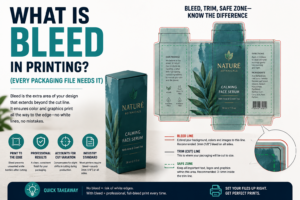
- Printing requirements — exterior only, interior, or both
- Volume — determines whether digital or offset printing makes economic sense
- Sustainability requirements — FSC certification needed for retail buyers or brand commitments?
Getting these nailed down before you brief a supplier saves rounds of back-and-forth and prevents spec decisions being made for you by default.
FAQ
What’s the difference between corrugated and cardboard?
Corrugated has a three-layer structure with a wavy inner flute sandwiched between two flat liners. That flute creates arch geometry that distributes compressive load. Plain cardboard is a single flat layer with no internal structure. Corrugated is significantly stronger for shipping; cardboard is fine for folding cartons and retail packaging that doesn’t go through a carrier network.
What ECT rating do I need for my product?
For products under 20 lbs, 32 ECT is typically sufficient. 20–50 lbs, step up to 44 ECT. Over 50 lbs or fragile, 48–51 ECT. Heavy or high-value fragile items: double-wall. When in doubt, spec up — the per-box cost difference between 32 ECT and 44 ECT is small compared to a return from transit damage.
Does moisture really affect corrugated that much?
Yes. ECT ratings are measured at controlled humidity. Real-world conditions — especially humid climates or extended outdoor handling — can meaningfully reduce compressive strength. If you’re shipping to high-humidity regions consistently, spec up one tier.
Can I print on corrugated?
Yes. Both digital (no plate fees, good for short runs) and offset (economical at volume) printing work on corrugated. White corrugated takes full-color printing well. Kraft board gives a more natural look but absorbs ink differently — simpler designs and spot colors tend to work better. Interior printing is also an option and creates a strong unboxing moment at relatively low incremental cost.
Is FSC-certified corrugated worth it?
If your customers or retail buyers care about sustainability, yes — and the cost is typically marginal. If you’re selling direct-to-consumer and sustainability isn’t a meaningful part of your positioning, it’s optional rather than essential.
When should I use double-wall corrugated?
For products over 80 lbs, high-value fragile items (ceramics, glassware, electronics), products that will be palletized and shipped long distances, or anything where a single-wall failure would be costly. Double-wall costs more but the protection-to-cost ratio holds up when the downside of damage is high.
Pricing and MOQs shift a lot depending on spec — flute, board weight, print complexity, and run size all move the number. Get a quote with your actual dimensions rather than estimating from a catalog. And order samples before committing to a full run. What looks right on a spec sheet doesn’t always feel right in your hand.
For a broader look at how box structure and material choices interact with the unboxing experience, our custom mailer boxes guide covers construction and design decisions in depth. And if you’re thinking through the sustainability angle with specifics on certifications and what you can actually claim, the eco-friendly packaging breakdown is worth reading before you brief a supplier.
But honestly? Custom corrugated boxes ecommerce brands use keep winning because the fundamentals are sound. Spec it right, size it for your product, and corrugated handles almost everything ecommerce throws at it. Corrugated doesn’t need defending. It just needs to be specced right.