
Chicago moves product. Third largest city in the country, one of the top cargo airports in the US, and a manufacturing base that never really went away — just evolved. Fulton Market went from meatpacking to tech startups. Pilsen went from industrial to artisan. The West Loop became a DTC corridor that nobody’s quite mapped yet.
And somehow, most packaging supplier websites treat Chicago brands the same way they treat everyone else: a city name plugged into a generic template, a “we ship nationwide” page that doesn’t say anything useful.
Illinois brands — whether you’re shipping candles from Wicker Park or healthcare products from the North Shore suburbs — have specific needs. The logistics are different. The industries are different. The weather is genuinely different, which affects how you spec corrugated. And the supplier relationship dynamic here tends to be different too: Chicago buyers want accountability, not a contact form.
This guide covers what custom boxes Chicago Illinois brands actually need, what separates good suppliers from frustrating ones, and what most brands get wrong before their first run.
Chicago’s Industry Mix — What It Means for Packaging
Chicago doesn’t have one dominant product category. It has five or six, and they each have different packaging requirements.
Food and beverage is still massive here. From Fulton Market’s restaurant brands to West Side food manufacturers, Chicago ships a lot of product. It needs food-safe, moisture-resistant packaging. If you’re shipping shelf-stable food products, your corrugated spec needs to account for product weight. It also needs to account for the fact that Chicago’s loading docks spend half the year in humidity and the other half in dry cold. Custom boxes for Chicago Illinois food brands have to handle both.
Cannabis became a significant packaging market after Illinois legalized recreational use in 2020. Cannabis packaging in Illinois isn’t optional — the state requires tamper-evident, child-resistant packaging with specific labeling under the Cannabis Regulation and Tax Act. If you’re in this category, your packaging vendor needs to understand compliance, not just aesthetics. A custom box that looks great but doesn’t meet CRTFA requirements is a liability, not an asset.
Beauty and skincare has had a real moment in Chicago. The brand density in neighborhoods like Lincoln Park and Andersonville has grown, and DTC beauty brands here are competing with coastal peers who have better access to suppliers. Getting packaging right is one of the few places a Midwest beauty brand can close that gap — and it’s not just about the first impression. The research on how packaging drives repeat purchases is pretty clear: beauty buyers in particular respond to the physical experience of receiving. A branded box in this category isn’t a luxury spend, it’s a retention tool. Easy Box Packaging’s healthcare and beauty packaging options are worth looking at if you’re in this space.
Manufacturing and industrial still accounts for a meaningful part of the Chicago MSA. If you’re shipping parts, tools, or equipment components, your packaging requirements lean toward protective corrugated — board weight, cushioning, and box sizing matter more than print quality.
What this guide covers: Why Chicago’s industry mix creates specific packaging requirements. How the O’Hare logistics corridor affects your lead time math. The seasonal spec problem nobody tells Midwest brands about. How to vet a supplier before you’re locked into a production run. What to avoid on a first order.
The common thread: Chicago brands are practical. They want specs that work. They want suppliers who respond the same day. And they want pricing that doesn’t require three rounds of back-and-forth to arrive at an actual number. I’ve worked with brands across the Midwest and the directness here is real — it’s not rudeness, it’s efficiency. They’ve been burned before and they know what questions to ask.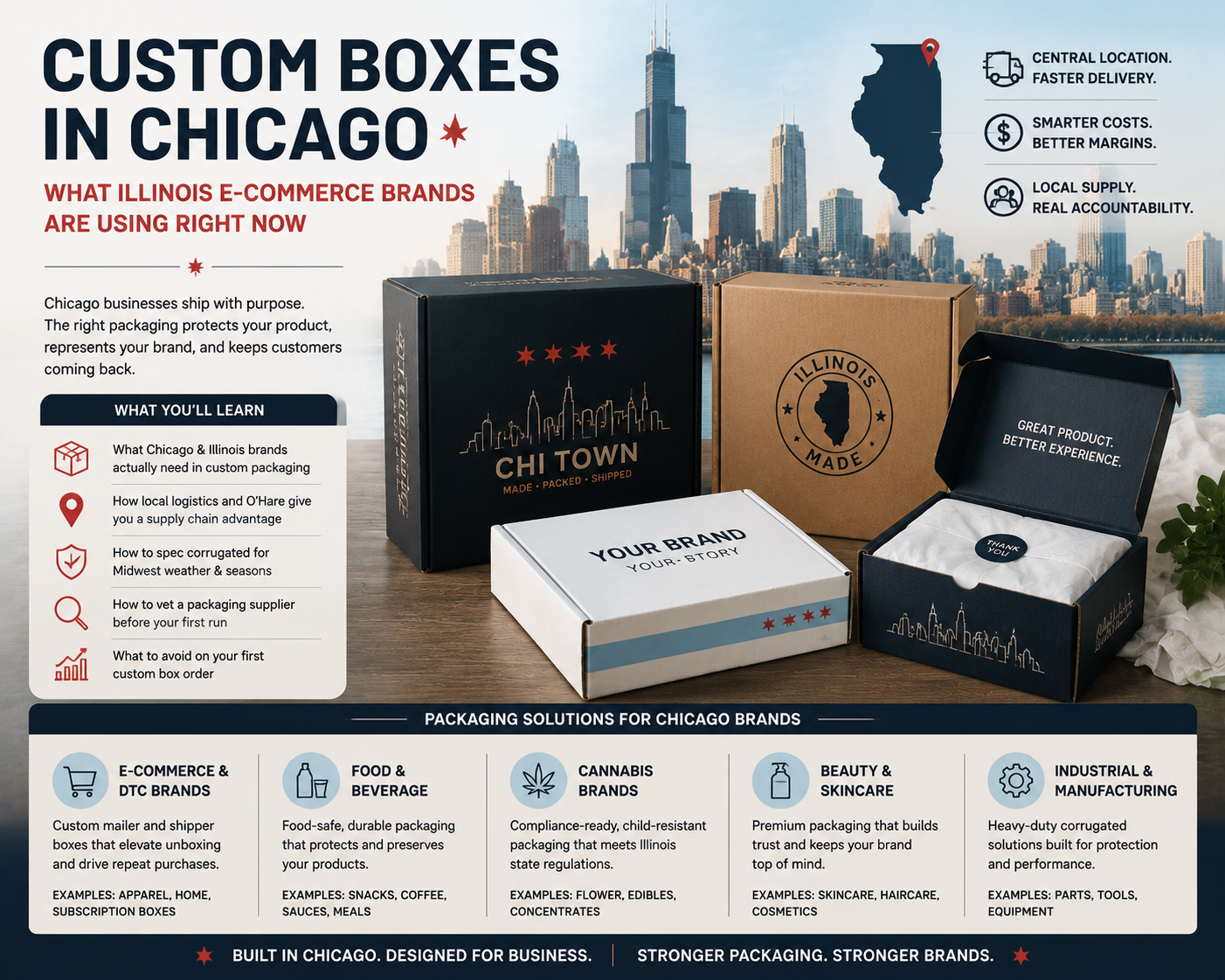
The O’Hare Advantage (And Why It Matters for Lead Times)
People talk about O’Hare as a passenger hub. It’s also consistently one of the top cargo airports in the United States, and that has real supply chain implications for Chicago brands.
If your packaging supplier ships through Chicago’s logistics network, reorder lead times get much shorter. The central US location means 2-day ground shipping to most of the country. West Coast suppliers can’t match that when you’re shipping to the Southeast or Northeast.
For first orders, this matters less. You’re running a sample and production run regardless. That timeline is set by the print queue, not freight. But reorders are different. A supplier who delivers a 2,000-unit reorder in 10 business days versus 18 is a different reality for a brand that’s scaling.
Chicago also sits at the intersection of major Midwest distribution networks. UPS and FedEx both have major regional sortation centers here. That means better carrier options and more competitive rate shopping. It also means faster resolution when something goes sideways.
The Seasonal Spec Problem
Here’s the thing that almost no packaging guide mentions: Chicago has some of the most extreme seasonal conditions in any major US city, and those conditions affect how corrugated performs.
ECT ratings — the compression strength measure used to spec corrugated boxes — are tested at 50% relative humidity, 73°F per industry standard. That’s a controlled lab condition. Chicago in July is not that. A loading dock on a humid August afternoon can push relative humidity north of 80%, and corrugated board absorbs moisture. When it does, compressive strength drops — not linearly, but rapidly above a certain moisture threshold.
The flip side is January. Chicago cold and dry air doesn’t weaken corrugated the same way humidity does — dry conditions actually preserve the rating — but extreme temperature differentials can cause condensation issues on certain products.
The takeaway: if your product ships through summer months, spec one board weight tier higher. A product that normally runs in 32 ECT may need 44 ECT through July and August. The per-box cost difference is a few cents. A damage claim costs far more.
We’ve seen this play out in actual damage data across thousands of shipments. Summer shipments through Midwest distribution centers have consistently higher damage rates for brands who haven’t accounted for humidity — a pattern that becomes obvious when you look at seasonal damage claims side by side. Worth knowing before your first peak season, not after it.
Choosing a Supplier: What Chicago Brands Should Actually Ask
Finding the right supplier is harder than it should be. The specs and pricing are part of it, but the relationship is most of it. Here’s what actually separates good suppliers from frustrating ones.
Ask about MOQ explicitly — before you fall in love with their portfolio. Custom boxes Chicago Illinois brands order can make sense at almost any scale. But the math is completely different at 200 boxes versus 5,000. Some suppliers won’t touch orders under 500 units. Others are built for emerging brands doing shorter runs. Get the minimums in writing before you start the design process. Otherwise you’ll waste time on a supplier who can’t serve you at your current stage.
Ask for a lead time with a specific number. “Fast turnaround” is marketing language. “18 business days from proof approval” is a spec. Typical lead times for custom corrugated run 2–4 weeks from approved proof. Complex finishes or specialty materials take longer. Get the number. Build it into your inventory planning. Don’t let a vague promise leave you shipping product in plain brown because the boxes didn’t arrive.
Order samples before committing to a production run. Every time. Hold the box. Fold it. Put a product in it and see how it feels. The dimensional fit, the print quality, the way the closure tab holds — none of this translates reliably from a digital proof to physical reality. Chicago brands who skip this step regret it. Every single one. Results vary by product and handling — we recommend testing samples before full production.
Look at how they communicate before you’ve given them money. A supplier who takes four days to answer a pre-sales question will take a week on a production one. The pace of response before the sale tells you everything about what happens after it.
Pricing and MOQs vary by specification. Request a custom quote for accurate details.
Illinois Cannabis Packaging: A Separate Conversation
If your brand is in the cannabis space — recreational, medical, CBD, or hemp — packaging compliance in Illinois isn’t optional, and it isn’t something most generic packaging guides cover.
The Illinois Cannabis Regulation and Tax Act requires:
- Tamper-evident packaging
- Child-resistant closures or features
- Specific labeling including product name, weight, THC content, health warnings, and license number
- Opaque packaging (product not visible)
- No packaging that could appeal to children
This means your packaging vendor needs to understand more than print specs. The structural design, closure type, and label placement all have compliance implications. If you’re getting quotes from suppliers who’ve never worked on cannabis packaging and can’t speak to CRTFA requirements, you’re taking a risk that goes beyond aesthetics.
We’ve worked with Illinois cannabis brands on compliant packaging that also looks good. It’s harder than it sounds. Opaque materials and child-resistant structures limit design options significantly. Have that conversation early. Don’t commit to a box structure that fails compliance review after the fact. Cannabis regulations update periodically — check current IDFPR packaging requirements before your production run, and have someone who knows the space review your specs. A packaging consultant or cannabis attorney is worth the conversation before you’re committed to 2,000 units.
What to Avoid
Most first-order mistakes are predictable — and they’re not unique to Chicago. The packaging mistakes that quietly kill your unboxing experience are consistent across markets. Here’s where Chicago brands specifically tend to burn money.
Ordering based on the cheapest quote. The cost difference between a supplier with 15 years of corrugated experience and one with 18 months shows up in die accuracy, print quality, and structural consistency. A box that photographs well but doesn’t fold squarely is a problem at 50 units. It’s a disaster at 2,000. I’ve seen brands save $0.15 per box and spend $3,000 sorting out a production run where 40% of the units had crooked scores. That math doesn’t work.
Skipping the sample phase to save time. The sample phase is not optional. It is the cheapest version of a mistake you can make. A bad production run is the expensive version.
Ordering too much on the first run. Order what you’ll sell in 3–4 months. Learn what works — which specs hold up in transit, which print finishes read the way you expected, whether the dimensions are truly right for your product. Then scale.
Assuming a national supplier has the same local accountability as a regional one. This isn’t universal, but it’s real: when something goes wrong on your order, a supplier with Chicago-area operations tends to resolve it faster than a call center in another time zone. That relationship matters more when something’s broken than when everything’s fine.
Getting Custom Boxes in Chicago, Illinois: A First-Order Checklist
Step 1: Define your product specs. Dimensions, weight, fragility level. Know these exactly before you talk to anyone.
Step 2: Decide on your packaging format. Is corrugated the right answer? For most shipping applications, yes — but soft goods and lightweight apparel may be better served by custom mailer boxes for ecommerce. The structural decision comes before the design decision.
Step 3: Get quotes from two or three suppliers. Same specs, same quantity, same timeline. An apples-to-apples comparison.
Step 4: Order samples from your top choice. One to three boxes, physically delivered to you. Use them.
Step 5: Ship product in them before your production run. If you can run 10–20 units in the sample boxes to real addresses, do it. Real-world transit is the test that matters.
Step 6: Place a production run sized to 3–4 months of volume. Not more. Not less.
For most custom boxes Chicago Illinois brands order for the first time, the full process runs 6–8 weeks from decision to product in hand. Plan accordingly.
FAQ
How much do custom boxes in Chicago, Illinois cost?
Per-unit costs depend heavily on board spec, run quantity, and print complexity. Short runs under 500 units typically start around $1–2 per unit. Larger volumes bring that down meaningfully. Get an itemized quote with your actual dimensions. Catalog pricing is almost always wrong for your specific product. Pricing and MOQs vary by specification. Request a custom quote for accurate details.
Do I need a Chicago-based supplier?
Not necessarily. A supplier with Midwest-friendly logistics and responsive communication is more important than a specific zip code. That said, suppliers with operations near the Chicago area often offer shorter freight times on reorders and easier resolution when something needs to be corrected. Location is one factor among several.
How does Illinois weather affect my packaging?
Summer humidity can reduce corrugated compressive strength meaningfully. If you’re shipping through July–September, consider speccing one board weight tier higher than the standard recommendation for your product weight. Winter cold doesn’t degrade corrugated the same way, but extreme temperature swings can cause condensation issues with certain products.
What’s the minimum order quantity?
Varies by supplier. Some start at 100 units; others won’t take orders under 500. Ask explicitly before getting deep into a quote process.
What do Illinois cannabis brands need to know about packaging?
The Illinois Cannabis Regulation and Tax Act mandates tamper-evident, child-resistant, opaque packaging with specific labeling. Work with a supplier who has experience with cannabis compliance — structural design decisions have compliance implications that generic suppliers may not flag.
How long does it take to get custom boxes?
First orders typically take 2–4 weeks from approved proof. Rush options exist but cost more. Build this into your inventory planning — the brands that get caught short usually assumed it would be faster than it was.
The market for custom boxes Chicago Illinois brands use is competitive. The brands getting it right aren’t spending the most. They’re speccing correctly for the product, the climate, and the category. A box that performs in July in Chicago — humid dock, mixed carrier handling, long transit — and arrives in good shape is doing work that most brands don’t account for until something goes wrong. Start with that spec. Everything else is detail.
If you’re figuring out the right format for your product — corrugated versus mailer, board weight, print complexity — the fastest way to get a real answer is a quote with your actual dimensions. We’ve worked with 10,000+ brands across categories and can usually give you a clear recommendation in the first conversation. Easy Box Packaging offers 100% FSC-certified corrugated options and builds boxes to your product dimensions rather than pulling from a standard size catalog — which matters both for brand presentation and for keeping your dimensional weight charges in check.
For a comparison of how other major markets approach custom packaging, our Texas custom packaging guide and New York packaging guide cover the regional differences worth knowing. Chicago is a different market, but the core spec work is the same wherever you’re shipping from. And if you need retail-ready custom packaging boxes, that’s the product category worth browsing before you brief a supplier.