
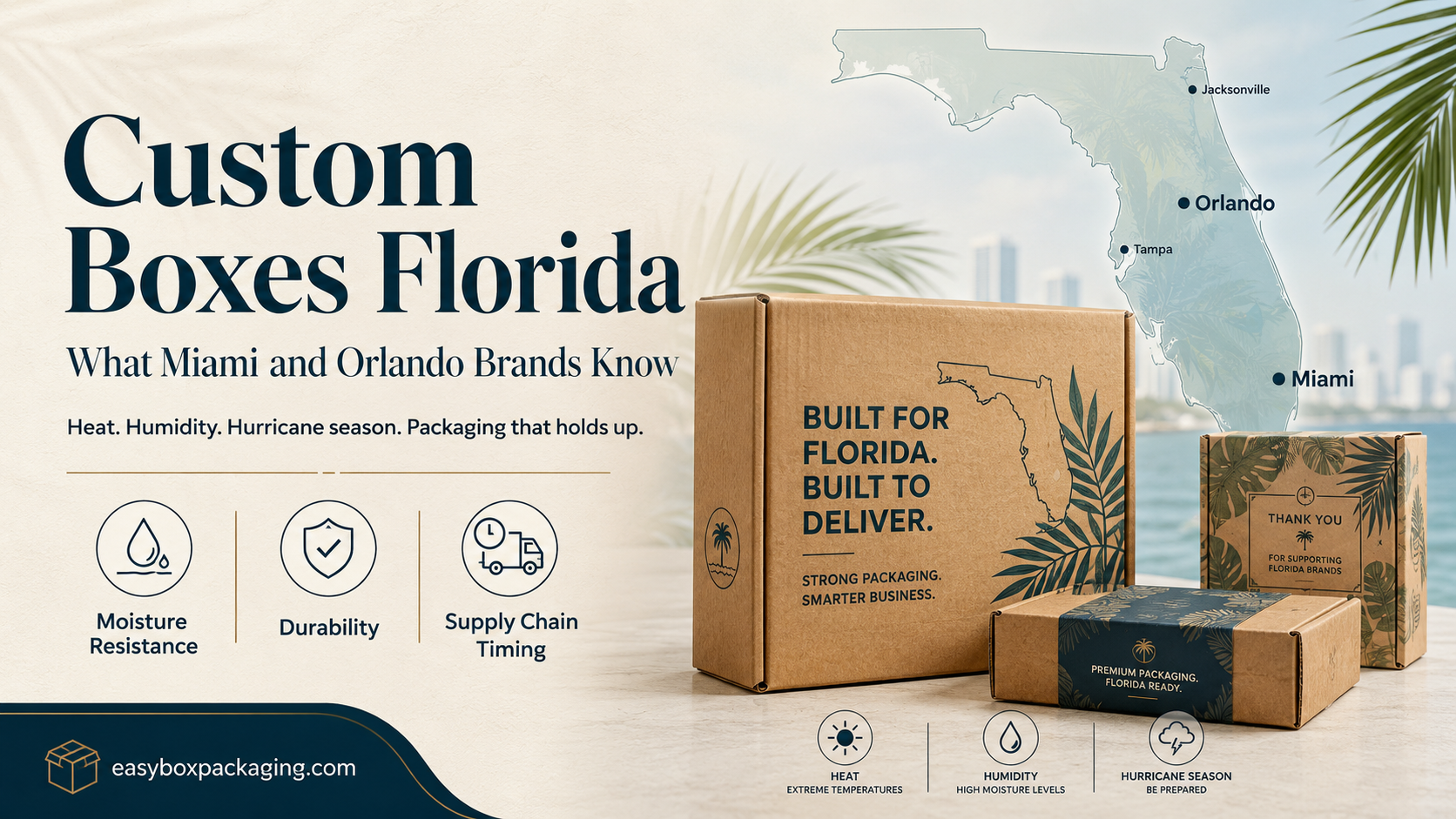
If you’re sourcing custom boxes in Florida, the question isn’t just “what design should I print?” It’s “what will hold up here?” Florida’s climate turns packaging decisions that are optional elsewhere into decisions you’ll regret if you get wrong.
Florida is the third most populous state, and its DTC and e-commerce market has grown accordingly. Miami is a global hub for beauty, fashion, and luxury goods — buyers who expect premium packaging and have been trained by international brands to notice when it’s missing. Orlando runs a massive tourism and gift economy with subscription services and souvenir packaging at real volume. Jacksonville is one of the Southeast’s most important logistics corridors. Tampa and St. Pete are producing more startups than they were five years ago.
But underneath all of that: Florida is hot and humid. Corrugated boxes absorb moisture. Heat weakens adhesives. Hurricane season can knock out supply chains for weeks. These are packaging problems that brands in Ohio or Colorado simply don’t deal with.
If you’re ordering custom boxes in Florida, you need to know what you’re buying, why it matters, and what to watch out for. That’s what this covers.
Florida Isn’t One Market — Miami, Orlando, Tampa, and Jacksonville All Want Different Things
This is the part that gets glossed over in most packaging guides: Florida isn’t uniform.
Miami is playing a different game entirely. You’ve got international fashion brands, luxury beauty, lifestyle products, food and beverage, and an enormous Latin American and Caribbean export market. The buyers here have been exposed to high-end packaging from European and South American brands. Matte laminate, foil stamping, textured finishes — these aren’t impressive in Miami’s premium beauty or fashion segment, they’re expected. I’ve talked to enough Miami brand founders to know the pattern: the product is right, the price is right, and the box reads “we didn’t budget for this.” In that market, that costs you immediately. Miami also has a bilingual dimension worth thinking about if you’re reaching Spanish-speaking customers in South Florida or shipping to the Caribbean — packaging with bilingual callouts can outperform English-only in certain categories.
Orlando is higher volume and more forgiving on premium finishes, but not on durability. Tourism gift shops, subscription boxes, branded souvenir packaging, and a fast-growing DTC scene mean Orlando sellers are moving product constantly and need boxes that survive handling, storage, and the occasional trip across an airport. Structural integrity matters more here than letterpress detail.
Tampa and St. Pete are producing more startups and CPG brands than they were a few years back. It’s a market still figuring out its packaging identity — not Miami’s luxury expectations, not Orlando’s volume churn. A lot of these brands are doing smaller runs and care deeply about unit economics at low MOQ.
Jacksonville is a logistics story. Port of Jacksonville is one of the Southeast’s major container ports. If you’re importing, exporting, or managing a distribution center, you’re probably already in Jacksonville’s orbit. Packaging decisions here often hinge on freight and storage costs rather than brand aesthetics — boxes that stack well, survive warehouse storage in humidity, and ship efficiently matter more than finish.
What you’ll learn in this article:
- Why Florida’s heat and humidity are actual structural risks for corrugated boxes — not just inconvenience
- How hurricane season should change your inventory planning
- What Miami buyers expect vs. what Orlando brands actually need
- How to choose a supplier that understands Florida’s logistics realities
- The mistakes Florida sellers make that brands in other states don’t
The Climate Problem Nobody Talks About
Here’s the thing no packaging supplier website will tell you upfront: paper fiber is hygroscopic.
That means it absorbs moisture from the surrounding air. It can’t help it. In dry climates, this is a non-issue. In Florida — where average humidity regularly runs above 70 percent and summer feels like breathing through a wet towel — it’s a structural concern.
Here’s the mechanism. Corrugated cardboard gets its strength from the fluted layer between the two flat sheets. Those flutes act like a series of arches, distributing compressive load across the whole surface. When the fiber absorbs humidity, those flutes soften. The arch structure weakens. A box rated for 200 lbs of stacking force when dry might hold 120 lbs after sitting in a humid warehouse for two weeks. That’s not a marginal difference. That’s boxes failing mid-stack in your storage space or arriving crushed on a customer’s doorstep.
Heat compounds the problem separately. Adhesives used in corrugated construction and in label application are often formulated for ambient temperatures. In Florida summers — where warehouses without proper climate control can hit 90 degrees or higher — some adhesives soften or lose bond strength. Boxes that were sealed fine yesterday can open at the seam tomorrow.
So what do you actually do about this?
A few things matter: specify a higher board grade than you’d otherwise use (32 ECT is fine in Seattle; 44 ECT or B-flute double-wall might be what you need in Miami). Request water-resistant coating options, particularly if boxes are stored in unconditioned spaces. Ask your supplier explicitly about adhesive performance ratings for warm climates — not all suppliers think to surface this unless you ask.
If you want to work through specs for your specific product weight, storage conditions, and shipping requirements, Easy Box Packaging can spec corrugated grades suited to high-humidity Florida storage — it’s one of the more common questions we get from Southeast brands.
I’d also add this: test your boxes in your actual storage environment before you commit to a full production run. Put a box in your warehouse for two weeks, load it, and see what happens. Results vary by storage conditions and board spec. Testing samples before full production is worth the effort.
Hurricane Season and Your Packaging Supply Chain
This one’s genuinely underestimated.
Florida hurricane season runs June through November. That’s six months of the year. Not every season produces a landfall, but the supply chain disruption from a major storm doesn’t require a direct hit — a storm tracking up the coast can delay freight, shut ports, and strand inbound shipments for weeks.
Most packaging guides don’t mention this because most packaging guides aren’t written for Florida businesses. But if you’ve operated here for more than a couple of years, you already know: you cannot count on getting a rush order through in September. Carriers are stretched. Port throughput slows. Road freight delays stack up.
The brands that handle this well treat packaging inventory the way they treat insurance: boring to maintain, painful to be without. In practical terms, that means building a packaging buffer before June. Not months of inventory — that’s carrying cost you don’t need. But something more than your usual 4-week supply. Six to eight weeks of packaging going into the season is a reasonable target.
It also means knowing where your supplier’s production and distribution is located and what their contingency looks like if their region gets hit. It’s a reasonable question to ask before you sign on — a supplier with manufacturing in the Southeast has different risk exposure than one shipping from the Midwest.
Choosing a Packaging Supplier for Your Florida Business
This is where it gets practical.
Understand the geography. Florida is not particularly close to the major packaging manufacturing clusters on the West Coast. Transit times from California or the Pacific Northwest add days and freight cost. Suppliers with Southeast operations, Gulf Coast distribution, or established carrier relationships into Florida will generally move faster than national suppliers treating Florida as an afterthought. That matters on first runs and matters more on reorders when you need something quickly.
Ask about climate-aware specs. Not every supplier thinks about humidity and heat by default — they’re designing for the median climate, not Florida’s. A supplier who proactively discusses board grades, moisture-resistant coatings, and adhesive performance for warm storage is demonstrating real operational knowledge. One who has never heard the question before is giving you information.
MOQ and lead time, written down. “Low minimums” and “fast turnaround” are marketing language. Get actual numbers in writing before you invest time in a quote process. Typical turnaround for custom corrugated often runs 2–4 weeks depending on complexity; rush pricing exists but costs more. Pricing and MOQs vary by specification — request a custom quote for accurate details.
A sample process that isn’t just aesthetic. It shouldn’t just look right in a photo. It should survive two weeks in your warehouse, ship in a carrier’s hands, and arrive the way you intended. Easy Box Packaging offers custom sizing and structural prototyping for exactly this reason — getting the specs right before a full run saves real money.
Ask about FSC certification if your brand makes any sustainability claims or you’re selling to buyers who care. We offer 100% FSC-certified corrugated options for brands that need the credential, not just the intention.
We’ve worked with 10,000+ brands across the country, and the ones that run into trouble in Florida most often are the ones who picked a supplier optimized for the average US climate without thinking about what “average” doesn’t include. Responsive communication is worth more than a polished portfolio. Email with a specific question and clock the response. A day is fine. Three days is a yellow flag. A week is a red flag — if they’re slow before you’ve given them money, they’ll be slower when production gets complicated.
What to Avoid
The temptation to go with the cheapest quote is real, especially when unit economics are tight. But here are the patterns we see go wrong most often in Florida specifically.
Undersizing on board grade. Brands pick a spec that works fine in their competitor’s marketing photos — shot in a climate-controlled studio, never stack-tested in a Florida July warehouse. Then they get returns and crushed product and wonder what happened. Board grade matters more in Florida than it does in other markets. Don’t spec it like you’re shipping to Denver.
Ignoring storage conditions. If your warehouse is unconditioned — common in small-scale operations — your packaging is being tested by Florida’s climate every single day. That’s not a reason to panic, but it is a reason to spec up, test before committing, and not be surprised when a generic corrugated box underperforms.
Ordering too much at once. Florida’s market shifts — tourism seasonality in Orlando, fashion cycles in Miami, hurricane disruptions statewide. Big inventory commitments leave you exposed. Keep your packaging buffer sensible: enough to survive a storm delay, not so much that you’re holding six months of product you haven’t tested properly.
Choosing a supplier based on price alone. A supplier who hasn’t heard questions about humidity resistance or heat-stable adhesives is not equipped for Florida. That gap will show up in production, not in the quote.
See how our custom packaging Texas guide handles similar regional spec decisions, and the custom packaging New York guide if you’re comparing premium-market expectations.
Getting Your First Florida-Ready Packaging Order Right
Step 1: Know your storage reality. Is your warehouse climate-controlled? What does summer look like in there? This determines whether you need to spec up on board grade, add moisture-resistant coatings, or both.
Step 2: Get your dimensions exact. Product weight, dimensions, how it’s being shipped (single units, multi-packs), which carriers are handling it. Get these locked down before you talk specs with anyone.
Step 3: Decide on design before you get quotes. Miami brand with luxury positioning? Finish options matter — plan for them. Orlando subscription business? Volume and structure are the priority. Know which problem you’re solving.
Step 4: Get two or three quotes from suppliers who understand Florida’s climate. Ask each one explicitly about board grade recommendations for high-humidity storage and heat-stable adhesives. The answers will tell you more than the pricing.
Step 5: Order samples and test them properly. Not just “does it look nice” — put it in your storage environment for a couple of weeks. Stack weight on it. Ship a few. See what happens. For a full breakdown of mailer box structures and what holds up in transit, our custom mailer boxes guide covers the details.
Step 6: Commit to a run that covers 3–4 months, plus a hurricane buffer if you’re ordering in spring. Build timing around the reality of Florida’s season, not against it.
FAQ: Custom Boxes in Florida
What’s the best corrugated grade for Florida humidity?
Honestly, it depends on how you’re storing and what you’re shipping. But generally: 32 ECT is the standard starting point for light e-commerce. In Florida, especially for anything stored in unconditioned warehouses or shipped through summer, 44 ECT or B-flute double-wall is often more appropriate. Ask your supplier to spec for your actual storage conditions, not just your product weight.
Does heat really affect packaging adhesives?
Yes. Not catastrophically under normal conditions, but adhesives used in corrugated construction and labeling have thermal tolerances. Warehouses that hit 85–95°F regularly can stress adhesives designed for ambient temperatures. It’s worth asking your supplier what adhesive grades they’re using and what the temperature range is. This is especially relevant for Miami brands storing product in summer.
How far ahead should I order packaging before hurricane season?
Most Florida operators aim to build their packaging buffer by late May — before the season peaks. Six to eight weeks of supply is a reasonable target for most operations. You don’t want to be placing a rush order in September.
Is bilingual packaging worth it in Miami?
Depends on your category and customer base. For beauty, food, and lifestyle brands reaching South Florida’s Spanish-speaking market or shipping to Caribbean and Latin American buyers, bilingual callouts can genuinely outperform English-only. It’s not a universal rule — test it if you have the distribution.
Are FSC-certified options available?
Yes. We offer 100% FSC-certified corrugated options for brands that need to back up sustainability positioning with a verifiable credential.
Should I pick a Florida-based supplier vs. a national supplier?
A local supplier isn’t automatically better, but transit time and freight cost are real factors in Florida — it’s geographically isolated from major packaging manufacturing clusters, so shipping from the West Coast adds days and money. A supplier with Southeast operations or strong carrier relationships into Florida will often move faster and cost less to ship. That said, the right supplier is the one who meets your specs, understands your climate, and communicates reliably. Location is one variable, not the whole answer.
What’s a realistic cost for custom boxes in Florida?
It varies widely by spec, volume, and complexity. Simple corrugated with one or two colors typically runs in a different range than premium rigid boxes with foil stamping. Pricing and MOQs vary by specification. Request a custom quote with your actual dimensions and volume — that’s the only number that matters for your situation.
Conclusion
Florida brands deal with packaging problems that don’t show up in most supplier pitch decks. The humidity is real. The heat is real. Hurricane season is real. And the gap between Miami’s luxury market expectations and Orlando’s volume-and-durability needs is real.
The brands that get packaging right in Florida aren’t necessarily the ones spending the most — they’re the ones who asked the right questions before they committed to a spec. What’s the board grade? What are the adhesive tolerances? Where’s the supplier’s distribution and what happens in September?
I’ve seen too many Florida brands order what worked for a brand in California and wonder why it’s arriving crushed at the warehouse door or peeling labels in July. The fix isn’t complicated. It just requires treating Florida like the specific market it is, not a generic one.
Get the spec right, test before you scale, and build your supply chain around a state that runs six months of hurricane season. The box is doing more work in Florida than it would anywhere else. Make sure it’s up to the job.