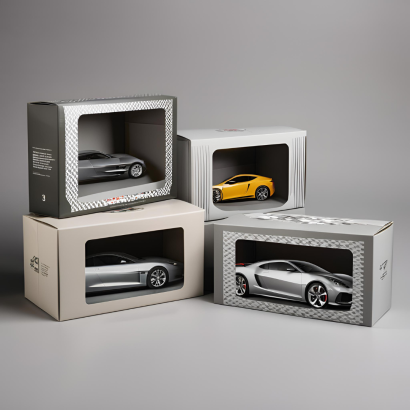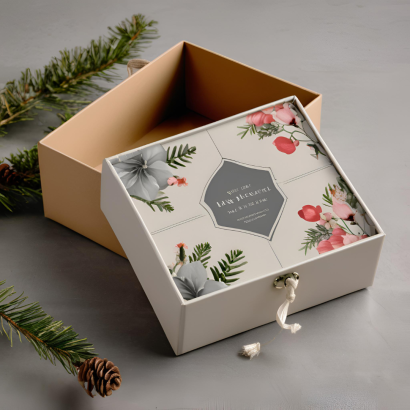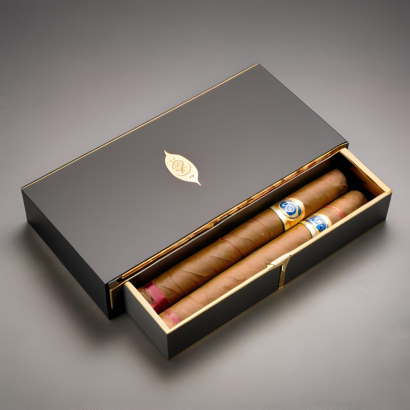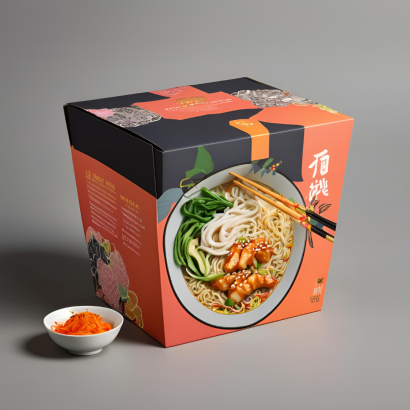

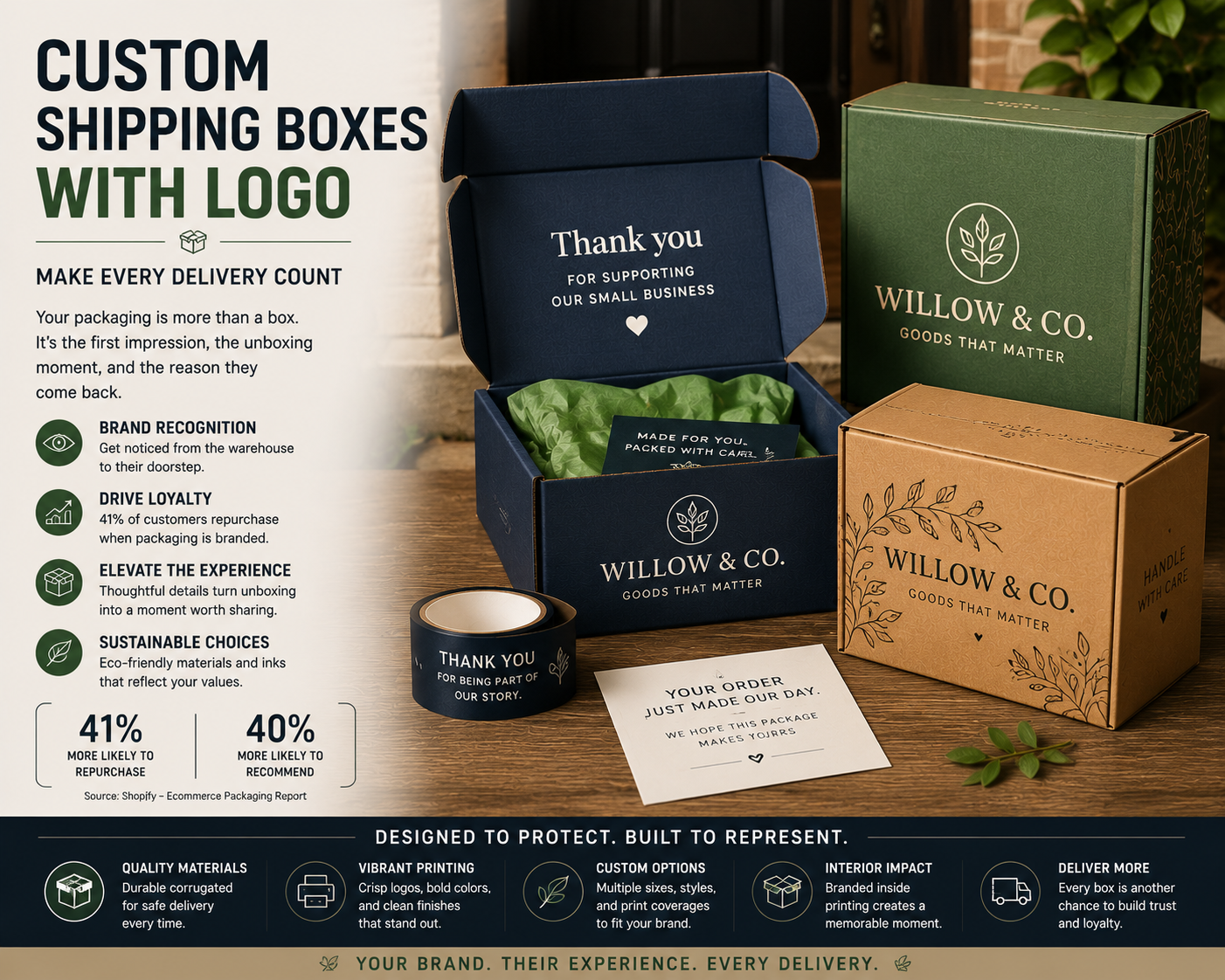
Your shipping box travels through a courier facility, rides in a van, sits on a doorstep, and often gets photographed before anyone reads your website. It passes through multiple pairs of hands and at least two public spaces before it reaches the person it was intended for.
That’s multiple brand impressions. Most brands treat them as zero.
According to Shopify’s ecommerce packaging research, 41% of consumers are more likely to repurchase from a brand when their order arrives in custom shipping boxes with logo. Another 40% are more likely to recommend the brand to someone else. The box isn’t just a container. It’s a retention and referral tool — and it costs almost nothing extra to activate.
The Math Most Brands Never Run on Custom Shipping Boxes With Logo
Here’s a number worth sitting with. You only need a 0.4% increase in sales to break even on custom shipping boxes with logo versus plain stock packaging.
That’s not a typo. Four tenths of one percent.
At 500 orders a month, that’s two additional sales. The premium per unit over plain boxes runs $0.30 to $1.50 depending on print coverage and volume. The revenue from two retained customers almost always exceeds the packaging cost premium for the entire month’s run.
Most brands never do this math. They see the per-unit cost increase and stop there. The calculation doesn’t work until you factor in what it costs to acquire a new customer versus retain an existing one.
I’ve watched brands agonise over a $0.60 per-unit packaging upgrade while spending $18 per click on paid search. The comparison doesn’t hold up.
What Makes a Custom Shipping Box With Logo Actually Work
A logo in the corner of a plain brown box is a label. Not a brand.
A properly branded custom shipping box with logo does something different. When someone can identify your company from across the room — from the color before they read the name — that’s brand recognition. That’s the thing you’re building.
Three decisions do most of the work:
Dominant color coverage. A logo in the corner of a plain brown box disappears. The same logo on a box where your brand color covers 60% or more of the exterior surface registers immediately. Color is what the eye catches first. The logo confirms it.
Logo scale. Too small and it’s invisible. Too large and it reads as desperate. The test: your logo should be legible from three feet away. Print a flat mockup at actual size, put it on a table, walk to the other side of the room. If you have to walk closer to read it, it’s too small.
One line of copy. Not a manifesto. One line. A thank-you on the inside flap. Your tagline on the exterior. One unexpected touch is the difference between a box that gets photographed and one that gets recycled.
Interior Print: The Decision Most Brands Skip
The exterior is what the doorstep sees. The interior is what the customer sees.
Research from Retently shows that 43% of DTC brands with interior printing report higher social media mentions compared to exterior-only print. It doesn’t have to be elaborate. A single color wash on the inside panels. A message on the inner flap. One line that speaks genuinely to the person opening it.
The unboxing moment is private. Personal. A brand that speaks to the customer in that moment builds the kind of memory that brings people back.
Research on how packaging drives repeat purchases confirms this consistently: the interior experience builds the emotional association. The exterior earns the first look. The interior earns the second order.
The Corrugated Printing Reality
Corrugated board is not coated paper. It’s porous, textured, and absorbs ink differently across the fluted structure.
Solid colors print well. A flat navy, a clean white, a consistent green — these translate reliably. What you design is close to what you get.
Gradients and fades don’t. Ink absorption variation causes gradients to band visibly. That smooth fade from teal to mint on screen becomes a striped effect in print. Avoid gradients on corrugated.
Fine lines and small type blur. Anything below 8pt body text or 0.5pt line weight risks bleeding. Script fonts that look elegant on your website will be unreadable on the box.
Colors shift. RGB on screen versus CMYK on corrugated means your brand colors will print differently. Request a physical proof before production. Skipping this is one of the most expensive packaging mistakes in the category — and impossible to fix after the full run.
Mailer Box vs. Corrugated Shipping Box: Which Format
Custom corrugated RSC boxes. Standard for most ecommerce. More surface area, more print canvas. Best for heavier products and anything needing compression protection. Larger panels give your design more room.
Custom mailer boxes. Smaller footprint, cleaner unboxing experience. The lid opening reveals the interior in a single motion. Popular for beauty, apparel, and subscription brands. Our custom mailer boxes guide covers the structural decision in detail.
For most brands shipping under 2–3 lbs, a mailer is the right structural choice. Heavier or fragile products need corrugated. Browse our full ecommerce packaging range for both formats.
Five Questions Before You Brief a Supplier
1. What print coverage do you want? Full print (all panels) costs more but makes the biggest impression. Partial print (top and one side) is a common cost compromise.
2. What’s your brand color in CMYK? Not RGB, not hex. CMYK is what printers use. Get your values from your designer before briefing anyone.
3. Do you want interior print? Decide before pricing the job — adding it after changes the spec entirely.
4. What’s your monthly volume? Under 500 units: digital printing. 500–2,000: digital or litho. Above 2,000: litho or flexo gives better per-unit economics.
5. Will you provide a physical proof before production? Non-negotiable. The only protection against color shifts and print quality issues before the full run is committed.
Pricing and MOQs vary by specification. Request a custom quote for accurate details.
FAQ
What’s the cheapest way to get custom shipping boxes with logo?
Single-color flexo printing on a standard RSC corrugated box. Simple design, high volume, one color. It won’t look premium but it will look intentional — a meaningful step up from a plain brown box with a sticker.
How many colors can I print on a corrugated shipping box?
Standard flexo handles 1–3 colors well. Digital printing handles full color at lower volumes but costs more per unit. Litho-laminate produces the highest quality full-color results at larger volumes. Choice depends on volume, budget, and design complexity.
Does box size affect print quality?
Yes. Larger boxes have more surface area — logos scale up and read more clearly. As box size decreases, simplify the design proportionally. Very small boxes with complex logos often result in unreadable print.
Do custom shipping boxes actually increase sales?
The data says yes. 41% of consumers are more likely to repurchase when orders arrive in branded packaging. 40% are more likely to recommend the brand. Break-even is approximately 0.4% sales increase — two extra orders at 500/month — at typical volume and per-unit premium.
Your shipping box is going places your ads never will. It’s in your customer’s building, on their street, in their photograph. The brands that treat it as a touchpoint get brand recognition, higher retention, and referrals at packaging rates. A logo in the corner is the floor. A box someone recognises before they read it is the ceiling. Everything between those two points is a design decision worth making on purpose.