
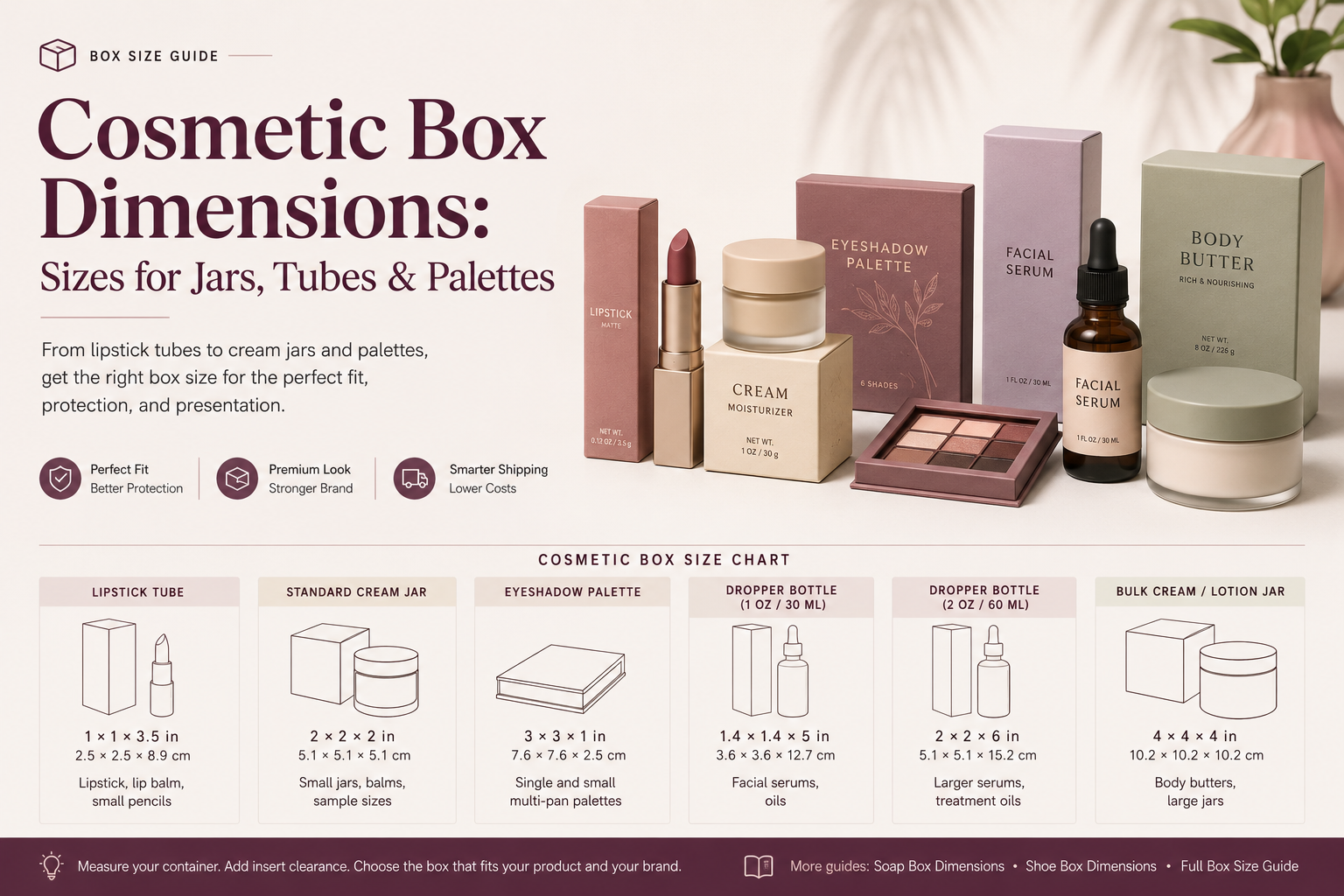
There’s no single set of cosmetic box dimensions, since “cosmetics” covers four completely different container shapes. A lipstick tube boxes at around 1 × 1 × 3.5 inches. A standard cream jar boxes at 2 × 2 × 2 inches. Palettes and dropper bottles need their own dimensions too. This guide charts all four container types. It also shows how to measure whichever one you’re packing. It’s part of our size guide series alongside our soap box dimensions and shoe box dimensions guides. For everything else, our full box size guide covers the rest.
Cosmetic Box Size Chart
| Container Type | Dimensions (L×W×H, inches) | Dimensions (cm) | Typical Use |
|---|---|---|---|
| Lipstick Tube | 1 × 1 × 3.5 in | 2.5 × 2.5 × 8.9 cm | Lipstick, lip balm, small pencils |
| Standard Cream Jar | 2 × 2 × 2 in | 5.1 × 5.1 × 5.1 cm | Small jars, balms, sample sizes |
| Eyeshadow Palette | 3 × 3 × 1 in | 7.6 × 7.6 × 2.5 cm | Single and small multi-pan palettes |
| Dropper Bottle (1 oz/30 ml) | 1.4 × 1.4 × 5 in | 3.6 × 3.6 × 12.7 cm | Facial serums, oils |
| Dropper Bottle (2 oz/60 ml) | 2 × 2 × 6 in | 5.1 × 5.1 × 15.2 cm | Larger serums, treatment oils |
| Bulk Cream/Lotion Jar | 4 × 4 × 4 in | 10.2 × 10.2 × 10.2 cm | Body butters, large jars |
Sources agree closely on lipstick and jar sizing. Dropper bottle boxes vary more by brand. Some run closer to 1.3 × 1.3 × 4.4 inches for a 1 oz bottle. Others run closer to 1.4 × 1.4 × 5. Both fit a standard 30 ml bottle. The gap comes down to how much insert padding a given brand builds in.
Why Cosmetic Box Dimensions Don’t Follow One Standard
Cosmetics aren’t one product category shaped like a single box. A tube, a jar, a compact, and a bottle each need a completely different footprint. None of them scale off each other, either. A serum brand that also sells a lip balm can’t reuse one box spec across both products. A bakery can scale one cake box formula up or down for different tiers. Cosmetics don’t work that way.
That’s a real difference from most categories in this cluster. It’s worth understanding why, per Wikipedia’s overview of cosmetics packaging. Shipping cartons and mailers scale fairly predictably by volume. Cosmetic packaging scales by container geometry instead. The container in your hand decides the box, not the ounce count on the label. A size chart alone can only get you in the right neighborhood. Measuring the actual piece is still the last step, every time.
How to Measure a Cosmetic Container for Its Box
Measure the container at its tallest and widest points, cap included. A twist-cap jar sits taller closed than open. That’s the dimension the box actually needs to clear. Add a quarter inch of clearance on width and depth for a snug rigid box. Add up to half an inch instead if the box includes a foam or cardboard insert.
Dropper bottles need extra care at the neck. The dropper assembly often sits higher than the bottle’s shoulder. Measure from the base to the top of the dropper bulb, not just the glass. Skip that step, and the lid won’t close over the finished product.
Palettes bring their own quirk: the hinge. A closed compact measures thinner than an open one. The hinge itself still adds a sliver of extra width, though, and most people forget to account for it. Measure the palette fully closed and latched, then add a small margin at the hinge side specifically. A box that fits the flat body but pinches at the hinge will crack the plastic after a few opens.
Rigid Box vs. Folding Carton: A Real Trade-off
A rigid, two-piece box with a magnetic close feels different in the hand than a folding carton does. That difference sells product before a customer reads a single word on the label. The snap of a magnetic lid signals a premium price point on its own. So does the heft of thick rigid board against the palm.
Folding cartons cost less to produce. They also ship flat until assembly, which matters at real volume. I’d reach for rigid packaging on a hero product or a gift set. I’d save folding cartons for everyday SKUs, where margin matters more than the unboxing moment itself. Running both product tiers through the same box spec usually means overpaying on one end, or under-delivering on the other. Neither mistake shows up on a spec sheet. Both show up in returns and repeat-purchase numbers a quarter later.
Custom Cosmetic Box Sizes
The chart above covers common tube, jar, palette, and bottle shapes. Multi-pan palettes, dual-chamber jars, and pump bottles all fall outside it. Each one adds its own quirks to the footprint. Travel-size and tester SKUs cause the most sizing headaches in practice. That’s because they’re often a scaled-down container, not a proportional shrink of the full-size version. A quarter-size jar doesn’t need a quarter-size box. It needs its own measurement, taken from the actual tester in hand.
Easy Box Packaging builds cosmetic boxes to the container’s exact dimensions, insert included where needed. Skincare and treatment products bring their own structural needs, mostly around glass bottles and droppers. Our healthcare and beauty packaging line handles that side of the business specifically.
Frequently Asked Questions
What size box fits a standard lipstick tube? Most lipstick tubes fit a box around 1 × 1 × 3.5 inches. Larger lipstick or lip balm tubes may need up to 1.5 × 1.5 × 4.5 inches. Measure the capped tube first, since brands vary.
Do dropper bottles need a box with an insert? Most do. Glass dropper bottles ship better with a foam or cardboard insert. That insert adds roughly a half inch of clearance to the box on every side, compared with a bare-bottle fit. Skipping the insert to save on box size is a common shortcut. It’s also usually the reason a glass bottle arrives cracked at the doorstep.
The Bottom Line
Cosmetic box dimensions depend on which container you’re packing, not one single standard chart. Measure the capped or closed container. Add clearance for any insert, and choose rigid or folding based on how the product needs to sell on shelf. Get a quote and get a cosmetic box sized to your actual container.