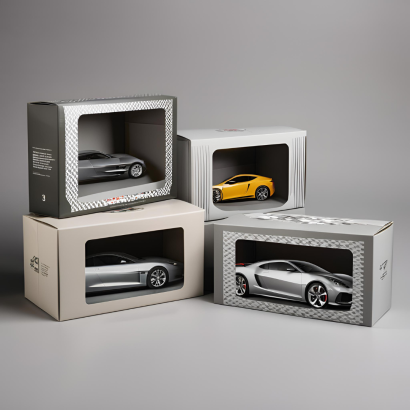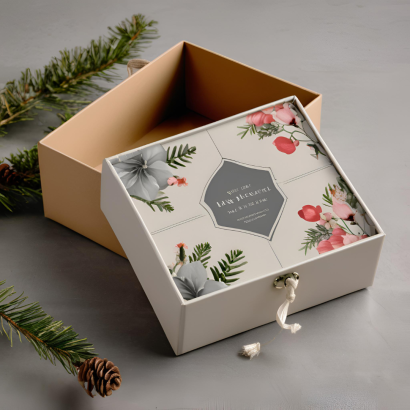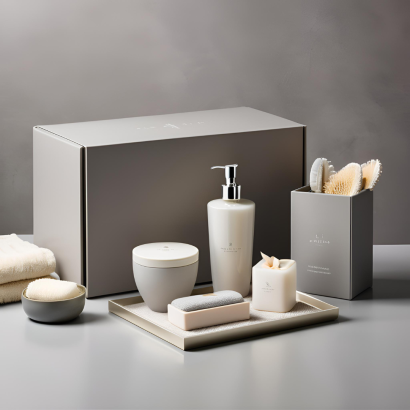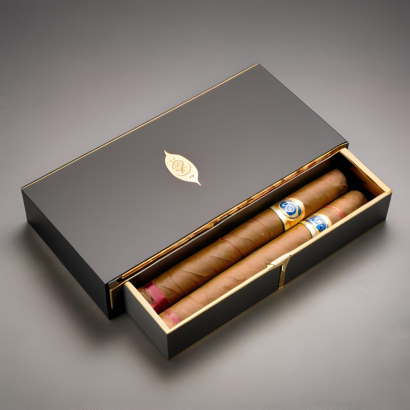

I’ve opened a lot of ecommerce packages. What’s inside the box is usually fine. But the insert — the card, the sticker, the sample, or whatever the brand decided to add — that’s where almost every brand gets it wrong.
Not because inserts don’t work. They do. It’s because most brands treat inserts like an afterthought. They stuff in a generic “thank you for your order” card that looks like it came off a template printer, and then they wonder why customers don’t engage with it. The customer doesn’t engage with it because it reads as filler — and filler gets thrown away.
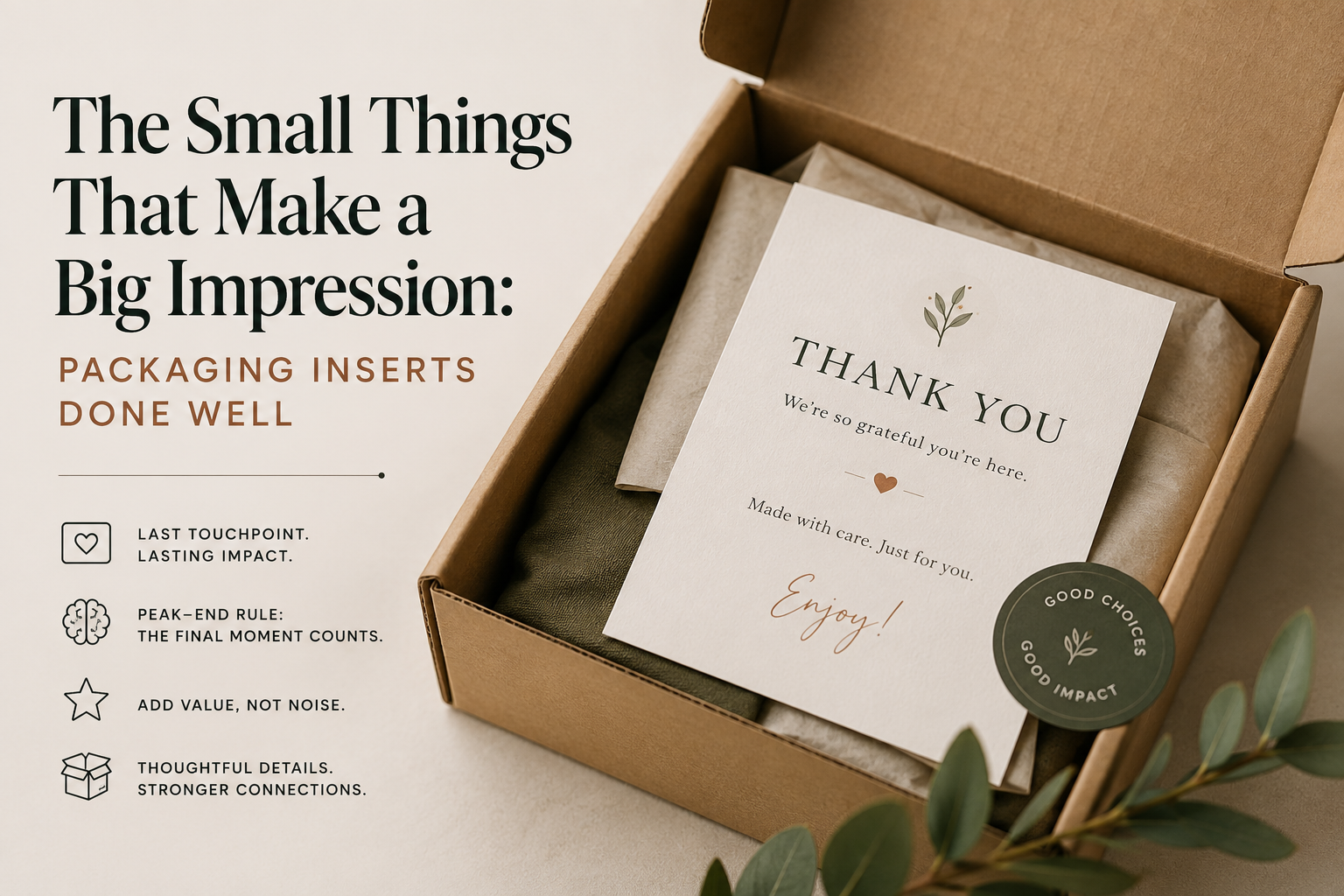
The brands that actually use packaging inserts for ecommerce well understand something most don’t: the insert is the last thing the customer experiences during unboxing. Behavioral economist Daniel Kahneman’s research on memory showed that we remember experiences primarily by their peak moment and their final moment. The insert IS the final moment. Most brands waste it.
Why Most Inserts Fail Before the Customer Reads Them
Walk into any DTC brand’s fulfillment operation and you’ll see the same thing: five different cards sitting in a pile next to the packing station. A thank you card. A discount code card. A referral card. A “follow us on Instagram” card. A care instructions card. All five go into every order.
The intent is good. The result is that it looks like a packet of junk mail. When a customer opens a box and finds a stack of promotional cards, they don’t read each one thoughtfully — they scan the pile, register “marketing stuff,” and discard it. Every individual card becomes less effective because it’s surrounded by other cards competing for the same attention.
This is the insert paradox: the more inserts you add, the less each one does. One well-made insert, given space to breathe, does more than five mediocre ones fighting each other.
The brands that get the most out of inserts pick one and do it right. That’s the starting point — not which five types to use, but which single insert is the right one for your brand and your customer right now.
The Insert Types That Actually Work (and the Ones That Don’t)
Thank you cards: the highest ceiling, the widest range. A thank you card done well is the best insert in ecommerce. A thank you card done poorly is a waste of paper. The difference is personalization — not expensive personalization, just the customer’s name and a message that feels specific rather than generic. Printing “Thank you, Sarah — your first order is the beginning of something good” converts better than “Thank you for your purchase.” The cost difference is zero. The response difference is real.
What kills thank you cards: the corporate tone. “We appreciate your business” is how a bank talks. You’re not a bank. If your brand has a voice — warm, witty, direct — the thank you card is where that voice should be loudest. A thank you card that sounds like the person who built the brand wrote it personally gets saved. One that sounds like a form letter gets binned.
Discount cards: work only when the offer is strong enough. A 5% discount insert does nothing. A 10% discount insert does almost nothing. A 20% off your next order insert with a clear expiry date creates urgency and actually gets redeemed. The threshold for a discount code to drive behavior is higher than most brands assume. If you’re going to print discount codes on inserts, make the offer meaningful — or don’t bother with this insert type at all.
The specific mistake I see constantly: brands print a discount code that expires in 90 days with no urgency messaging. Customers pocket the card meaning to use it, forget it exists, and the offer expires. Print the expiry date prominently. “Use by August 31 — or lose it.” That phrasing increases redemption significantly.
Referral cards: only with two-sided incentives. Referral inserts that benefit only the person making the referral have near-zero conversion. The customer has no reason to give a card to someone else unless that someone else also gets something valuable. Two-sided referral programs — where both the referrer and the new customer get a benefit — work. One-sided ones don’t, and the card just goes in the bin.
Product samples: excellent ROI for the right categories. Skincare, food, coffee, supplements, personal care — product samples inside ecommerce orders have strong data behind them. About 73% of consumers who receive a sample try it, according to industry surveys on sampling programs. For brands with complementary SKUs, including a sample of a product the customer hasn’t tried is one of the cleanest insert strategies available. The cost is the sample itself, but the conversion rate on sampled products typically justifies it at scale.
This connects directly to how packaging drives repeat purchase behavior — the sample is a physical nudge toward the next order, not a piece of paper asking for it.
Stickers: underrated, high keep rate. A well-designed branded sticker has a better keep rate than almost any other insert type. People don’t throw away stickers — they stick them on laptops, water bottles, phone cases, notebooks. Every sticker that gets placed somewhere is a micro piece of brand awareness. Among Gen Z and millennial customers especially, a sticker with actual design quality (not a logo slapped on a white circle) becomes something the customer actively wants to use.
The cost is minimal — a 3-inch custom sticker runs $0.05–0.10 per unit at 1,000 units. If 30% of recipients place the sticker somewhere visible, the brand impression value per dollar is extraordinary compared to almost any other marketing spend.
Care instruction cards: functional doubles as brand touchpoint. For products that require care — leather goods, silk garments, skincare tools, plants, ceramics — a care card is both useful and an opportunity. Useful because it reduces “I ruined it” customer service contacts. Brand opportunity because a card with clear care instructions in your brand voice reinforces the quality signal of the product. When a care card is well-written and well-designed, customers keep it. When it’s a generic printed sheet, it goes with the packaging.
The One-Insert Rule in Practice
If you’re just starting out with packaging inserts, the answer is almost always a high-quality thank you card. Not a postcard-size card with a stock photo. A simple, well-designed card with your brand colors, a message that sounds like a human wrote it, and the customer’s name if you can personalize it.
At 1,000+ units, a printed thank you card costs $0.08–0.15 per card. Add personalized printing (variable data printing that inserts the customer’s name) and you’re looking at $0.12–0.20. That’s under $0.20 per order to dramatically improve the end of the unboxing experience — the moment Kahneman’s research says matters most for how the experience is remembered.
For brands that have been running inserts for a while and want to level up: pair the thank you card with a single sticker. Two items, but one is tactile and one is a message — they don’t compete the same way five cards compete. That combination is where I’ve seen the strongest customer response for mid-size DTC brands.
What Brands Get Wrong About Insert Design
The insert design mistakes that make inserts feel cheap:
Wrong size. A thank you card that’s the same size as a business card looks like an afterthought. Cards that are 4×6 or A6 (4.1×5.8 inches) have enough surface area to communicate something real. Anything smaller reads as filler.
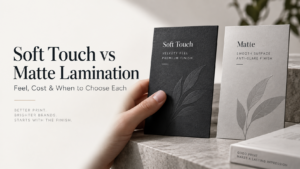
Wrong paper stock. Thin paper signals low value. If your product costs $40, your thank you card should not feel like it came off a home printer. 16pt card stock with a matte or soft-touch finish is not expensive at volume — it costs maybe $0.02 more per card — and it completely changes how the insert feels in hand.
Wrong message hierarchy. The most important thing on the card — the thank you, the offer, the message — should be the first thing the eye lands on. Many insert designs bury the relevant content under logos and brand marks. The customer should be able to read the key message in two seconds without hunting for it.
Generic copy. “Thank you for your order! We’re so grateful for your support!” Nobody has ever read that and felt anything. Write something specific — specific to your brand, to what you sell, to why your customer chose you. If you sell specialty coffee, a thank you card that references the notes in the particular roast the customer ordered is memorable. If you sell pet supplies, a card that says “Your dog is going to lose their mind” is more human than “Thank you for shopping with us.”
These are the same kinds of packaging mistakes that damage the unboxing experience at a structural level — the insert is just the final expression of the same problem.
How Inserts Fit Into Your Packaging System
Inserts work best when they match the overall packaging experience. If your custom mailer box is high quality — good print, clean construction, a brand experience that starts before the product is even visible — a well-made insert lands as the natural conclusion to that experience. If the mailer box is generic and the product isn’t wrapped, the insert is doing all the work alone, and it can’t carry that weight.
Think of the unboxing sequence: the outer box → opening experience → product presentation → the insert. Each layer should feel intentional. The insert is the last impression, not the only impression.
For brands still figuring out their packaging setup, the investment order typically should be: first the outer box, then tissue or wrapping, then the insert. An expensive insert in a generic box is like wearing a good suit with no shoes — the overall impression is still off.
FAQ: Packaging Inserts for Ecommerce
What is a packaging insert?
A packaging insert is any item placed inside a shipping box or mailer alongside the product — thank you cards, discount codes, product samples, stickers, care instructions, referral cards, or branded tissue paper. They’re used to extend the unboxing experience, drive repeat purchases, and create brand memory after delivery.
Do packaging inserts actually drive repeat purchases?
Yes, when done well. The mechanism is the reciprocity principle — an unexpected small gift or personal message creates a positive emotional response that makes customers more likely to return. Generic marketing inserts don’t trigger this. Personalized, specific inserts do.
How much do packaging inserts cost?
Printed thank you cards: $0.08–0.20 per unit at 1,000+ units. Custom stickers: $0.05–0.10 per unit. Product samples vary by product cost. Total insert cost for a well-executed single-insert approach typically runs under $0.30 per order at scale — among the cheapest per-unit marketing investments available to ecommerce brands.
Should I include multiple inserts or just one?
Start with one. Multiple inserts dilute each other’s impact and signal “marketing materials” to the customer, which triggers the instinct to discard. One high-quality, purposeful insert gets more engagement than five generic ones. If you add a second insert later, make sure the two items complement each other — a message card and a sticker work together; a thank you card and a discount card and a referral card and a care card all compete.
What’s the best packaging insert for getting more reviews?
A personalized thank you card with a direct, low-friction ask for a review. The key: the card should include a specific URL or QR code that takes the customer directly to the review page — not to your homepage where they have to navigate. The further the customer has to travel to leave a review, the lower the conversion. One scan, one tap, review page: that’s the sequence that works.
Can I use inserts to promote other products?
Yes, but make the promotion feel relevant rather than opportunistic. A beauty brand promoting a complementary product with a sample works because it’s genuinely useful. A brand promoting an unrelated product with a flyer feels like spam. The insert should feel like a gift or a service, not an ad.
How do I personalize inserts at scale?
Variable data printing (VDP) allows print runs where each card includes a personalized name, order-specific details, or unique discount codes. Most commercial print suppliers offer VDP at minimal additional cost above standard printing at 500+ unit runs. Your fulfillment software exports the variable fields; the printer maps them to the template. At 1,000 orders per month, this is operationally straightforward.
The Insert Is a Decision, Not an Afterthought
The best inserts I’ve seen aren’t impressive because they’re expensive. They’re impressive because someone made a deliberate decision — what do we want the customer to feel when they pick this up? What do we want them to do? What does this card say about who we are as a brand?
Most brands never ask those questions. They order thank you cards because everyone orders thank you cards, pick a template, print a batch, and move on. The customer feels nothing because nothing was put into it.
Pick one insert type. Think about what it should accomplish. Write the copy like a person, not a marketing team. Print it on paper that doesn’t feel cheap. Put it in every box.
Easy Box Packaging works with DTC brands on packaging systems that make every element — the box, the finish, the insert — feel like it was designed together. See our ecommerce packaging options to see what a complete packaging setup looks like for brands at different volume stages.
If you’re not sure where inserts fit in your total packaging budget, our custom packaging budget guide breaks down how to allocate across box, finish, insert, and shipping at different order volumes.