
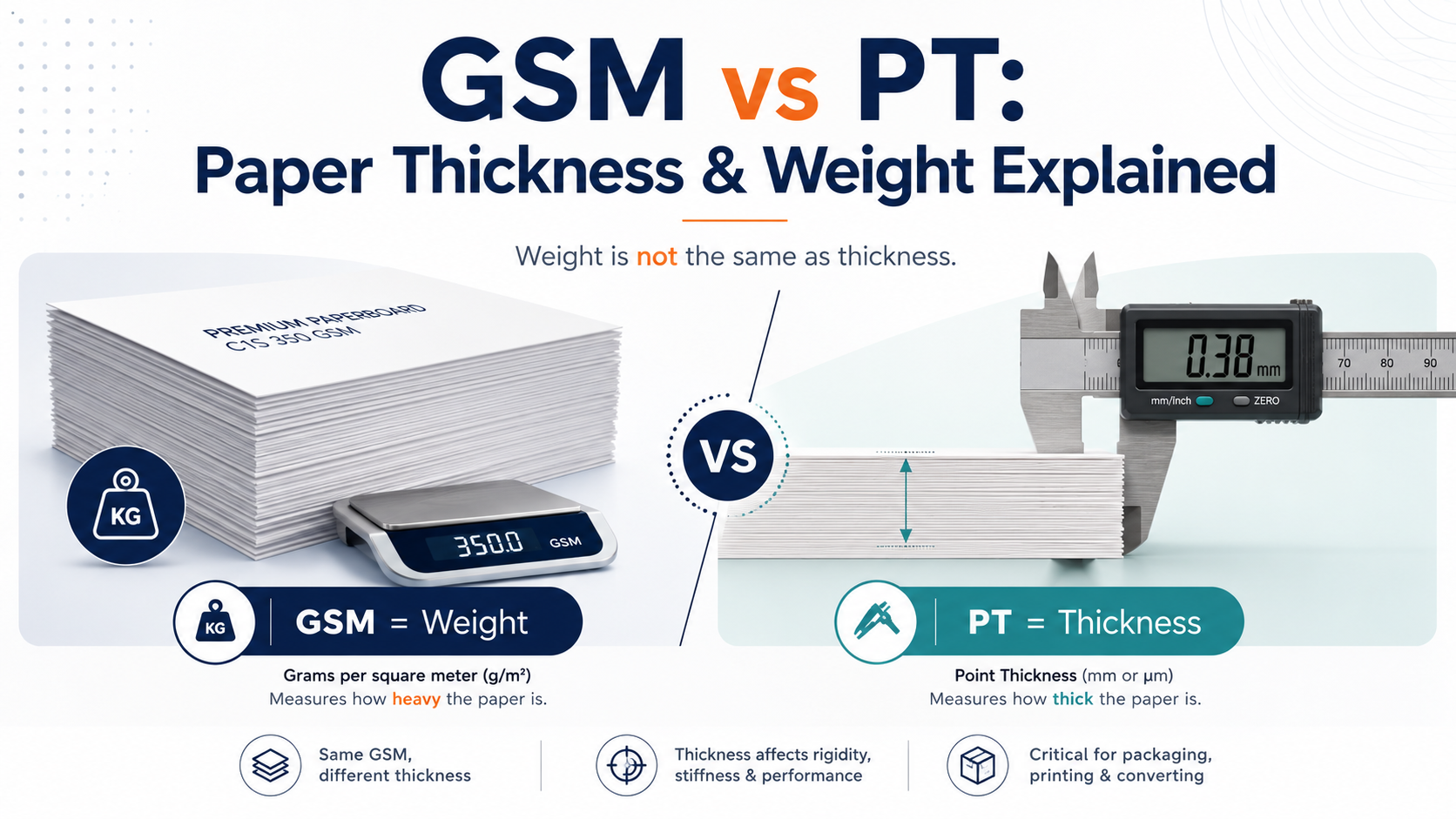
GSM and PT measure two different things. GSM stands for grams per square meter. It tells you how much a sheet of paper weighs. PT stands for points, a measure of physical thickness. One point equals 0.001 inch. The two are related, but they’re not interchangeable. A common shortcut divides GSM by roughly 25 to estimate PT. That shortcut is only an approximation. It can mislead you when comparing paper from different mills.
Here’s why that matters for a box order. Two paperboards can share the same GSM. They can still feel different in your hand.
What GSM Actually Measures
GSM measures weight, not thickness. It’s defined by ISO 536, the international standard for paper grammage. A single square meter of the paper gets weighed, in grams. That number becomes the GSM rating.
Higher GSM generally means a heavier, sturdier sheet. But weight alone doesn’t tell you how thick that sheet actually is. Two sheets can weigh the same. They can still have different calipers, depending on how the fibers are packed together.
GSM is the number you’ll see most often on paper spec sheets and mill data. It’s the standard unit across most of the world outside the US. That’s one reason it shows up so often on imported stock. It’s useful for comparing weight and, loosely, sturdiness. It’s less useful on its own for predicting exact thickness.
Most mills also list GSM alongside a description of the paper type, like coated, uncoated, or recycled content. That context matters. A coated sheet and an uncoated sheet at the same GSM can behave differently on press. That’s true even before you get to thickness.
Recycled content can shift GSM behavior too. Recycled fiber sometimes needs a slightly higher GSM to match virgin fiber’s stiffness at a lower weight. Sustainability and stiffness both matter on plenty of projects. If that’s your situation, ask your printer how recycled stock compares to virgin stock at the same GSM.
What PT Actually Measures
PT measures thickness directly. It’s a caliper reading, taken with a micrometer, expressed in thousandths of an inch. A 14pt board measures 0.014 inch thick. A 16pt board measures 0.016 inch.
PT shows up most often in the US paperboard and packaging world. You’ll see it most on folding cartons, business cards, and rigid box board. It tells you exactly how thick the material is, regardless of what it weighs.
A caliper micrometer measures PT directly. It clamps down on the sheet and reads the gap in thousandths of an inch. It’s a physical measurement, not a calculated estimate. That’s part of why PT feels more concrete to people who work with the material every day. You can hold two swatches and feel the difference yourself. The PT numbers on each will usually confirm what your hand already told you.
Neither measurement is “better.” They answer different questions. GSM answers “how much does this weigh?” PT answers “how thick is this, physically?”
Knowing both matters most in one specific moment. That moment is switching printers. One printer’s spec sheet might list GSM. Another might quote everything in PT. Knowing both lets you compare apples to apples instead of guessing.
Why the Conversion Isn’t Exact
The rough conversion most guides use divides GSM by about 25 to get PT. That’s a fine starting estimate. It comes from a typical paper density that isn’t universal across every mill.
Paper density, sometimes called bulk, is the missing variable. Bulk describes how densely the fibers are pressed into the sheet. A low-bulk paper packs fibers tightly, so it’s thinner for its weight. A high-bulk paper packs fibers more loosely, so it’s thicker for the same weight.
That means two boards at the same GSM can measure different PT. A dense 300gsm sheet might come in around 12pt. A fluffier 300gsm sheet from a different mill might measure closer to 14pt. Same weight on paper, different feel in your hand.
I’ve seen a brand assume their reorder would feel identical, since the GSM matched the original order. It didn’t. The reorder used board from a different mill, at a slightly different bulk. The finished boxes felt noticeably thinner in hand. The GSM number matched on the spec sheet. The paper itself didn’t feel the same.
If a specific hand-feel matters to your brand, ask for a physical swatch before committing. You can compare thickness by hand yourself. No special equipment is needed for a rough comparison. Easy Box Packaging can match GSM and PT specs across reorders. We can also recommend an equivalent when a mill’s stock changes.
GSM vs PT: Quick Reference
| GSM (approx.) | PT (approx.) | Typical Use |
|---|---|---|
| 150–200 gsm | 6–8 pt | Lightweight inserts, tags |
| 250–300 gsm | 10–12 pt | Standard folding cartons |
| 300–350 gsm | 12–14 pt | Premium folding cartons, mailers |
| 350–450 gsm | 14–18 pt | Rigid boxes, premium retail packaging |
These ranges are approximate. Always confirm exact caliper with your printer. This matters most for a mailer or rigid box order, where hand-feel is part of the brand experience.
Common Mistakes When Comparing GSM and PT
The first mistake is treating the GSM-to-PT ratio as fixed. It’s an estimate, not a formula. Different paper stocks convert differently, sometimes by a full point or more.
The second mistake is one of the quieter packaging mistakes that kill the unboxing moment. That’s choosing a spec by number alone, without ever holding a physical sample. A box that looks fine on a spec sheet can feel flimsy in someone’s hands.
The third mistake is comparing GSM figures across paperboard and corrugated material, without adjusting expectations. Corrugated structure adds rigidity that a solid folding-carton board of the same GSM won’t have. GSM tells you about the paper itself. It doesn’t account for flute structure or the air gap that gives corrugated its strength.
The fourth mistake is assuming a heavier GSM always means a better box. A well-chosen 300gsm board with the right coating can outperform a poorly chosen 350gsm board. That depends on the product. Weight isn’t the only variable that matters here.
A fifth, smaller mistake is forgetting that specs can shift slightly between print runs. This happens even from the same mill. Paper is a natural material. Small variance is normal. Ask your printer what tolerance they consider acceptable before a large order.
A sixth mistake shows up when comparing overseas mills against US converters. Brands sometimes skip translating units first. A mill quote in GSM and a converter quote in PT can look wildly different at a glance. The actual boards might be nearly identical. Convert one to the other before you compare prices, not after.
Which Should You Choose?
Shipping lightweight inserts or hang tags? Look toward the 150–200 gsm range. Building a standard folding carton for a retail product? 250–300 gsm covers most needs.
Want a sturdier feel for a custom mailer boxes style order, or a premium folding carton? Move up to 300–350 gsm. Building a rigid box, or want a premium in-hand feel? Look at 350gsm and up, in the 14–18pt range.
Not sure which spec fits your product? Request a few physical swatches at different weights before locking in a design. Getting this right the first time matters. Consistent box feel is part of what turns a first order into a repeat one. Customers do notice when a familiar box suddenly feels different.
Using cardboard boxes or another corrugated build? Remember flute type affects rigidity more than GSM alone. Confirm both specs with your printer together, not separately. That way nothing gets lost between the paper order and the structural design.
GSM vs PT: FAQ
What does GSM mean in packaging? GSM stands for grams per square meter. It measures how much a sheet of paper or board weighs per square meter of area.
What does PT mean in paperboard? PT stands for points. One point equals 0.001 inch of physical thickness, measured with a micrometer.
How do you convert GSM to PT? A rough estimate divides GSM by about 25. It’s an approximation. Actual thickness depends on paper density, not weight alone.
Is higher GSM always thicker? Not necessarily. Two boards at the same GSM can have different thickness. It depends on how densely the fibers are packed.
What GSM is a standard folding carton? Most standard folding cartons fall in the 250–300 gsm range. Exact specs still vary by product and printer.
Does GSM or PT matter more for a custom box quote? Neither one matters more on its own. Quote requests usually need both. That means GSM or PT for the paper spec, plus structural details like flute type or fold style. Give a printer both numbers up front. Include your target use case too. That combination gets you a faster, more accurate quote.
Get a free quote — dieline and design support included.