
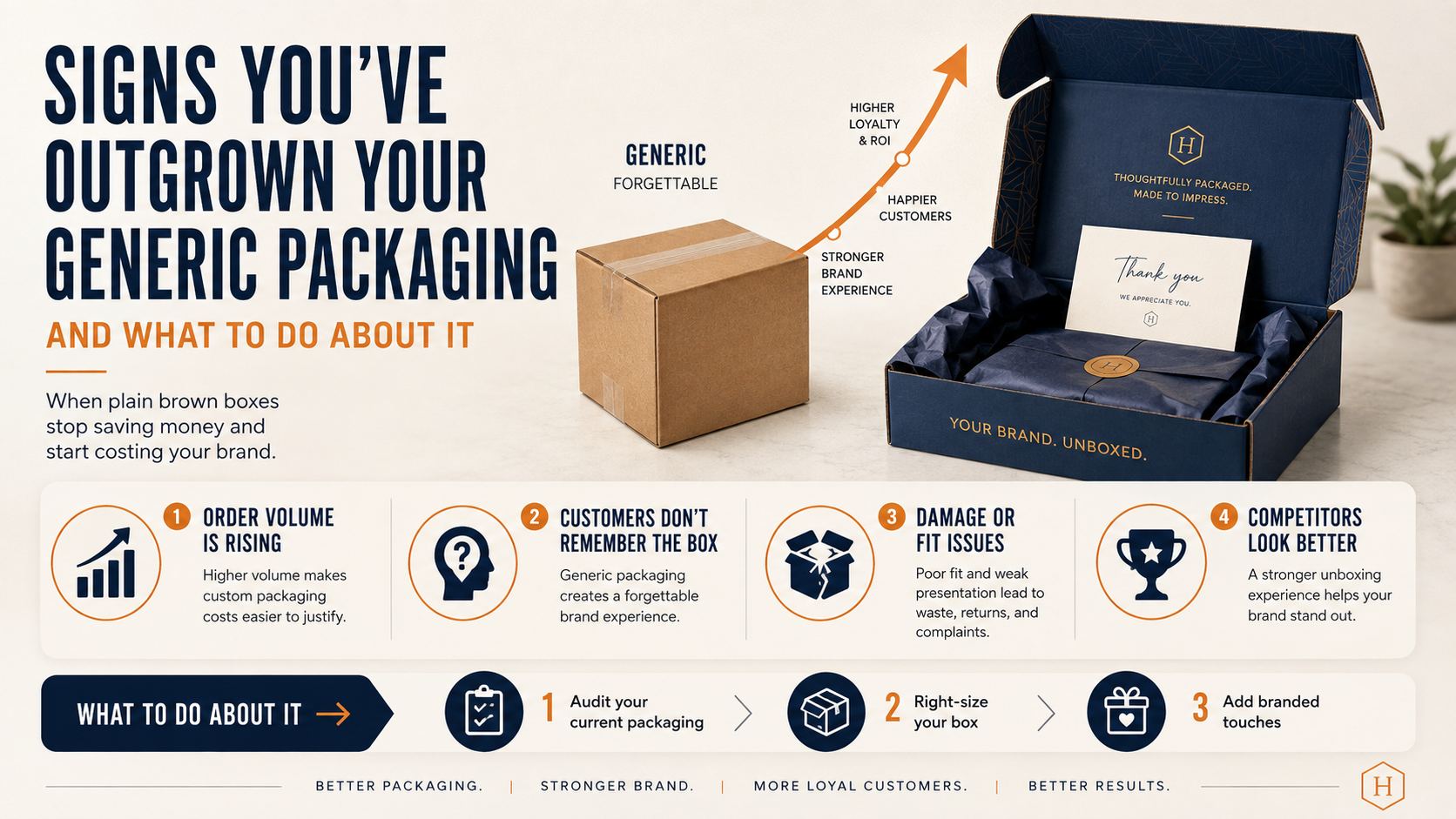
Most brands don’t decide to upgrade to custom boxes. They drift into it — one too many customer comments about the box, a competitor’s package that stops them mid-scroll, a damage claim that shouldn’t have happened. The signs that it’s time are usually there for months before anyone acts on them. Here are the ones that matter, and what to actually do when you’re ready to move.
Generic packaging isn’t always wrong. A brand doing 30 orders a month, still testing product-market fit, shipping a $14 item — the math on custom packaging doesn’t work yet. But at a certain point, the generic box stops being a cost-saving decision and starts being a brand tax. Every shipment that goes out in a plain brown box is a customer interaction with no brand identity attached to it.
The question isn’t whether custom packaging is better. It usually is. The question is whether you’ve crossed the point where the return on the investment is real — and whether the signs in your current operation are telling you something you should listen to.
The Order Volume Crossover Point
The clearest signal that it’s time to upgrade to custom boxes is a math problem, not a brand problem. At low volumes, the per-unit cost premium for custom packaging over generic is hard to absorb. At higher volumes, it closes fast.
Here’s what that looks like in practice. A generic poly mailer at 100 units costs roughly $0.15–$0.25 per unit. A custom-printed mailer box at 100 units might cost $2.50–$4.00 per unit — a real gap. At 500 units, the custom mailer drops to $1.20–$1.80 per unit. The generic alternative doesn’t move much. At 1,000 units, custom corrugated with digital print runs $0.85–$1.20. The gap is now $0.60–$0.90 per unit.
For a brand doing 300 orders per month at a $55 average order value, a $0.80 per unit premium works out to $240 per month. If that packaging generates even a 3% repeat purchase lift — three additional orders per 100 customers — you’ve covered the premium and then some. The detailed breakdown of what to spend on packaging at different revenue stages runs through this math at specific volume thresholds.
The rough threshold where custom packaging makes financial sense for most ecommerce brands: 150–200 orders per month with an AOV above $30. Below that, the per-unit premium is real and the repeat purchase sample size is too small to measure. Above it, the ROI case tends to work.
Signs to Upgrade to Custom Boxes: The Brand Tells
Some of the clearest signs aren’t in your financials — they’re in what you’re already doing by hand.
You’re adding things manually to compensate. If you’re wrapping every order in tissue paper you buy from a craft store, hand-stamping boxes with your logo, tucking in a printed card you designed yourself, or applying custom stickers to the outside of a plain box — you’ve already made the decision that the generic packaging isn’t enough. You’re just executing it manually at scale, which is labor-intensive and inconsistent. That manual process is a sign. You’ve crossed the threshold where you care about the customer experience enough to spend time on it. The question is whether it makes more sense to build it into the box itself.
Your price point has moved but your box hasn’t. A $12 item in a plain poly mailer is fine. A $75 item in the same plain poly mailer is a mismatch. I’ve watched brands steadily raise prices as their product got better — better ingredients, better materials, better design — without ever adjusting the packaging to match. The customer pays more, opens the same generic envelope, and has a moment of cognitive dissonance. The price said premium. The packaging said generic. These two things are in tension, and the packaging usually loses the argument when it comes to whether the customer feels their money was well spent.
Your competitors look better than you in the box. This one is uncomfortable to acknowledge, but it’s one of the most reliable signs. If you’ve ordered from a competitor — or seen their unboxing content on social media — and their packaging made yours look like an afterthought, that’s data. Customers are making the same comparison. The brands that invest in packaging create a visual contrast that works against the ones that don’t, especially in categories where customers shop around.
The Shipping Quality Warning Signs
Some signs that it’s time to upgrade show up not in the brand experience, but in what’s going wrong in transit.
Your damage rate is stubbornly consistent. Every ecommerce brand has some damage-related returns. If yours has stayed flat for 6+ months despite switching carriers, adjusting fulfillment processes, or adding void fill — the problem is probably the box itself, not the carrier or the process. A generic corrugated box that’s not sized for your product, sealed with standard tape, and not rated for your product weight is going to produce a predictable rate of transit damage regardless of how carefully it’s packed. The packaging mistakes that generate the most returns are almost always structural — wrong size, wrong board weight, wrong closure type — and they don’t fix themselves by packing better. They fix when the box is right for the product.
Your box doesn’t fit your product. Generic boxes come in standard sizes. Your product doesn’t. If your team is regularly making decisions about how to fill void space, which direction to orient the product, or how many packing peanuts it takes to stop something from shifting — the box is the wrong size. Custom packaging is sized for your product. The product fits. The void fill need drops. The damage rate drops with it. This is a more common situation than brands realize: they ordered generic boxes that were “close enough,” and they’ve been compensating with packing materials ever since.
When the Upgrade to Custom Boxes Becomes Obvious to the Customer
Two signs show up on the customer side, and they’re harder to see from the inside of your business.
Customers can’t identify your brand after delivery. This one is subtle. A customer orders from you, receives the package, opens it, uses the product. Forty-five days later, they’re ready to reorder — and they Google the product instead of going straight back to your site, because they can’t remember the brand name. The generic box left nothing behind. No logo, no brand colors, no sensory association. They remember what they bought. They don’t remember who they bought it from. Custom packaging solves this by attaching a brand identity to the physical moment of receiving the product. Understanding how packaging drives repeat purchases makes clear how often this specific failure — brand amnesia — is the gap between a one-time buyer and a returning customer.
You’re not getting tagged in unboxing content. Unboxing posts happen organically when a package gives a customer something worth filming. A plain brown box with a packing slip gives them nothing. If you’re in a category where unboxing content exists — beauty, food and beverage, fashion, lifestyle, gifts — and you’re not appearing in any of it, the packaging is why. The custom mailer box generates unboxing content more reliably than any other shipping format because self-locking construction creates a physical reveal moment. Customers film what’s interesting to watch. A plain box opening is not interesting to watch.
What the Switch Actually Looks Like
Most brands put off the upgrade because they assume it’s more complicated or expensive than it is. Here’s what it actually involves.
First run options are smaller than you think. Digital printing on corrugated starts at 50–100 units at most suppliers, with no plate setup costs. A brand doing 150 orders per month can test a custom mailer box with a one-month inventory commitment. If it doesn’t work — wrong size, wrong design direction, wrong format — the exposure is minimal. The days of needing a 3,000-unit minimum to see a custom box are largely over at the digital printing level.
The timeline is 3–5 weeks for domestic digital. Structural dieline, artwork approval, production, shipping. Three to five weeks from confirmed spec to boxes at your fulfillment location for a standard domestic digital run. This is not a six-month project. Most brands that delay the upgrade are operating on an outdated mental model of how long custom packaging takes.
The cost delta at scale is smaller than it looks at low volume. The per-unit premium that makes custom packaging feel expensive at 100 units — $1.50–$2.00 more per box — compresses significantly at 500–1,000 units. At those volumes, you’re often looking at $0.40–$0.80 more per unit over a comparable generic alternative. On a $55 order, that’s less than 2% of revenue. The phase guide for small brand packaging decisions breaks down exactly what to spend at each volume level so the budget decision is concrete rather than abstract.
Start with one box. The most common mistake in the upgrade process is trying to overhaul everything at once — new mailer, new tissue, new insert card, new tape, new label design. Pick the highest-volume SKU. Get one custom mailer box right for that product. Run it for 90 days. Measure repeat purchase rate and damage claims. Then expand from there. The goal of the first custom box run is to prove the model in your specific business, not to achieve a complete brand packaging system on the first order.
FAQ: Signs It’s Time to Upgrade to Custom Boxes
How do I know if I’m ordering enough to make custom boxes worth it?
150–200 orders per month with an AOV above $30 is the rough starting threshold where custom packaging begins to make financial sense for most ecommerce brands. Below that, per-unit costs are hard to absorb. Above it, the repeat purchase lift and brand value tend to justify the premium. Run the math on your specific CAC, AOV, and repeat purchase rate to get a number that’s real for your business.
Is a consistent damage rate really a packaging problem?
Often yes. If your damage rate hasn’t improved despite changes to packing process or carriers, the box itself is usually the issue. The most common causes: box too large for the product (too much void fill movement in transit), board weight too light for product weight, or tape closures failing in temperature extremes. All of these fix at the packaging spec level, not the fulfillment process level.
What’s the minimum order for a first custom box run?
With digital printing, 50–100 units is achievable with most suppliers at no plate setup costs. That’s enough for a one-month test at moderate order volumes. Offset printing becomes economical at 500–1,000+ units when per-unit cost is the priority. Start with digital to test the format and design before committing to a larger offset run.
Do I need a designer to upgrade to custom boxes?
Not necessarily. Many suppliers offer templates and browser-based design tools that let you upload a logo and set brand colors without professional design software. For more complex artwork — full surface print, custom illustrations, specific Pantone colors — a designer or pre-press file in Adobe Illustrator is the right approach. The spec requirement is a vector file (.AI or .EPS) built on the supplier’s dieline. Simple designs can be handled without a professional designer; complex ones benefit from one.
Should I upgrade all my packaging at once?
No. Start with the highest-volume SKU and one box format. Get that right first. Measure the results at 90 days. Then expand. Trying to overhaul all packaging at once creates complexity, increases upfront cost, and makes it harder to attribute results to specific changes. The phased approach is slower but it produces a packaging system that actually works rather than one that looks complete on paper but has operational problems in practice.
What’s the fastest sign that my packaging upgrade is working?
Repeat purchase rate at 90 days is the clearest signal. It takes time to collect, but it’s the most direct measure of whether the packaging is affecting customer behavior. Shorter-term signals: reduction in damage-related return claims (shows up in 30–60 days), and organic social mentions or unboxing tags (shows up whenever it happens). If none of these move at 90 days, the issue is either the design or the product category — not custom packaging in general.
Can I upgrade to custom boxes without a full rebrand?
Yes. A custom box doesn’t require new brand colors, a new logo, or a brand overhaul. A clean, single-color print with your current logo and a consistent brand color on a well-sized corrugated mailer is a meaningful upgrade over a plain brown box. Start with what you have. Build on it as the brand evolves. The goal of the first upgrade is to attach a brand identity to the physical delivery experience — not to produce a complete brand system from scratch.
The Generic Box Was Fine. It’s Just Not Fine Anymore.
The clearest upgrade to custom boxes signs aren’t dramatic. Nobody wakes up one morning and decides their packaging is catastrophically wrong. It’s more gradual: the manual tissue wrapping that’s eating 10 minutes per order, the damage claim that looked familiar, the competitor’s box that made an impression. These are the signals that the generic packaging has done its job — and that the job has changed.
The switch doesn’t have to be expensive or complicated. One box, one SKU, one digital print run. That’s the right starting point. Get that right and the rest follows.
See our ecommerce packaging options to talk through what format and spec makes sense for your specific product and order volume. The first run is smaller and faster than most brands expect.