
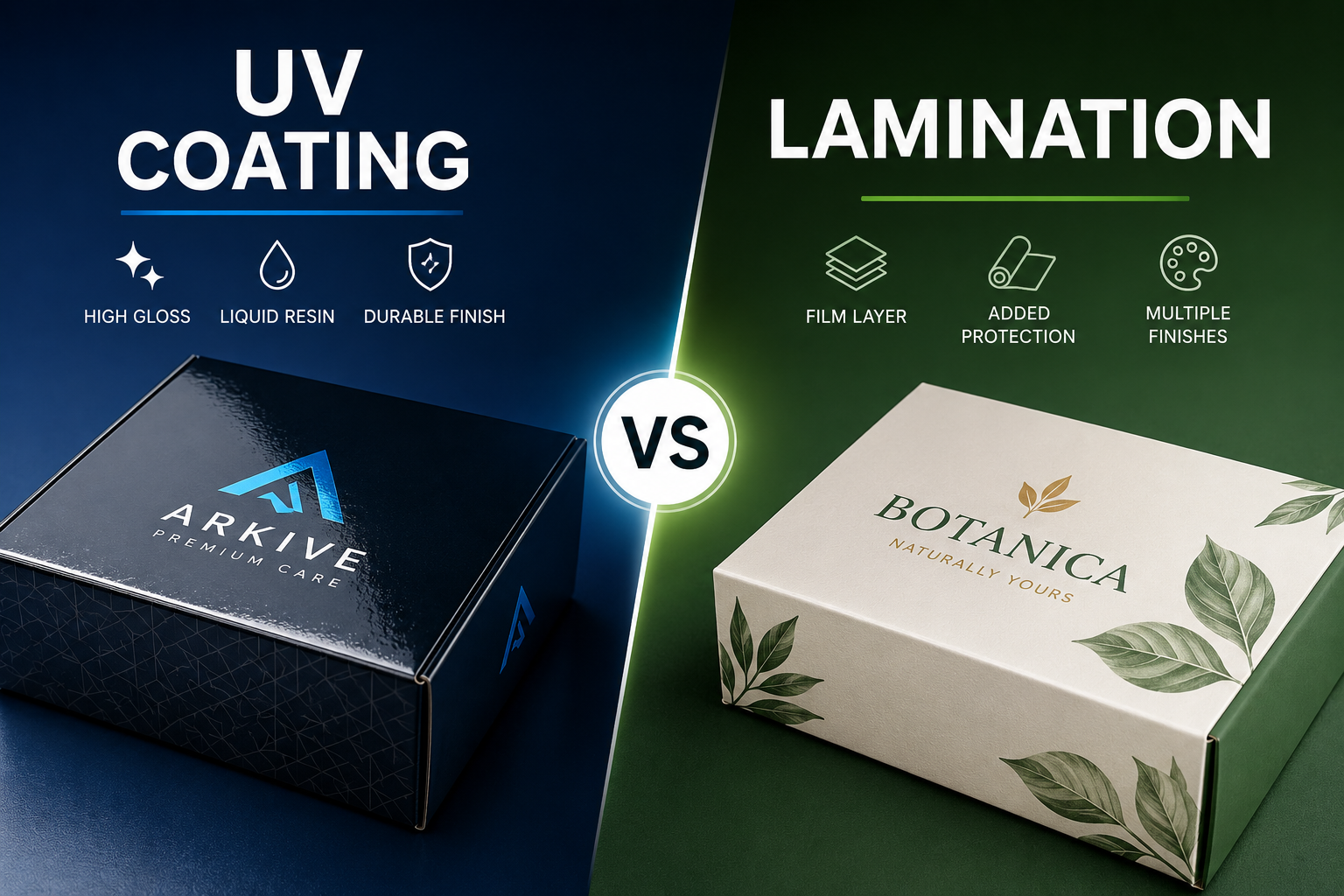
UV coating vs lamination comes down to one physical difference. UV coating is a liquid resin. It gets cured onto the printed sheet with UV light. Lamination bonds a separate plastic film to that sheet with adhesive. One becomes part of the surface. The other sits on top as its own layer. That single difference drives almost everything else. It shapes how each one looks. It shapes how each one holds up. It shapes which boxes each one actually suits.
Picking between them isn’t really about which finish looks glossier in a mockup. It’s about what happens after the box gets folded, shipped, and handled a few dozen times. This article breaks down uv coating vs lamination in practice. It covers where each finish wins. It covers where picking the wrong one shows up as a problem you didn’t expect.
What Is UV Coating?
UV coating starts as a liquid or gel resin. It gets applied directly onto the printed sheet. It then cures almost instantly under UV light. The resin becomes part of the surface. It isn’t a separate layer sitting on top of it. That’s why UV-coated boxes can look extremely glossy and deep. They often look almost wet, right off the press.
It comes in gloss and matte versions. Spot UV coats only specific areas, like a logo, for contrast against a matte background. That’s its own related technique, covered separately from this comparison. Here, the focus stays on flood UV coating across a whole panel versus lamination film.
So where does uv coating vs lamination actually start to diverge? It starts with what each material physically is, before either one ever touches a box.
What Is Lamination?
Lamination works differently. A thin plastic film, usually BOPP or PET, gets bonded to the printed sheet. Heat and pressure do the bonding, along with adhesive. That film is a distinct, separate layer. You could theoretically peel it back. UV coating can’t be peeled the same way, since it becomes part of the sheet itself.
Lamination comes in gloss, matte, and soft-touch finishes. Soft-touch lamination has a velvety hand-feel. It’s a specific luxury variant worth its own separate comparison. For this uv coating vs lamination breakdown, the point is simpler. Every lamination type shares the same core structure. It’s a bonded film, not a cured coating.
The Fold-Line Difference Most Guides Skip
Here’s the part that decides which finish actually holds up: what happens right where the box folds. UV coating is a rigid, cured resin. Bend it sharply enough, and it can crack. The cracks tend to show up right along the fold. Lamination film flexes with the substrate instead. It doesn’t crack the same way, because it’s a pliable plastic layer rather than a hardened resin.
That distinction matters far more on a small folding rigid box. It also matters on a mailer with tight creases. It matters far less on a flat display panel. A flat panel never flexes, so UV coating holds up fine there. A box with sharp folds puts real stress right on the coating’s weakest point. That’s the practical core of the uv coating vs lamination decision for most box styles.
I’ve seen a brand pick UV coating for a small folding rigid box. The choice came down to how stunning it looked in early flat mockups. Then the production samples came in folded and assembled. Hairline cracks showed up right along every fold line, just from ordinary handling. Switching to lamination on the reprint fixed it completely. The film simply flexed with the fold instead of splitting.
Durability: Which One Actually Lasts Longer?
Beyond the fold-line issue, lamination generally resists scuffing and moisture better over time. The continuous plastic film acts as a real barrier against both. Trade sources describing packaging finishes generally note that laminated surfaces hold up better under repeated handling. Cured coatings fall a bit short by comparison. The film forms a sealed layer. A thin cured surface doesn’t offer the same protection.
UV coating protects reasonably well against light scuffing on flat areas. It doesn’t form that same sealed barrier, though. It’s more exposed on box corners and edges. Those spots take the most repeated handling. Anything shipped or handled by multiple people feels that gap eventually. A box displayed for months on a shelf feels it too. That durability gap adds up over the life of the box.
For a short print run meant for one event, either finish will likely hold up fine. A quick unboxing moment doesn’t put much stress on either finish. The uv coating vs lamination durability gap only really matters once handling adds up over time.
Cost and Turnaround
Lamination generally costs more than UV coating for an equivalent run. It’s a separate material, bonded on with its own machine pass. UV coating tends to have a faster turnaround too. Curing happens almost instantly under UV light. It skips the bonding and cooling cycle lamination requires. Request a quote for exact pricing and lead times on your specific run. Both vary by quantity, size, and box style.
That cost gap is part of why some brands default to UV coating without checking fold geometry first. It looks like the cheaper, faster choice on paper. It only becomes the wrong choice once the box actually gets folded and handled.
UV Coating vs Lamination: Quick Comparison
| Factor | UV Coating | Lamination |
|---|---|---|
| Structure | Cured resin, part of the sheet | Bonded plastic film, separate layer |
| Fold-line durability | Can crack at sharp folds | Flexes with the fold |
| Scuff/moisture resistance | Moderate | Higher |
| Turnaround | Faster | Slower |
| Relative cost | Lower | Higher |
Common Mistakes When Choosing Between Them
The first mistake is judging a finish from a flat, unfolded mockup. A sample sheet never shows fold-line stress. Ask for a folded, assembled sample before committing to a full run.
The second mistake is defaulting to UV coating purely for cost savings on a box with tight folds. That savings can disappear fast if cracked samples force a reprint in lamination anyway.
The third mistake is assuming lamination always wins as the safer choice. On a flat display panel with no folding at all, uv coating vs lamination gets much closer. It’s a pure look-and-cost decision there. The fold-line risk simply doesn’t apply.
A fourth mistake is skipping a real handling test before a full production run. Rigidity and flex behavior can surprise you even when the spec sheet looks straightforward.
A fifth mistake is treating uv coating vs lamination as a one-time decision for every product line. A brand might run both a flat mailer insert and a folding rigid box. Choosing UV coating for one and lamination for the other is a reasonable call. The two finishes aren’t mutually exclusive across a catalog, even when only one makes sense per box style.
Which Should You Choose?
Building a small folding rigid box or anything with tight creases? Lean toward lamination. The flex resistance at the fold is worth the extra cost. It’s worth the extra lead time too, on a box that gets handled repeatedly. Retail and gift packaging sold through retail display channels tends to hold up best with lamination. That’s for exactly this reason.
Printing a flat display panel, a sign, or a box with minimal folding? UV coating vs lamination becomes a much closer call here. Pick based on look and turnaround instead. The durability gap barely matters without sharp folds to stress the finish.
Not sure which one your specific box style needs? Our guide to rigid box vs folding carton covers how box structure affects finish choices more broadly. Our guide to luxury rigid box packaging breaks down premium finish options in more depth. Easy Box Packaging can also send a folded, assembled sample in either finish. Request one before you commit to a full run. That’s the only real way to test fold-line durability ahead of time.
UV coating vs lamination isn’t really a question of which finish is “better.” It’s a question of fit. Which one matches how your box actually gets folded and handled? Get that match right, and the finish holds up exactly the way it looked in the sample.
UV Coating vs Lamination: FAQ
Is UV coating cheaper than lamination? Generally yes, for an equivalent run. Lamination requires bonding a separate film layer, which typically adds cost and time versus UV coating’s near-instant cure.
Does UV coating crack over time? It can, particularly at sharp fold lines under repeated handling. Flat, unfolded areas hold up much better than tight creases.
Can you laminate over a UV-coated box? No. Lamination and UV coating both get applied to the raw printed sheet before folding. They aren’t layered on top of each other. Pick one finish per panel.
Get a free quote — dieline and design support included.