
Most Shopify store owners think about custom packaging for Shopify stores the same way they think about a website redesign — something to do eventually, once the brand is more established. The result is brands shipping $60 products in plain brown mailers, running Instagram ads that show a beautiful brand, and then handing over the actual customer experience to a generic box. That gap is where repeat purchases go to die. Here’s how the practical side of custom packaging actually works for a Shopify operation — the minimums, the fulfillment mechanics, and where to start without overcomplicating it.
Shopify makes selling easier than it’s ever been, but it doesn’t touch packaging. That decision lives entirely outside the platform. The box your customer receives is yours to spec, source, and integrate with your fulfillment workflow — whether you’re self-fulfilling out of a garage, using a 3PL, or running through the Shopify Fulfillment Network. Each of those setups has different constraints, and the packaging decision looks different in each one.
Custom Packaging Shopify Stores: The Minimum Order Reality
The first question most Shopify operators ask: what’s the minimum order quantity? The answer has changed significantly in the last few years, and the old assumption — that custom packaging requires thousands of units — is no longer accurate for most formats.
Digital print runs start at 50–100 units. No plate setup costs, no tooling fees, no commitment to a size that might change. A Shopify store doing 100–150 orders per month can test a custom mailer box on a one-month inventory cycle. If the size is wrong, the design needs work, or the format isn’t right for the product, the financial exposure is minimal. Digital print is slower and costs more per unit than offset, but it’s the right call for early-stage stores that are still iterating.
Offset print runs make sense at 500–1,000+ units. This is where per-unit cost drops meaningfully — often by 40–60% compared to digital at the same format. Stores doing 300+ orders per month can usually absorb a 500-unit run without holding more than 6–8 weeks of inventory. The tradeoff: longer lead times (4–6 weeks vs 3–4 for digital), minimum volume commitment, and a design that needs to be locked before printing.
Print-on-demand packaging is a different category entirely. Some fulfillment services offer on-demand custom packaging — each box printed at time of order, no inventory to hold. The unit economics are much worse than even digital short runs, and the format options are limited. It makes sense for very low-volume stores or gift-box businesses with high SKU counts. For most Shopify operators with a defined product line and consistent order volume, bulk digital or offset runs are more cost-effective.
Understanding how packaging drives repeat purchases changes the way you think about the minimum order math. The question isn’t just “what does the box cost?” — it’s “what’s the repeat purchase value of the customer who opens it?”
Shopify Fulfillment Setups and How Packaging Fits Each One
Where your inventory lives determines how you manage custom packaging. The three common setups for Shopify stores have different practical constraints.
Self-fulfillment (garage, home, small warehouse). You control the entire packing process. Custom packaging integrates cleanly because you’re doing every pack yourself — you know what box is going to what SKU, you can stock multiple box sizes, and you can add branded inserts or tissue manually as needed. The main risk is ordering more custom packaging than you can move in a reasonable timeframe. Order based on 60–90 days of sales, not optimistic projections. Keep 2–3 box sizes in stock if your product range varies significantly in dimensions.
Third-party logistics (3PL). Your products live in a warehouse, and the 3PL picks, packs, and ships orders as they come in. Most 3PLs accommodate custom branded packaging, but the process needs to be set up correctly. You’ll ship your custom boxes to the 3PL as a packaging supply. They’ll charge a per-unit pick-and-pack fee. Key things to confirm before committing to a custom packaging spec: what box dimensions does the 3PL prefer (many have cartonization software that selects box size by algorithm), how they handle multi-SKU orders, and whether they’ll source packaging on your behalf or require you to supply it. Some 3PLs charge a storage fee for packaging inventory. Factor that into your cost model.
Shopify Fulfillment Network (SFN). SFN is Shopify’s own fulfillment service, available to qualifying merchants. As of mid-2026, SFN uses Shopify-branded or plain packaging by default. Getting custom branded packaging through SFN requires direct coordination with your SFN account manager and isn’t universally available at all volume tiers. If brand packaging is a priority and you’re on SFN, clarify the options before assuming it’s available.
What Box Format Is Right for a Shopify Store?
The most common packaging mistake Shopify operators make: ordering the same box format they’ve seen other brands use, without thinking about whether it matches their specific product and order profile. There’s no universal answer. Here’s how to think through the format decision.
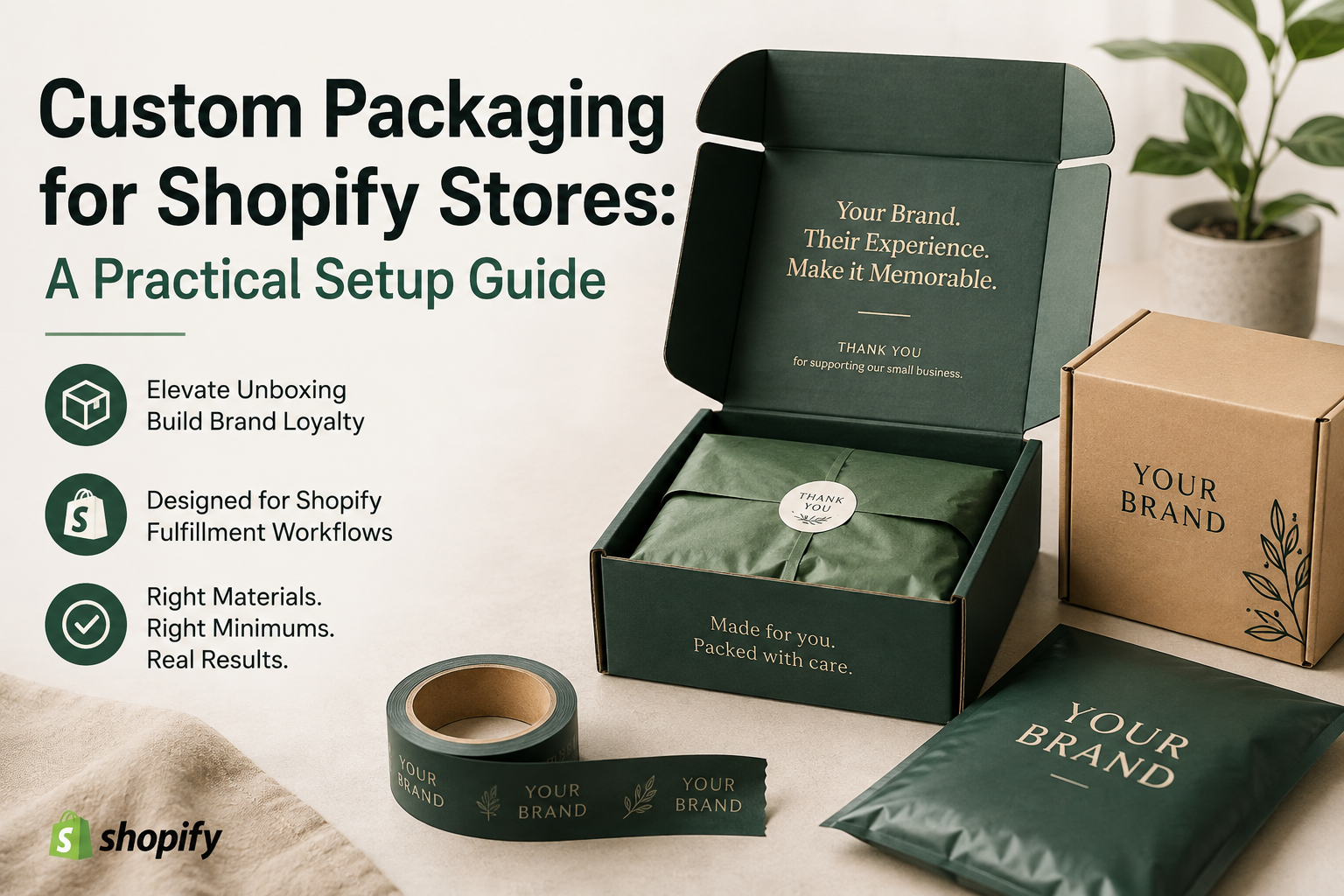
Mailer boxes for single-SKU or curated orders. The custom mailer box is the dominant format for DTC Shopify brands for good reasons. Self-locking construction means no tape required. The rigid structure protects products without added void fill in most cases. The interior lid is a natural canvas for a brand message or design. And the box creates a physical reveal moment — the self-opening mechanism is what gets filmed in unboxing content. If you’re shipping apparel, beauty, food, wellness, or lifestyle products in the $30–$150 range, a mailer box is usually the right call.
Corrugated RSC shippers for heavy or fragile product. A regular slotted container (RSC) — the standard corrugated box sealed with tape — is appropriate for heavier products, fragile items that need specific void fill, or subscription boxes with variable contents. The RSC gives you more interior dimension flexibility than a mailer box. It’s less dramatic as an unboxing experience but structurally appropriate for products where protection is the priority. Custom printing on corrugated RSC is available at similar minimums to mailer boxes.
Poly mailers for soft goods at lower price points. If you’re shipping apparel, fabric products, or accessories in the sub-$40 range, a custom-printed poly mailer is a cost-effective upgrade from generic. Per-unit cost is lower than corrugated, and at digital minimums you can get a full-color print with your logo and brand colors for a meaningful step up from plain packaging. They don’t create the same unboxing moment as a rigid mailer, but they’re appropriate for the product type and price point.
Gift boxes for premium items. Shopify stores selling jewelry, skincare, premium food, or high-end gifts often need a two-piece rigid box — the kind that doesn’t collapse when opened. These are higher per-unit cost and typically have higher minimum orders (100–250 units minimum at most suppliers), but for a product priced at $80+ they’re appropriate. The packaging mistakes that erode premium perception almost always come down to format mismatch — a premium product in a non-premium box.
Speccing Your Custom Packaging for Shopify: The Practical Steps
Getting from “I want custom packaging” to boxes arriving at your fulfillment location is a 5-step process. Most Shopify operators make this more complicated than it needs to be.
Step 1: Measure your products, not your boxes. Your current generic box size is not the right spec for a custom box. Measure your actual products — L × W × H in inches — with 0.5–1 inch of clearance on each side. That’s your interior dimension target. Order boxes sized for your product, not for whatever generic size you’ve been using.
Step 2: Choose the board weight and finish. Standard ecommerce corrugated is typically E-flute (thin, good for smaller items, crisp print surface) or B-flute (thicker, better for heavier or fragile items). For most Shopify products under 3 lbs, E-flute is the right choice. Finish options: matte lamination (premium, flat look), gloss lamination (brighter colors, shows fingerprints), soft-touch (premium tactile feel, higher cost), or uncoated kraft (natural look, recyclable). Finish affects per-unit cost by $0.15–$0.50 depending on the option.
Step 3: Prepare artwork on the supplier’s dieline. Every packaging supplier provides a dieline — a flat template showing exactly where the box panels, folds, and cuts are. Your artwork needs to be built in Adobe Illustrator (or an equivalent vector program) on that specific dieline. If you don’t have a designer, many suppliers offer browser-based design tools. The minimum file requirement is a vector file (.AI or .EPS) with fonts outlined. Don’t submit a Canva export or a low-resolution PNG.
Step 4: Order a physical sample before committing to a full run. Most suppliers offer pre-production samples — either a digital proof or a physical sample box — for a small fee. Always order a physical sample. Check that your product fits, that the print colors match your brand, that the structural quality is right, and that the box opens and closes correctly. I’ve watched brands skip this step and commit to 500 units of a box that turned out to be the wrong size. A $50 sample saves a $600 mistake.
Step 5: Build ordering into your inventory cycle. Custom packaging has a 3–5 week lead time for domestic digital runs. That means when you’re at 30–40% of your packaging inventory, you should be placing the next order — not when you run out. Running out of custom packaging and reverting to generic boxes while you wait for the next run is a common and avoidable problem. Set a reorder trigger in your inventory system, or put a calendar reminder in your ops workflow.
Custom Packaging Shopify Stores: The Brand Investment Case
Shopify’s analytics make it easy to track conversion rate, revenue, and ad spend. Packaging ROI is harder to see in the dashboard — which is partly why so many Shopify operators underinvest in it.
The mechanism is repeat purchase rate. A customer who receives a well-packaged order from a Shopify brand has a higher probability of returning directly to the site for their next order. They remember the brand, they associate positive feelings with the purchase experience, and they skip the competitor comparison they might otherwise do. A customer who receives a plain brown box remembers the product but often not the brand — and the next purchase starts with a Google search rather than a direct URL.
I’ve run this math enough times to know that the packaging investment is usually recoverable at 200+ orders per month, and often at lower volumes for higher-AOV products. A $0.80 per unit premium on a $65 AOV is 1.2% of revenue. If it generates even a 3% improvement in 90-day repeat purchase rate, the math works. The full breakdown of custom packaging ROI runs through the model in detail — worth reading before you decide the investment isn’t justified.
What Shopify analytics don’t surface: earned media value from unboxing content. Shopify stores in categories with strong social sharing — beauty, food, lifestyle, gifts — generate organic content when packaging gives customers something worth filming. That content reaches potential customers at zero cost-per-impression. It’s not in your Shopify dashboard, but it’s real and it compounds over time.
What to Spend on Custom Packaging at Different Shopify Revenue Stages
The right packaging investment number changes as the business grows. Here’s a rough framework by revenue stage:
$0–$10K/month: Not the moment for custom packaging in most cases. Per-unit costs are hard to absorb, and order volume is too low to measure repeat purchase effects cleanly. Use high-quality plain packaging and put a printed insert card inside — that’s a brand touchpoint at minimal cost. Reserve custom packaging for the next stage.
$10K–$30K/month: This is where the math starts to work for digital short runs. At 100–200 orders per month (assuming $50–$150 AOV), a 50–100 unit digital print run is achievable and measurable. Start with one box format for your highest-volume SKU. Keep it simple: logo, brand colors, clean design. Measure repeat purchase rate before and after.
$30K–$100K/month: Volume supports offset printing for better per-unit economics. At this stage, a 500–1,000 unit run is typically less than 2 months of inventory, and the per-unit cost comes down significantly. Consider adding branded tissue, a custom insert card, and a consistent brand system across box exterior and interior. This is also where sustainable packaging choices — FSC-certified board, recycled content — become economically practical without a significant premium.
$100K+/month: Full packaging system — multiple SKU-matched formats, custom inserts, branded void fill, seasonal variations. At this volume, packaging is a strategic asset, not a cost center. The eco-friendly packaging cost breakdown is worth reading at this stage, because sustainable options become cost-competitive and the sustainability signal starts paying returns with the consumer segments that care about it.
FAQ: Custom Packaging for Shopify Stores
How does custom packaging integrate with Shopify?
Shopify doesn’t manage packaging — it manages orders. Packaging is a physical supply that lives in your fulfillment location (home, 3PL, or warehouse). When an order comes in through Shopify, your fulfillment process uses the custom box to pack and ship it. There’s no Shopify app or plugin required. The integration is operational: you order custom packaging as a supply, store it, and use it for packing. The only platform consideration is if you use SFN, where custom packaging availability varies by tier.
What’s the minimum order quantity for custom packaging on Shopify?
With digital printing: 50–100 units at most suppliers. With offset printing: 500–1,000 units minimum, with better per-unit economics. Print-on-demand options exist for stores that need zero inventory commitment, but per-unit costs are significantly higher. For most Shopify stores doing 100+ orders per month, digital short runs are the right starting point.
Can I get custom packaging if I use a 3PL for Shopify fulfillment?
Yes. You supply your custom packaging to the 3PL as a packing material, typically shipped directly from your packaging supplier to their warehouse. Most 3PLs accommodate this. Confirm before committing to a spec: what dimensions work with their cartonization system, how they handle the packaging supply receiving and storage, and what per-unit fees apply for using your own packaging versus their standard options.
What’s the lead time for custom packaging for a Shopify store?
Domestic digital printing: 3–4 weeks from artwork approval to delivery. Offset printing: 4–6 weeks. International manufacturing: 6–10 weeks depending on shipping method. Plan your reorder points accordingly — don’t wait until you’re out of stock to place the next order. At 30–40% inventory remaining, trigger the next run.
Does Shopify have its own packaging options?
Shopify sells basic branded packaging through the Shopify Hardware Store, primarily designed for retail/POS scenarios. For DTC ecommerce packaging — custom corrugated mailers, branded boxes — you’ll source from packaging suppliers directly, not through Shopify. The Shopify ecosystem has no native integration for custom ecommerce packaging procurement.
Should I use the same box for all my Shopify SKUs?
Not necessarily. If your products vary significantly in size or weight, you may need 2–3 box sizes to avoid shipping air or over-packing small items in oversized boxes. Start with one box sized for your highest-volume SKU. Add sizes as you scale and as different product dimensions make the case. Too many box sizes at low volume creates inventory management complexity that outweighs the packaging efficiency gains.
How do I handle custom packaging for Shopify gift orders?
Shopify’s gift options (gift message, gift wrapping toggle) are separate from your packaging spec. If you offer gift wrapping, it typically means an upgraded pack-out — tissue paper, ribbon, a gift card — inside your standard custom box, or a dedicated gift box format for that SKU. Set up the gift packaging as a distinct SKU in your fulfillment workflow so your packing team or 3PL knows what to include. Don’t try to solve gift packaging at the order management level — solve it at the physical fulfillment level.
Your Shopify Brand Ends at the Box — Or It Extends Through It
Every Shopify store owner knows that the brand experience online is in their control — the theme, the photos, the copy, the checkout flow. What’s easier to overlook is that the brand experience continues offline, in the physical moment the customer opens what you shipped them. That moment is entirely determined by the box.
The best custom packaging for Shopify stores isn’t the most expensive or the most elaborate. It’s the packaging that fits the product, matches the price point, integrates with the fulfillment setup, and gives the customer a reason to remember who they bought from. That’s it. Start with one box, one SKU, one run. Get it right there first.
See our ecommerce packaging options to talk through what format and spec makes sense for your Shopify store’s product line and order volume. Most first runs are ready to ship to your fulfillment location in 3–4 weeks.