
Charlotte’s packaging challenge is a Piedmont problem. Custom boxes Charlotte North Carolina brands deal with summers that push 90°F with humidity hitting 70–75% through July and August, then winters that deliver ice instead of snow — repeated freeze-thaw cycles that are harder on standard packaging than steady cold. That dual-season pattern, combined with a brand scene shaped by finance, healthcare, and a fast-growing DTC corridor, sets the spec baseline for what packaging actually needs to do here. Get the climate right, match the consumer expectations of the Queen City market, and the box does real work. Get it wrong and you’re replacing damaged product and shipping in plain brown boxes that no Charlotte customer will remember.
The city’s economic identity matters for packaging too. This isn’t a generic mid-size Southern market. Bank of America and Wells Fargo are both headquartered here. Atrium Health and Novant Health anchor a significant healthcare sector. NASCAR’s commercial operations run out of the Charlotte region. And SouthPark, Ballantyne, and the South End design corridor have produced a consumer base with premium brand expectations that show up clearly in what the DTC market here responds to. Here’s what actually works for custom packaging in Charlotte.
Custom Boxes Charlotte North Carolina: The Climate Spec
Charlotte sits at the edge of two climate patterns, and both of them put stress on packaging in ways that don’t show up in generic corrugated specs.
Summer humidity. Charlotte’s July and August average relative humidity runs 68–75%, with heat index readings well above 100°F on peak days. Corrugated ECT stacking strength — the rating that tells you how much compression load a box handles before buckling — degrades significantly in humid conditions. At 85% RH, corrugated can lose close to half its dry-condition stacking strength. Charlotte brands storing corrugated inventory in non-climate-controlled space through summer, or shipping products stacked multiple units high, need to account for this in their board spec. Moisture-resistant board sizing is not a premium upgrade in this climate — it’s the right spec for summer fulfillment.
Piedmont winter ice. Charlotte doesn’t get the consistent snow that the North Carolina mountains see. What it gets is ice. January and February bring repeated freeze-thaw events — temperatures crossing 32°F multiple times across days — that create a specific packaging problem: hot-melt tape adhesive loses bonding strength below 40°F and approaches failure below 20°F. A Charlotte package sitting on a front step during an ice event goes through several freeze-thaw cycles before anyone brings it inside. Self-locking corrugated construction — tuck-top mailer boxes, auto-lock bottoms — removes that tape dependency entirely. The box holds its form through temperature swings with no adhesive required.
Brands getting the spec right in Charlotte use moisture-resistant board sizing for summer structural performance and self-locking construction to handle winter adhesive failure. Neither requires expensive materials — both are spec decisions made at the brief stage. The packaging mistakes that generate the most transit damage in dual-season markets are almost always structural choices that looked fine in a dry, temperate warehouse but failed in actual shipping conditions.
Charlotte’s Brand Ecosystem and What It Expects
Charlotte’s DTC consumer base has been shaped by several industries that set high packaging expectations.
Finance and professional services. Charlotte is one of the largest banking centers in the United States. The workforce that comes with that — finance professionals, corporate services, legal and accounting firms — represents a high-income, brand-literate consumer segment. For DTC brands selling to this demographic, packaging is read as a proxy for product quality. A premium-priced item in a generic brown box lands differently here than it might in a market where the consumer comparison set doesn’t include the premium presentation standards of financial services brands. SouthPark and Ballantyne premium retail have further set the expectation bar.
Healthcare and wellness. Atrium Health and Novant Health are two of Charlotte’s largest employers. The healthcare-adjacent consumer brand category — supplements, wellness products, medical devices, health-tech — is significant here, and this segment has specific cleanliness expectations for packaging. Corrugated that arrives crushed, with visible contamination from transit, or with structural failure undermines the product credibility in a way that matters more in the wellness category than in most others. Clean, well-constructed packaging is table stakes, not a differentiator, in this segment.
NASCAR and motorsports merchandise. Charlotte is the commercial hub of American motorsports. Race team merchandise, motorsports licensing brands, and performance product companies all ship from the Charlotte region. This category has its own packaging requirements: items that may be autographed or collectible, merchandise that needs to arrive in pristine condition for fans who are buying for display as much as use, and retail-to-DTC brands accustomed to motorsports’ premium presentation standards.
Food, beverage, and craft brands. Charlotte’s food scene has grown substantially over the last decade. Craft breweries, specialty food producers, local sauces and condiments, and artisan coffee brands all have DTC operations that require food-safe board and climate-aware specs for summer heat. The Queen City’s consumer appetite for local brands creates a strong market for Charlotte-based food DTC — but only if the packaging holds up in summer transit.
Custom Boxes Charlotte North Carolina: Neighborhood Signals
Charlotte’s geographic spread means different neighborhoods send different brand signals, and packaging that reads well in one part of the city can miss the mark in another.
SouthPark / Ballantyne: Charlotte’s premium consumer corridor. High-income, design-aware, brand-conscious. Packaging here competes against the presentation standards of SouthPark Mall’s luxury retail tenants. Matte lamination is a reasonable baseline; soft-touch for premium positioning; rigid box construction for high-value items. This segment notices construction quality and uses it as a signal of product legitimacy.
South End / NoDa: Charlotte’s design and arts district. South End has become a startup and creative industry corridor; NoDa (North Davidson) is the original arts district with an artisan-forward consumer culture. These two areas respond to packaging that signals craft and intentionality. Kraft corrugated with recycled content, minimal but deliberate design, and FSC certification perform better here than high-gloss premium finishes. The sustainability signal and the authenticity signal matter to this consumer segment.
Uptown / Fourth Ward: Charlotte’s downtown core, with a mix of corporate employees and urban residential. This demographic skews professional and convenience-oriented. Clean, efficient packaging that arrives intact and opens easily is the priority. Interior brand moments — a printed lid panel, a brand color field — generate more return here than elaborate exterior finishes on a box that arrives at an apartment building mailroom.
Huntersville / Lake Norman / Mooresville: Charlotte’s northern suburbs, including the NASCAR technical corridor in Mooresville. Motorsports brand fans in this area respond to premium branded merchandise packaging in ways that reflect the collector and enthusiast culture of the sport. Understanding how packaging drives repeat purchases matters particularly in this segment — motorsports fans who have a great product experience become multi-purchase customers across gear, collectibles, and apparel.
Charlotte’s Interstate Logistics Position
Charlotte sits at the intersection of I-77 (north-south, connecting to Columbia, SC and to Charlotte’s northern suburbs toward Statesville) and I-85 (the primary Southeast corridor, running southwest toward Atlanta and northeast toward Greensboro, Durham, and Raleigh). I-485 encircles the metro. Charlotte Douglas International Airport is American Airlines’ second-largest hub and one of the busiest cargo airports in the Southeast.
This position gives Charlotte brands strong ground shipping reach: Atlanta is roughly 4 hours by I-85, Raleigh-Durham is 2.5 hours northeast, Columbia is 90 minutes south. The Southeast and Mid-Atlantic corridors are both accessible without a second distribution point for most DTC brands at early-to-mid scale. That distribution reach makes the packaging investment case stronger — when you can reach Atlanta, Raleigh, Columbia, and Charlotte itself with 1-day ground from a single fulfillment location, the box is what differentiates the brand experience from the warehouse it shipped from.
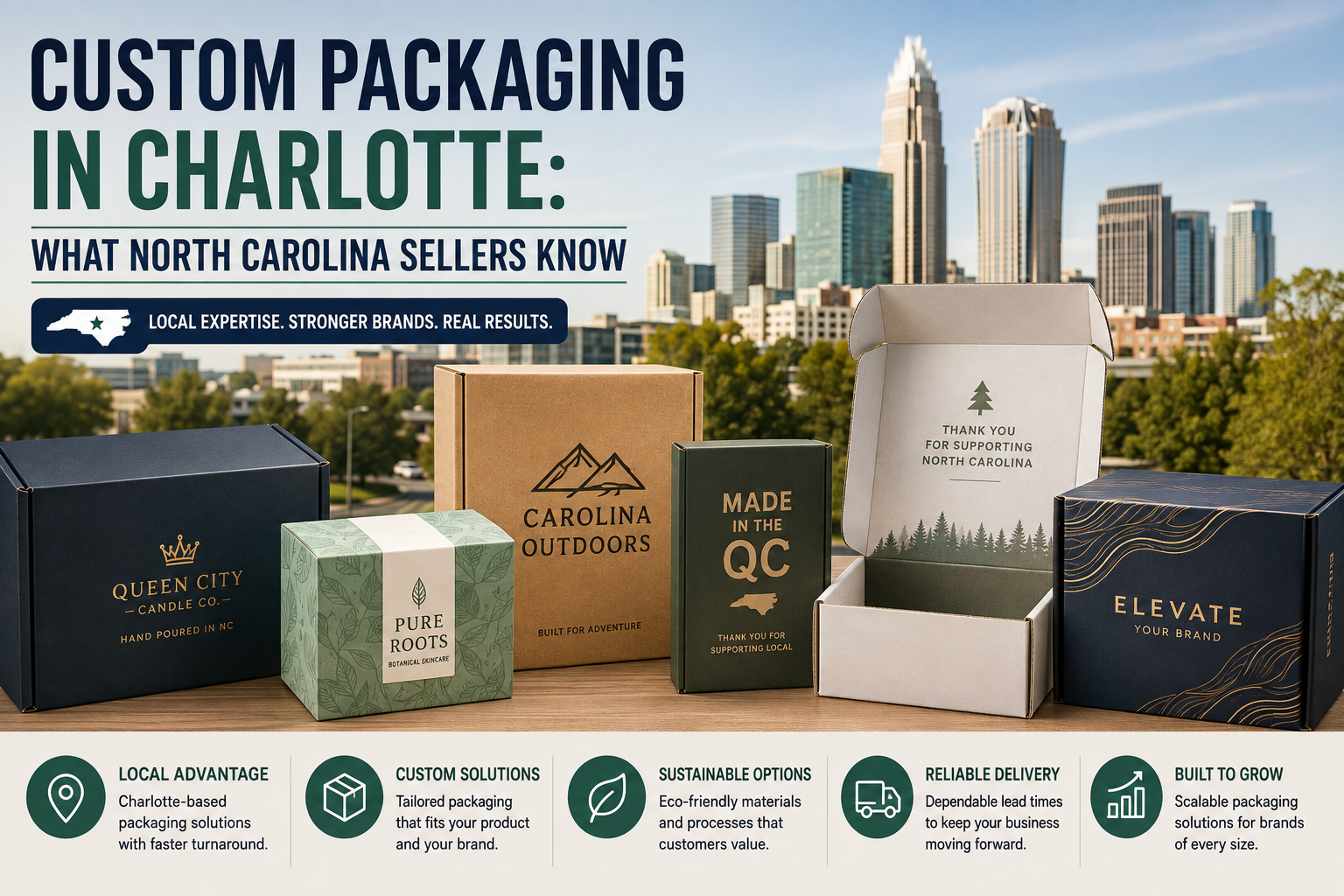
The custom mailer box is the dominant format for Charlotte DTC brands across most consumer categories, specifically because its self-locking construction handles the city’s dual-season climate without tape dependency. It also generates the unboxing content that performs well in social-sharing categories — Charlotte’s growing food, wellness, and lifestyle brand scene depends on this kind of organic reach more than the traditional retail-to-DTC categories.
What Gets the Spec Right in Charlotte
Across Charlotte’s DTC brand categories, these are the packaging decisions that separate brands that ship well from those that don’t.
Self-locking construction over tape closures. Charlotte’s December–February freeze-thaw pattern is the same problem Nashville, Philadelphia, and other dual-season markets face. Auto-lock bottoms and tuck-top mailer box designs remove tape from the structural equation. The box holds regardless of ambient temperature.
Moisture-resistant board for heavy or stacked products. Charlotte’s July–August humidity pushes corrugated into the range where stacking strength degrades for unconditioned board. For heavy products, multi-unit orders, or inventory stored in non-climate-controlled warehouse space through summer, moisture-resistant board sizing is the right call.
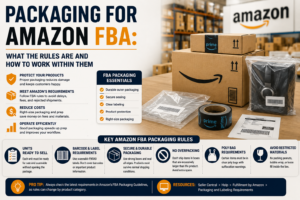
Food-safe board for consumables. Charlotte’s craft food, beverage, and supplement brands need FSC-certified food-safe board wherever the corrugated contacts or contains a consumable product. Ask for it by name — it’s not the default corrugated spec and won’t be included unless specified in the brief. This also matters for Amazon FBA eligibility and natural food retail requirements.
Finish matched to neighborhood and category. SouthPark and Ballantyne warrant matte or soft-touch lamination. South End and NoDa warrant kraft and recycled content. Neither answer is universal — the right answer depends on who’s opening the box. Applying a blanket premium finish to a brand with a sustainability-forward positioning, or kraft to a brand competing on premium presentation, is a mismatch that costs money without generating the expected return.
Interior print for social-sharing categories. Charlotte’s food, lifestyle, and wellness brands generate their best organic reach when packaging gives customers something worth posting. A printed interior lid — brand message, artwork, a color field — creates a moment at box-opening that plain corrugated doesn’t. I’ve watched Charlotte brands in the food and wellness space get tagged in unboxing content at a rate that their generic-box competitors never see, for an incremental cost of roughly $0.15–$0.20 per unit.
FAQ: Custom Boxes in Charlotte, North Carolina
What packaging construction handles Charlotte winters best?
Self-locking construction — tuck-top mailer boxes, auto-lock bottoms — removes tape from the equation. Charlotte’s December–February ice events create repeated freeze-thaw cycles that degrade standard hot-melt tape adhesive. Self-locking corrugated holds its form through temperature swings with no tape dependency, which means no failed closures on packages sitting on porches during an ice storm.
Does Charlotte’s summer humidity actually affect corrugated?
Yes. At 68–75% relative humidity — which Charlotte hits regularly in July and August — corrugated ECT stacking strength degrades compared to dry-lab conditions. For heavy products, stacked inventory, or anything stored in non-climate-controlled warehouse space through summer, moisture-resistant board sizing is the appropriate spec. It’s not a premium upgrade — it’s what corrugated should be in this climate for products that need structural integrity in transit.
What’s the minimum order for custom boxes in Charlotte?
Digital printing runs start at 50–100 units with no plate setup costs — the right range for Charlotte brands testing formats or running lower volumes. Offset printing becomes economical at 500–1,000+ units when per-unit cost is the priority. Domestic suppliers typically deliver to Charlotte in 3–5 weeks for digital runs, making it practical for brands iterating on design or scaling into custom packaging for the first time.
Do Charlotte food brands need different packaging specs?
Yes. Food-safe board is non-negotiable for corrugated contacting any consumable product. Weight ratings for bottled products require ECT-32 minimum and often double-wall for pallet distribution. Charlotte’s summer heat also creates thermal management considerations for temperature-sensitive products — chocolate, certain condiments, specialty sauces — that may require insulated corrugated liners or reflective coatings for summer transit.
How does Charlotte compare to other Southeast markets for packaging?
Charlotte shares the dual-season climate challenge with Nashville and Philadelphia — hot humid summers, freeze-thaw winters — more than it shares with Atlanta or Columbia, which have milder winters. The premium DTC consumer expectation is comparable to Atlanta’s Buckhead or Nashville’s Gulch, driven by Charlotte’s finance and healthcare industry workforce. Spec for both the climate and the consumer expectation, and you’re covering the market correctly.
What finish works best for Charlotte’s SouthPark consumer base?
Matte lamination is the baseline for premium positioning in SouthPark and Ballantyne. Soft-touch lamination signals luxury and is appropriate for products priced at $75+. Gloss lamination is brighter but shows fingerprints and reads as less premium than matte in this consumer segment. For NoDa and South End, kraft with recycled content and minimal print coverage performs better — the sustainability and craft signals matter more to that demographic than surface finish.
Does NASCAR merchandise require specific packaging?
Collectible and autographed motorsports merchandise has specific requirements: the item needs to arrive in pristine, display-ready condition. Rigid corrugated construction with appropriate internal cushioning is the standard. For autographed items, the packaging itself is often part of the collectible presentation — tissue paper, a certificate of authenticity, and branded presentation matter. For high-value signed merchandise, a two-piece rigid box with a foam insert is appropriate. For general fan merchandise, a well-constructed corrugated mailer box with branded interior handles the job.
Charlotte Has the Market. The Box Is How You Work With It.
The brands getting custom boxes Charlotte North Carolina right aren’t fighting the climate — they’ve spec’d for it. Moisture-resistant board for summer stacking strength, self-locking construction for winter tape failure, food-safe stock for the city’s substantial food and beverage brand population. These aren’t upgrades. They’re the baseline spec for a market that ships through ice storms and stores inventory through August humidity.
Get the structural spec right, then match the finish and sustainability choices to the specific Charlotte neighborhood and consumer segment you’re actually selling to. That’s when packaging stops being a logistics cost and starts doing brand work — the way the finance and healthcare industries in this city have always expected from the brands they interact with.
Easy Box Packaging works with DTC brands throughout the Carolinas — from Charlotte finance-adjacent wellness brands to NoDa craft food producers to motorsports merchandise operations in the Mooresville corridor. See our ecommerce packaging options to talk through what your products and your Charlotte market specifically need.
For Southeast regional context, the Atlanta packaging guide covers the comparable premium DTC market two hours down I-85, with the same humidity considerations and similar consumer expectations. And for the closest climate parallel — dual-season Piedmont patterns that match Charlotte’s summer humidity and winter freeze-thaw dynamic — the Nashville packaging guide runs through the same structural spec decisions from a Tennessee perspective.