
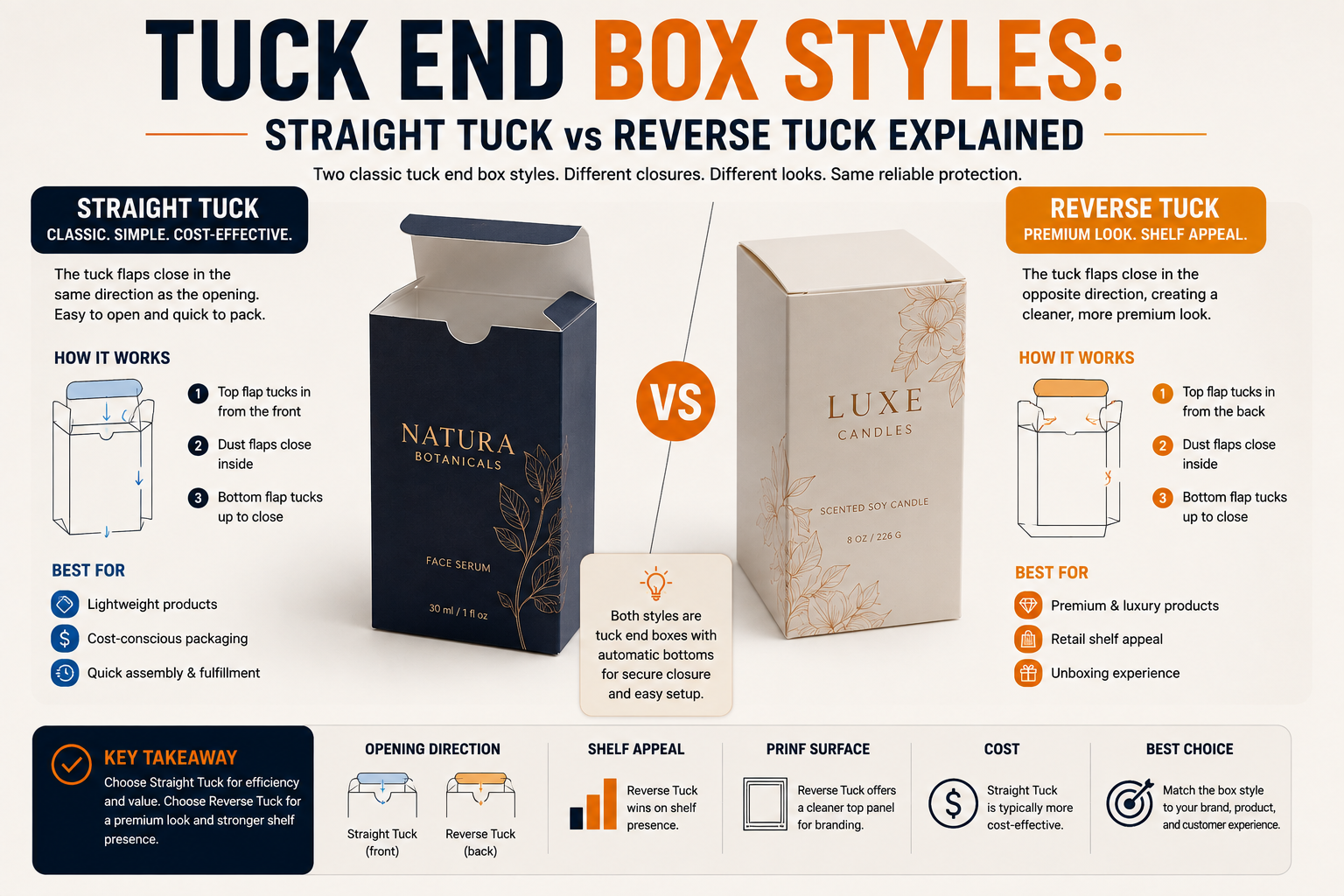
Straight tuck vs reverse tuck comes down to which way the flaps fold. A straight tuck box has both the top and bottom flaps tucking the same direction. Both tuck toward the back panel. A reverse tuck box works differently. Its top flap tucks toward the back, but the bottom flap tucks toward the front. That small difference changes how easy the box is to fill. It also changes how likely the box is to pop open by accident.
This article covers straight tuck vs reverse tuck in plain terms. It covers how each one actually folds, and which style fits your product.
What Is a Tuck End Box?
A tuck end box is a folding carton with flaps that tuck into slots. That’s what holds the box shut, no tape or glue needed at the ends. The box ships flat. It then folds up and locks closed by hand or on an assembly line.
Almost every folding carton on a store shelf uses some version of a tuck end. The two most common styles are straight tuck and reverse tuck. Both use the same basic idea. They differ in which direction the flaps rotate to close.
How Straight Tuck Works
A straight tuck end (STE) box has both flaps closing the same way. Picture the box lying flat before the final fold. The top flap swings down and tucks in toward the back panel. The bottom flap does the same thing, also tucking toward the back panel. Both flaps rotate in the same direction, like two pages of a book turning the same way.
This matching motion makes straight tuck boxes fast to fold by hand. There’s one motion to learn, then repeat on the other end. That speed is the main reason straight tuck shows up on simple, low-cost packaging.
The tradeoff is closure strength. Since both flaps push the same way, there’s less opposing tension holding the box shut. A straight tuck box can pop open more easily under pressure or rough handling.
How Reverse Tuck Works
A reverse tuck end (RTE) box closes with the flaps working against each other. The top flap tucks toward the back panel, same as straight tuck. But the bottom flap tucks toward the front panel instead. The two flaps rotate in opposite directions. Picture a lid that opens from one side, paired with a base that locks from the other.
That opposing motion creates real tension once both flaps are tucked in. Each flap presses against the other, and the box holds shut almost like a spring. This is why reverse tuck is the default choice for boxes that get shipped, stacked, or handled roughly.
The Pop-Open Problem Most Guides Skip
Here’s what most straight tuck vs reverse tuck comparisons leave out. The real reason to pick one over the other isn’t looks. It’s what happens once the box gets jostled.
I’ve seen a brand order straight tuck boxes for a product on a fulfillment center’s conveyor line. The boxes kept popping open during transit. The same-direction flaps had no opposing tension to resist the shaking and bumping. On the reorder, switching to reverse tuck fixed the problem completely. No tape, no extra assembly step, just a different fold direction.
Does your box go through shipping, handling, or an automated packing line? Reverse tuck’s opposing flaps are worth the small assembly tradeoff. Straight tuck vs reverse tuck often comes down to exactly this. How rough is the ride your box will actually take? ISTA’s package testing standards cover exactly this kind of transit and handling stress. They show how packages get tested before they ship.
Straight Tuck vs Reverse Tuck: Quick Comparison
| Factor | Straight Tuck (STE) | Reverse Tuck (RTE) |
|---|---|---|
| Flap direction | Both flaps tuck the same way | Flaps tuck opposite ways |
| Assembly speed | Faster, one repeated motion | Slightly slower, two motions to learn |
| Pop-open risk | Higher under pressure | Lower, flaps hold tension |
| Common uses | Simple retail cartons, low handling stress | Shipped, stacked, or shelf-stocked products |
Straight tuck vs reverse tuck aren’t the only tuck styles out there, though they cover most real-world cases.
Other Tuck Variants Worth Knowing
A lock tuck adds small locking tabs to the flap. The flap clicks into a slot instead of just resting in place. That adds security beyond a standard reverse tuck. It’s useful for a box that gets opened and reclosed by the customer.
A French tuck skips the fold-in flap entirely. The panel tucks straight into a slot with no additional flap fold. It’s less common but shows up on smaller, low-stress cartons where a simpler closure works fine.
Which Style for Your Product?
Choose straight tuck when the box holds a light product and gets minimal handling. Speed of hand assembly matters more than closure strength here. Simple retail items placed gently on a shelf are the classic fit.
Choose reverse tuck when the box will be shipped, stacked, or run through an automated line. The opposing-flap tension is worth the marginal difference in assembly time. This is the safer default for most ecommerce and shipped products, including standard cardboard boxes built for transit.
Our guide to how die cutting works explains how either tuck style gets cut from the flat sheet. Our guide to what a dieline actually is covers how the flap layout gets mapped before cutting.
Common Mistakes
The first mistake is picking straight tuck just because it looks simpler on the spec sheet. Does the box travel through a fulfillment center, or get stacked? The pop-open risk isn’t worth the small assembly time saved.
The second mistake is assuming all tuck end boxes close the same way. Straight tuck and reverse tuck look similar on a flat template but behave very differently once folded.
The third mistake is not checking which style your printer defaults to. Some suppliers standardize on one tuck style. Confirm the exact style in your quote rather than assuming.
A fourth mistake is ignoring print-face direction. A logo or graphic near a tuck flap can end up angled or upside down. This happens when the tuck direction isn’t accounted for in the design file.
A fifth mistake is skipping a physical sample before a full run. A flat proof can’t show how the flaps actually hold under real handling. Ask for a folded sample, not just a flat one.
FAQ
What’s the real difference in straight tuck vs reverse tuck? The flap direction. Straight tuck has both flaps tucking the same way. Reverse tuck has flaps tucking opposite ways, which creates more closure tension.
Which tuck style is more secure? Reverse tuck, generally. The opposing flap direction creates tension that resists popping open. Straight tuck relies on flap fit alone, with no opposing pressure.
Does tuck style affect box cost? Not meaningfully on its own. Any small cost difference usually comes from setup and print-face adjustments, not the fold style itself. Our team can confirm your exact quote once your style is set.
Can I switch tuck styles on a reorder without changing my dieline? Usually not without an update. It’s smaller than a full rigid box vs folding carton switch. It still shifts flap size and placement on the dieline, though.
Get a free quote — dieline and design support included.