
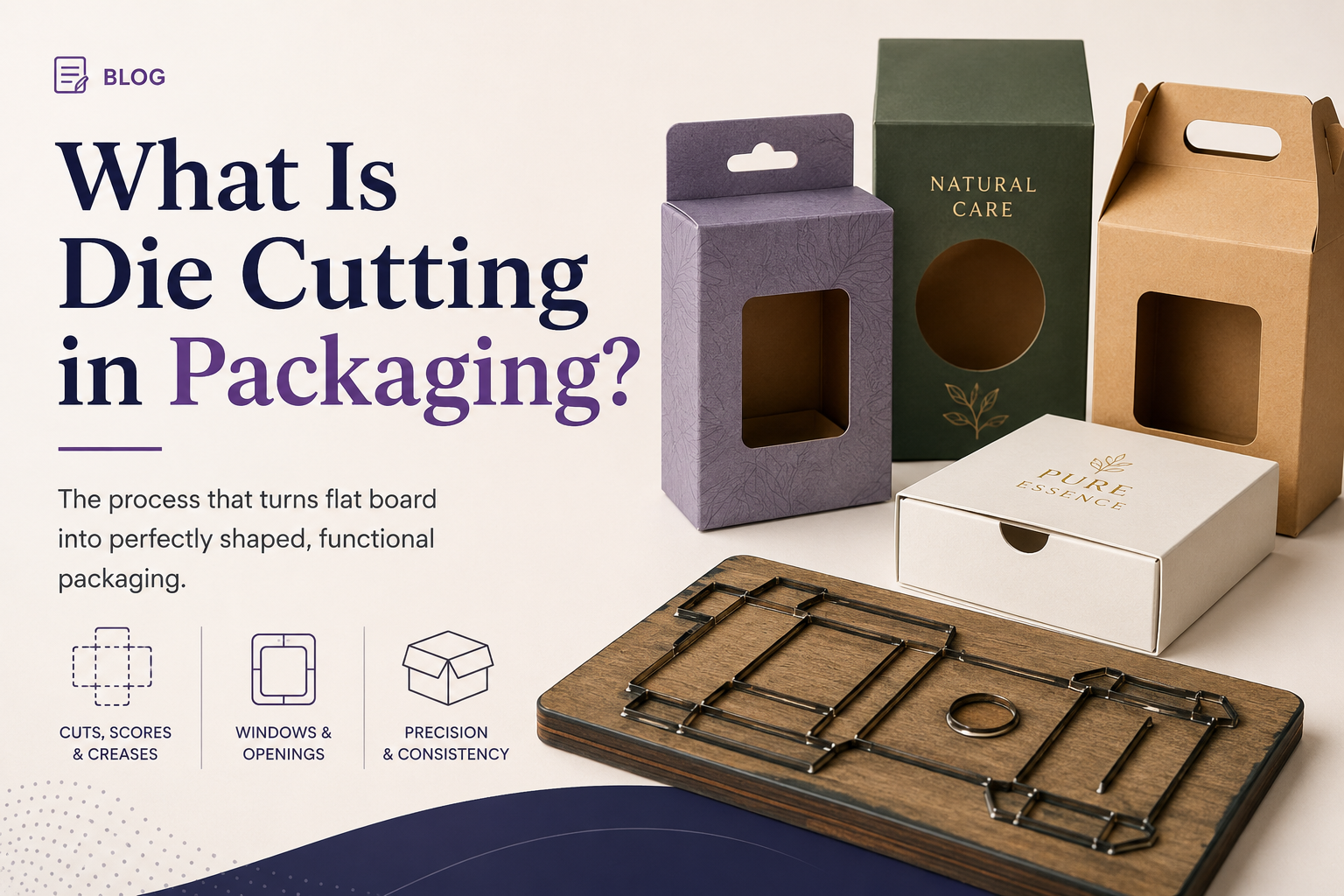
What is die cutting in packaging? It’s the process of cutting board into a specific shape using a custom-made cutting tool. That tool is called a die. It cuts window openings, box outlines, and folding lines all at once. Nearly every custom box starts with a die cut. It happens whether or not the box also gets foil, embossing, or print. Without it, board is just a flat sheet with no shape at all.
How Die Cutting Actually Works
A die is a board with sharp steel rules bent into your exact shape. Those rules sit in a wood or metal base. The whole assembly presses through your printed sheet under heavy force. The blades cut through the board wherever they touch. Everywhere else stays intact.
Most dies also carry scoring rules alongside the cutting rules. Scoring creases the board without cutting through it. That’s what lets a flat sheet fold cleanly into a box shape later.
One die usually cuts several things in a single pass. It cuts the outer silhouette, scores the fold lines, and cuts any window or handle opening. All three happen in one motion through the press.
Registration matters here too. The die has to line up precisely with the printed sheet underneath it. A misaligned die can cut straight through part of your artwork or leave an off-center window.
Steel Rule Dies vs Rotary Dies vs Digital Cutting
Steel rule dies are the traditional method. A flatbed press pushes board through a custom-built die. This works well for short to medium runs and complex shapes.
Rotary dies wrap the cutting rules around a cylinder instead. Board feeds through continuously rather than sheet by sheet. This runs much faster at high volume, and it’s common on corrugated shipping boxes.
Digital cutting uses a computer-guided blade or laser with no physical die at all. There’s no tooling cost, and changes are instant. It’s slower per unit than a die. That makes it a better fit for short runs and prototypes than large production orders.
According to Bobst’s overview of die-cutting technology, rotary die cutting remains the standard for high-speed packaging lines. Flatbed and digital methods serve lower-volume and prototyping needs instead. That matches what most converters see in daily production.
Steel Rule vs Rotary vs Digital Compared
| Method | Tooling Cost | Speed | Best For |
|---|---|---|---|
| Steel rule die | One-time cost per shape | Moderate | Short to medium runs, complex shapes |
| Rotary die | Higher upfront cost | Fast | High-volume corrugated runs |
| Digital cutting | None | Slow per unit | Prototypes, very short runs |
The right choice depends mostly on volume. Low volume favors digital. High volume favors rotary. Most everyday orders land on steel rule, since it balances cost and speed well for typical box quantities.
Die Cutting on Different Box Materials
Corrugated board runs through die cutting constantly. Shipping boxes, mailers, and retail-ready cartons all start as a die-cut corrugated sheet. Rotary dies handle most of this volume.
Folding cartons use steel rule dies almost exclusively. The thinner board doesn’t need the speed of a rotary setup. Complex window or handle shapes are also easier to cut on a flatbed press.
Rigid board is trickier. It’s thick and dense, so it needs more pressure and a sturdier die to cut cleanly. Rigid box dies also tend to cost more than folding carton dies for that reason.
Kraft board brings its own quirk. The natural fiber can shed small particles along a fresh cut edge. A slightly duller die makes this worse. Kraft runs often need more frequent die maintenance than coated stock does.
Custom mailer boxes usually run on rotary dies at scale, though shorter runs sometimes use steel rule instead. The choice mostly comes down to order size rather than the box design itself.
Where Die Cutting Goes Wrong
Most guides just say “the die cuts your shape.” Here’s the part they skip. A die can dull over time, especially on abrasive board like uncoated kraft. A dull die tears the board instead of cutting it cleanly. That leaves rough, fuzzy edges along the cut line.
Scoring depth matters just as much as cutting depth. Too shallow, and the fold cracks or splits when the box gets assembled. Too deep, and the score can cut through the board entirely in the wrong spot.
Here’s the one that catches people off guard: dies wear out gradually, not all at once. I’ve had a client run a reorder on the same die from months earlier. The cut edges came back visibly rougher than the original run. Nobody had flagged the die for resharpening between orders. That’s one of the packaging mistakes that kill the unboxing moment. It showed up on a reorder that should have been simple. Ask your printer whether your die gets inspected before every production run, not just the first one. Clean, consistent edges on every reorder keep a box feeling premium. It should look as good on the tenth order as it did on the first. That consistency is exactly the kind of thing that turns a first order into a repeat one.
What Die Cutting Adds to Your Quote
Every new box shape needs its own die. That’s a one-time tooling cost on the first order. Reorders reuse the same die for free, as long as it’s still in good condition.
Complexity drives the price more than size does. A simple rectangular box costs less to die-cut than one with windows, handles, or an irregular silhouette. Each extra cut or score line adds to the die’s complexity and cost.
Rotary dies cost more upfront than steel rule dies. That cost only makes sense at high volume, where the speed pays for itself. Request a quote for real numbers on your specific shape and order size.
Turnaround depends on the die-making step. A new die takes time to build before the first run can start. Reorders skip that step and move straight to production, provided the die hasn’t been damaged or dulled.
A design with multiple windows, handles, and score lines takes longer to tool than a simple box. Build extra lead time into your schedule if your shape carries more than one special cut.
Which Should You Choose?
Running a short prototype batch before committing to a full order? Digital cutting skips the tooling cost entirely. It’s the fastest way to hold a physical sample in your hands.
Ordering a mid-size run of folding cartons with a custom window or handle? A steel rule die is the standard choice here. It handles detailed shapes well at a reasonable cost.
Shipping high volumes of custom mailer boxes or retail cartons? Rotary dies pay off at that scale. The higher tooling cost spreads thin across a large run.
Working with a heavier or rigid box structure? Budget for a sturdier, more expensive die. Rigid board needs more pressure and a tougher cutting tool to get a clean edge.
Building a display packaging piece with an irregular shape? Expect a more complex die and a longer lead time. Irregular silhouettes take more precision to cut cleanly, and that shows up in both cost and turnaround.
Custom toy display boxes are a good everyday example: the window that shows the toy is its own die-cut line on top of the outline and score, which is exactly the kind of added cut that pushes tooling cost and lead time up on an otherwise simple box.
Planning multiple reorders down the line? Ask about die storage and maintenance upfront. A well-kept die produces the same clean edge on order twenty as it did on order one.
Die Cutting: FAQ
What is die cutting used for in packaging?
Cutting board into a specific shape and scoring fold lines, all in one pass through a press. It’s the step that turns a flat printed sheet into a foldable box.
What’s the difference between a steel rule die and a rotary die?
A steel rule die is flat and works sheet by sheet. A rotary die wraps around a cylinder and runs continuously, which suits high-volume corrugated production.
Does die cutting work on rigid boxes?
Yes, but it needs more pressure and a sturdier die than folding carton stock does. Rigid board is thicker and denser, which raises the tooling cost.
Why did my reorder come back with rough edges?
The die likely dulled between production runs. Ask your printer to inspect and resharpen dies before every reorder, not just the first one.
Is digital cutting cheaper than a steel rule die?
For short runs, yes, since there’s no tooling cost at all. At higher volumes, a steel rule or rotary die becomes the more economical choice per unit.
Die cutting is the step every custom box depends on, whether or not it ever gets noticed. Match the method to your volume and shape complexity, not just the lowest quoted price. A well-made die pays for itself across every reorder that follows.