
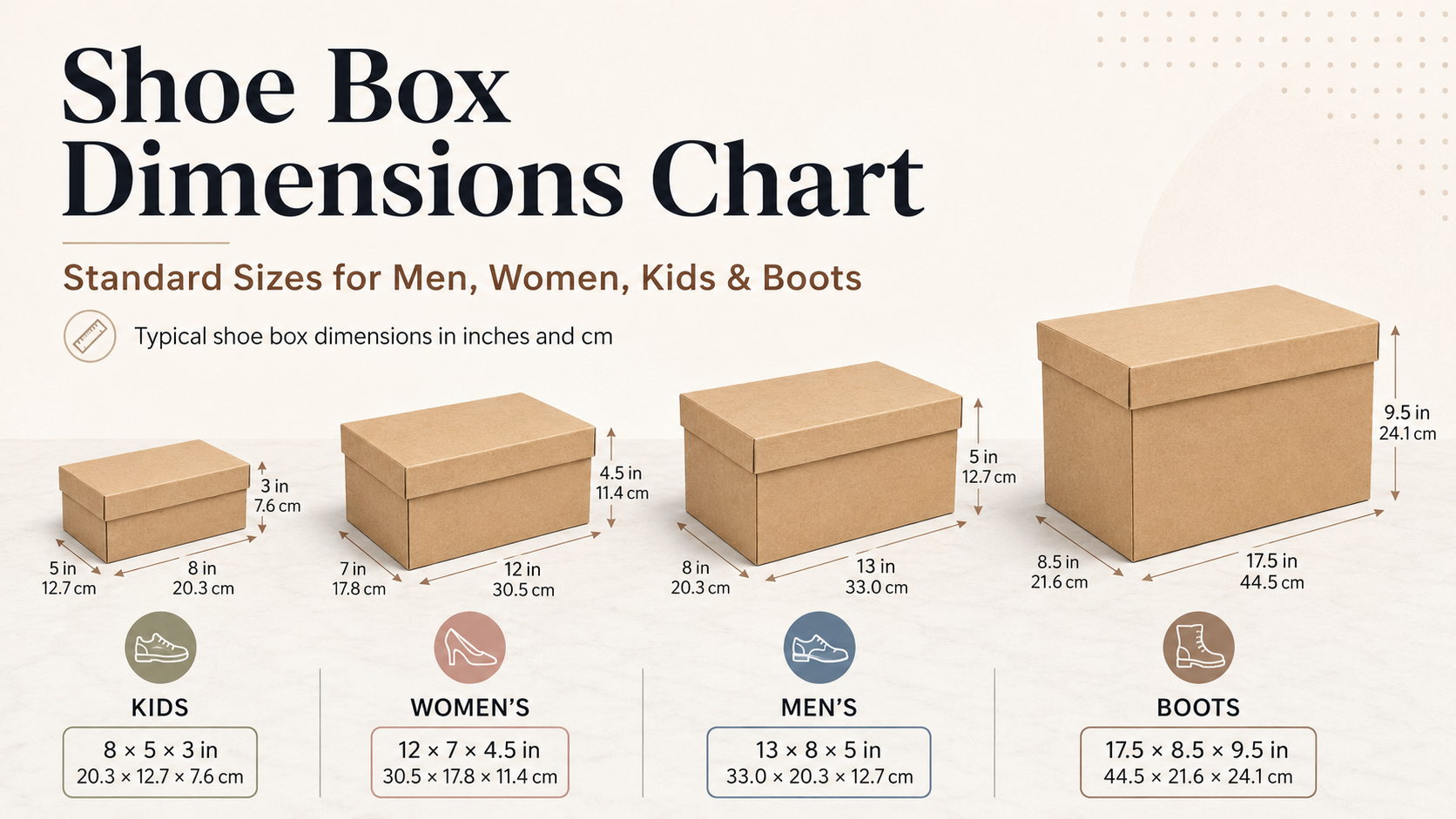
A standard adult shoe box runs about 13 × 8 × 5 inches for men’s. Women’s runs a touch smaller at 12 × 7 × 4.5 inches. That’s the two-piece, lid-and-base style most shoe brands still use. Kids’ boxes shrink to roughly 8 × 5 × 3 inches, and boots need considerably more depth. The chart below breaks out every category, plus where the printed shoe size stops telling you anything useful. This post is part of our size guide series, alongside our breakdowns of pizza box sizes and mylar bag sizes. For everything else, our full box size guide covers the rest.
Shoe Box Dimensions Chart
| Category | Dimensions (L×W×H, inches) | Dimensions (cm) | Typical Use |
|---|---|---|---|
| Infant (sizes 1–4) | 6.25 × 4.25 × 2.75 in | 15.9 × 10.8 × 7 cm | First walkers, crib shoes |
| Toddler (sizes 5–9) | 8.25 × 5.25 × 3.25 in | 21 × 13.3 × 8.3 cm | Toddler sneakers, sandals |
| Youth/Big Kids (sizes 10–6) | 10.25 × 6.25 × 4 in | 26 × 15.9 × 10.2 cm | School shoes, youth sneakers |
| Women’s | 12 × 7 × 4.5 in | 30.5 × 17.8 × 11.4 cm | Flats, sneakers, standard heels |
| Men’s | 13 × 8 × 5 in | 33 × 20.3 × 12.7 cm | Standard sneakers, dress shoes |
| Ankle Boots | 13.5 × 7.5 × 6.5 in | 34.3 × 19.1 × 16.5 cm | Ankle boots, booties |
| Knee-High Boots | 17.5 × 8.5 × 9.5 in | 44.5 × 21.6 × 24.1 cm | Tall and knee-high boots |
Men’s sizes 12 and up tend to run a half inch to an inch longer than the standard box above. Chunky midsoles can add another half inch of height on top of that. If you’re boxing size 12+ athletic shoes, size the box to the actual shoe rather than the chart.
How to Measure a Shoe for Its Box
Measure the shoe itself, heel to toe, at its longest point, not the printed size on the label. Two different size 10 sneakers from two different brands can differ by half an inch in actual length. “Size 10” isn’t a fixed measurement — it’s a brand’s own last, and lasts vary.
Add clearance on all three dimensions once you have the shoe’s real measurements. A quarter to half inch on length and width keeps the shoe from wedging against the walls. Height needs the most padding of the three. A sneaker’s toe box and heel counter are rigid. A box that’s too short will crush them every time the lid goes on.
Sizing for Boots vs. Sneakers vs. Flats
These three categories don’t scale the same way, and treating them like they do is where most sizing mistakes start.
Sneakers and flats are wide and flat. Their box dimensions track shoe length and width closely, with modest height. Boots are the opposite. Their footprint barely changes from an ankle bootie to a knee-high, but the height climbs dramatically. That’s why a knee-high boot box runs nearly double the height of an ankle boot box. Both still hold roughly the same size foot.
There’s a real trade-off in how boot boxes get built. A box tall enough for the shaft to sit upright looks better on a shelf. It also wastes cubic space in shipping. Some brands fold the boot shaft over instead, using a shorter box. It ships cheaper, but the shoe arrives with a crease that needs steaming out. Neither option is wrong. It depends on whether the box is going to a retail shelf or straight to a customer’s door.
Custom Shoe Box Sizes
The chart above covers standard adult and kids’ sizing. It doesn’t cover platform soles, orthopedic builds, or cleats with a hangtag window. It also doesn’t cover anything sold as a matched pair with an insert. Those need a box built around the actual product, not the nearest size on a chart.
Easy Box Packaging builds shoe boxes to the exact dimensions a shoe needs, tissue inserts and printed branding included. I’ve measured plenty of “size 9” sneakers that needed a size 10 box. Once the sole and midsole are accounted for, the label stops being reliable. A custom cut removes that guesswork entirely, and the box shows up ready to ship, not sized “close enough.”
Packaging plays a bigger role in repeat purchases than most footwear brands give it credit for. We get into that more in our piece on why packaging drives repeat purchases. A shoe box that fits well and opens cleanly reads as a better product. That holds true even when the shoe inside is identical to a competitor’s.
Frequently Asked Questions
What size box does a men’s size 10 shoe need? A standard 13 × 8 × 5-inch box fits most men’s sizes up to about 11. Size 12 and above typically needs a half inch to an inch more length.
Do boots need a taller box than sneakers? Yes, significantly. An ankle boot box runs about 6.5 inches tall versus 5 inches for a standard sneaker box. A knee-high boot box can run 9.5 inches or more.
The Bottom Line
Shoe box dimensions split cleanly by age group and shoe type. The printed size on the box means less than the actual shoe in front of you, though. Measure the shoe, add clearance, and match the box to what you’re actually shipping. Get a quote and get a box built to the shoe, not the label.