
New York’s Packaging Standard Is Not the US Average
Blunt truth: soft-touch laminate, foil stamping, and spot UV are not luxury upgrades in the New York beauty, fashion, and specialty food market. They’re table stakes.
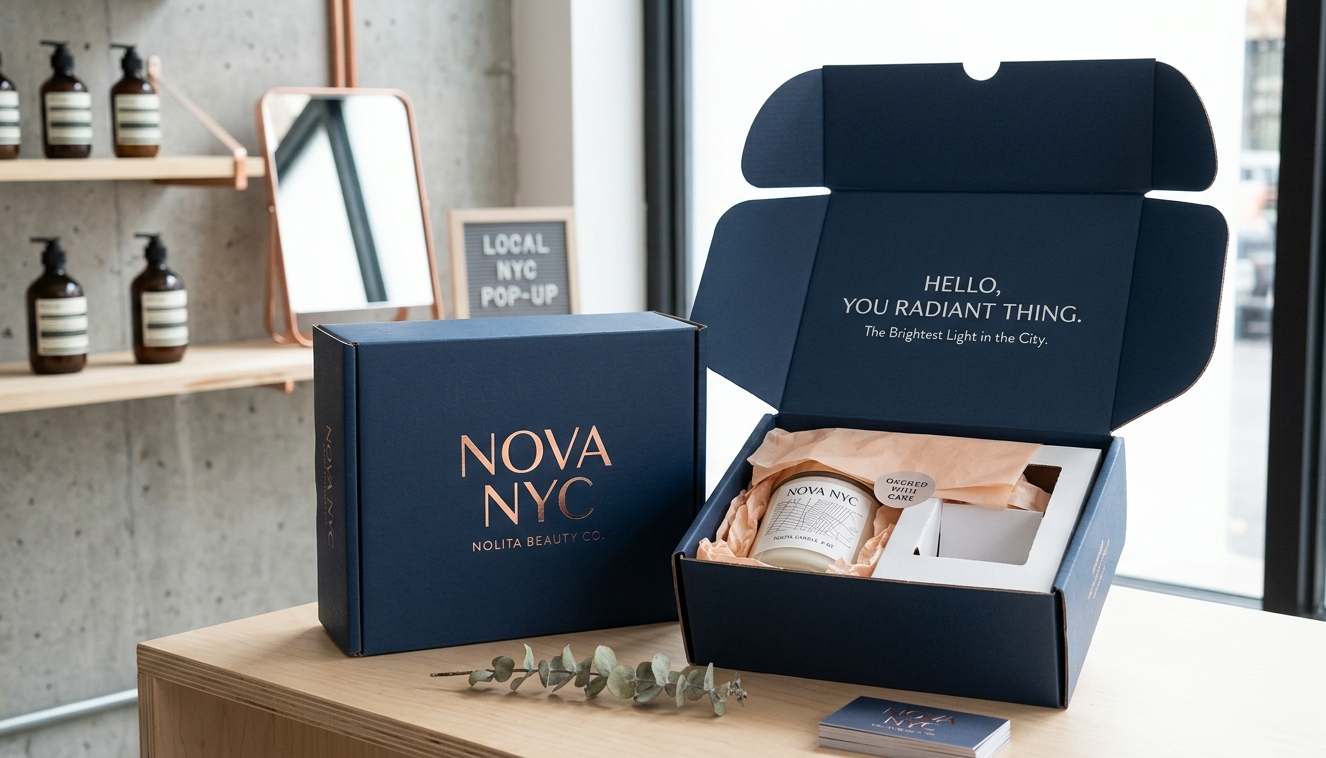
When a customer in Nolita picks up your candle from a pop-up next to Aesop, your box is being silently compared to Aesop’s box. That’s not fair. It doesn’t matter. It’s the reality.
I was at a pop-up in Nolita recently and watched a brand get passed over by customers specifically because the box looked like a return from Amazon. The product was genuinely good. The packaging killed it. The founder had no idea it was happening — nobody stopped to explain why they put it back down.
We’ve seen this pattern enough times that it stopped being surprising. Brands spend real money on a product, then ship it in a plain kraft mailer that reads “prototype” to the customer receiving it. The packaging doesn’t have to be extravagant. It has to feel considered.
This doesn’t mean you need a $40 rigid box for a $28 product. But a few things consistently matter:
Texture. A matte laminate finish signals care. A glossy, fingerprint-prone surface can quietly undercut an otherwise great product — and you won’t know it’s happening because customers won’t tell you.
Print quality. Muddy colors or slightly off-registration printing reads as amateur in a market where customers know what good printing looks like. They really do.
The interior. NYC-based buyers — especially those who’ve been through a dozen DTC subscription boxes (and they have) — notice when the unboxing experience is thought through versus thrown together.
You don’t have to match Aesop’s budget. You have to match their intentionality.
- Why NYC buyers hold small DTC brands to the same standard as Glossier and Allbirds
- How to match your packaging specs to your specific borough’s buyer
- The tri-state supplier advantage most NYC brands miss
- Why “low MOQ” quotes often aren’t what they look like
- How to vet a supplier and build a relationship that speeds up reorders
Know Your Borough, Know Your Buyer
New York isn’t one market. This is probably the most useful reframe for any brand doing custom boxes in New York, and it’s one most brands skip entirely. A Williamsburg streetwear drop has different packaging expectations than a West Village candle brand or a Jackson Heights specialty food retailer. Not slightly different. Actually different.
SoHo and Downtown Manhattan
Premium retail territory — and the most unforgiving room in the city. If you’re selling here, rigid setup boxes, foil stamping, and embossed finishes aren’t upgrades, they’re admission tickets. Your packaging is part of the in-store display. Buyers here have seen the best of what the industry produces, and they notice when something doesn’t belong. A brand that corners SoHo with strong packaging will punch above its weight class for years. A brand that treats SoHo like any other market will wonder why the sell-through numbers don’t add up.
Williamsburg and North Brooklyn
Artisan signals dominate, but there’s a specific version of “artisan” that works here and a version that reads as try-hard. Kraft stock, natural textures, handwritten-style fonts, visible sustainability credentials — yes. But the packaging also has to feel like it was made by someone with taste, not assembled from a “indie brand starter pack.” The aesthetic is “made carefully, not made at scale” — even if you’re absolutely at scale. Williamsburg buyers are good at spotting the difference.
Bushwick and the Eco-Corridor
Eco credentials need to be on the box, not buried on your website. Visible certifications, recycled content callouts, plastic-free construction — for this buyer, those aren’t nice-to-haves. If your branded packaging in New York for this audience doesn’t signal environmental awareness, you’re leaving real trust on the table.
Queens and Harlem/Bronx
Two different neighborhoods, but they share something: speed and authenticity over premium polish. In Queens — particularly LIC, Astoria, and Flushing — there’s a growing DTC food and specialty goods scene where clean, clear branding on a short-run mailer box consistently outperforms over-engineered packaging. In Harlem and the Bronx, the aesthetic skews bold and identity-driven. Customers here are brand-loyal when you earn it, and packaging that feels authentic to the brand earns it faster than anything borrowed from a Williamsburg mood board.
The Tri-State Advantage Most NYC Brands Don’t Use
A lot of New York brands haven’t considered this: you don’t need a Manhattan-based manufacturer.
New Jersey and Connecticut have legitimate, established packaging suppliers. B&C Industries in NJ and PackEdge in CT are worth looking at — both have real track records in the region. They’re typically 1–2 business days transit to any NYC address. Functionally the same speed as local, without the cost premium that comes with Manhattan rent baked into supplier pricing. I’m not on their payroll — just names worth googling if you’re doing your regional research.
NYC founders default to searching for packaging suppliers in NYC when what they actually need is regional, not local. Those aren’t the same thing. A supplier in Newark or Stamford who has your files on record and a dedicated rep who knows your specs will serve you better than a local print shop that treats you like a walk-in every single time.
If you want to test structural options — different corrugated weights, insert configurations, closure styles — Easy Box Packaging offers custom sizing and structural prototyping so you can evaluate the actual box before committing to a production run. That kind of hands-on testing is easier to justify when you’re not paying a geographic premium just for the zip code.
Pricing and MOQs vary by specification. Request a custom quote for accurate details.
Why “Low MOQ” Quotes Aren’t Always What They Look Like
This one trips up small brands constantly. A supplier quotes you a low MOQ — say, 250 units — at a unit price that seems reasonable. You approve artwork. Then the invoice arrives and there’s a plate setup charge (typically $400–$800+ depending on color count and complexity) that wasn’t exactly front and center in the initial conversation.
Plate fees are real and legitimate. Flexographic and offset printing require physical printing plates, and those cost money to produce. The more colors in your design, the higher the setup cost, since plates are made per color. But if you’re doing a 200-unit limited drop and the all-in cost is nearly double the unit price quote, your economics just broke.
Always ask for a total all-in quote before you approve artwork. Ask specifically:
- Are there plate setup or tooling fees?
- Is digital printing available for this run size?
- What does reordering cost (without new setup fees)?
Under 500 units? Go digital. Anyone quoting you plates on a 200-unit run is either not set up for small brands or hoping you don’t know the difference. Digital printing works differently from offset or flexo — it prints directly from a digital file, no physical plates required. No plates means no plate-making cost means no setup fee. You can also change your artwork between orders without any financial penalty, which matters if you’re running seasonal drops or testing colorways.
Setup is typically same-day or next-day for digital. Per-unit cost is higher, but total cost — especially on a first run or a limited drop — is almost always lower.
Speed That’s Actually Trend-Compatible
New York has a drop culture. Limited releases, pop-up exclusives, seasonal collaborations — these are real commercial strategies for a lot of brands here. And drop culture has a ruthless timeline. If your custom shipping boxes in New York take 12–14 weeks to arrive from overseas, you’ve already missed the window.
Realistic domestic timelines for digital short-run packaging:
- Artwork approval to production start: typically 1–2 business days
- Production and printing: typically 5–7 business days
- Shipping to NYC-area address from a regional supplier: typically 1–2 business days
- Total: typically 10–14 business days from approved artwork
That’s workable for a 3-week launch window. Overseas is not.
These are realistic estimates, not guarantees. Production delays happen — supplier capacity, artwork revisions, shipping exceptions. Build 2–3 days of buffer into any timeline that actually matters.
The brands who execute drops cleanly all do one thing the scramblers don’t: they build a supplier relationship designed for reorders. Get a named account rep. Have them hold your brand specs, approved dielines, and color profiles on file. When you reorder, you’re not starting over — you’re authorizing a repeat of a known, pre-approved file.
Almost nobody does this until they’ve been burned by a delayed reorder once. Don’t wait for the lesson.
Sustainability Is a Visible Brand Signal in New York
Research suggests a meaningful share of NYC-area consumers have switched to a competitor specifically because of more sustainable packaging options. That proportion tends to be higher in certain neighborhoods (see the borough breakdown above), but the pattern holds across the market as a whole.
“Eco-friendly” is not a differentiator anymore. It’s noise. Every brand claims it. What works is specificity — and the brands getting traction in this market know that.
Instead of “eco-friendly packaging,” put the actual credential on the box:
- FSC-certified corrugated (Forest Stewardship Council certification, third-party verified)
- X% post-consumer recycled content
- Plastic-free construction
- Curbside-recyclable
If your supplier can’t give you documentation on any of those claims, that’s your answer about how seriously to take their sustainability pitch.
We offer 100% FSC-certified corrugated options for brands that need to put a real credential on the box rather than a vague claim. That documentation exists and can be passed through to your customer if you want to be transparent about the supply chain.
How to Vet a Custom Packaging Supplier in New York
Whether you’re sourcing locally, regionally, or nationally, the vetting process is the same. Having worked with 10,000+ brands, we’ve seen what separates the suppliers who make reorders easy from those who make them painful.
Get physical samples, not mockups.
A 3D render tells you what something might look like. A physical sample tells you how it feels, how the lid closes, whether the insert holds the product securely. Always request samples before committing to a production run. Results vary by product and handling. We recommend testing samples before full production.
Ask about reorder consistency.
Color matching between runs is a real problem with some suppliers — and it rarely comes up until you’re staring at two boxes that are supposed to be the same brand but clearly aren’t. Ask directly: how do you ensure color consistency on reorders? Do you retain my files and specifications? What’s your tolerance on Pantone matching?
Ask for references from brands in your category.
A supplier who does great work on industrial corrugated may not be the right partner for premium beauty packaging. Ask who else they serve. Ask to speak with a reference in a similar product category.
Get a total all-in quote.
Unit price, setup fees, tooling, shipping, proofing — all of it. Don’t compare quotes until you’re comparing equivalent all-in numbers. You’d be surprised how many brands skip this step and then wonder why the invoice looks different from the conversation.
Ask about the account management structure.
If the answer is “you’ll work with whoever’s available,” that’s a signal. You want a single point of contact who knows your brand.
Easy Box Packaging handles sampling, proofing, and production in a single workflow — so you’re not managing three different vendor relationships to get from concept to finished box. That’s not always the right fit for every brand, but for founders who don’t have a dedicated packaging ops person, consolidating the workflow matters.
FAQ: Custom Packaging in New York
How much does custom packaging cost in New York?
It depends heavily on run size, materials, and finish. Digital short-run packaging for 250–500 units typically runs higher per unit than offset runs of 1,000+. Always request a total all-in quote that includes setup fees and shipping. Pricing and MOQs vary by specification — request a custom quote for accurate details.
What’s the minimum order quantity for custom boxes in New York?
MOQs vary by supplier and print method. Digital printing often starts at 50–100 units, though minimums vary by provider. Offset and flexographic printing typically starts at 500–1,000 units due to plate costs. If you’re doing small drops, ask specifically about digital options.
How long does custom packaging take in New York?
For digital short-run orders with a regional supplier, 10–14 business days from artwork approval is typically realistic. Overseas production can run 8–14 weeks. For time-sensitive drops, domestic regional suppliers are almost always the right call.
Do I need a local NYC supplier, or can I use a regional one?
Regional is functionally equivalent to local for most NYC brands. New Jersey and Connecticut suppliers are typically 1–2 business days transit to NYC. You’ll often get better pricing than Manhattan-based shops, with comparable turnaround.
What’s the difference between digital and offset printing for custom boxes?
Digital printing requires no physical plates — setup is fast, costs are lower for small runs, and you can change artwork between runs without additional fees. Offset and flexographic printing requires plates (typically $400–$800+ in setup costs, depending on color count and complexity) but produces lower per-unit costs at higher volumes. For runs under 500 units, digital almost always wins on total cost.
How do I know if a supplier’s packaging is actually sustainable?
Ask for documentation: FSC certification numbers, recycled content percentages, third-party audit reports. “Eco-friendly” without specifics is marketing language. Real sustainability claims come with paperwork.
Conclusion
Look, NYC is a tough room. Your customers have been handed Glossier boxes and Aesop bags and Allbirds mailers — they know what good packaging feels like even when they can’t articulate why. The brands that get this right aren’t necessarily spending more money. They’re just being deliberate about the things that matter for their specific buyer, neighborhood, and use case.
Start with one good sample. Figure out your borough. Ask for the all-in quote upfront. Build a supplier relationship designed for reorders, not one-off transactions. The rest follows from there — and faster than you’d expect.
Want to go deeper on specific packaging formats? Custom mailer boxes covers structure and materials in detail. If you’re expanding beyond New York, we’ve also covered industry-specific packaging strategies and custom packaging for Texas brands.