
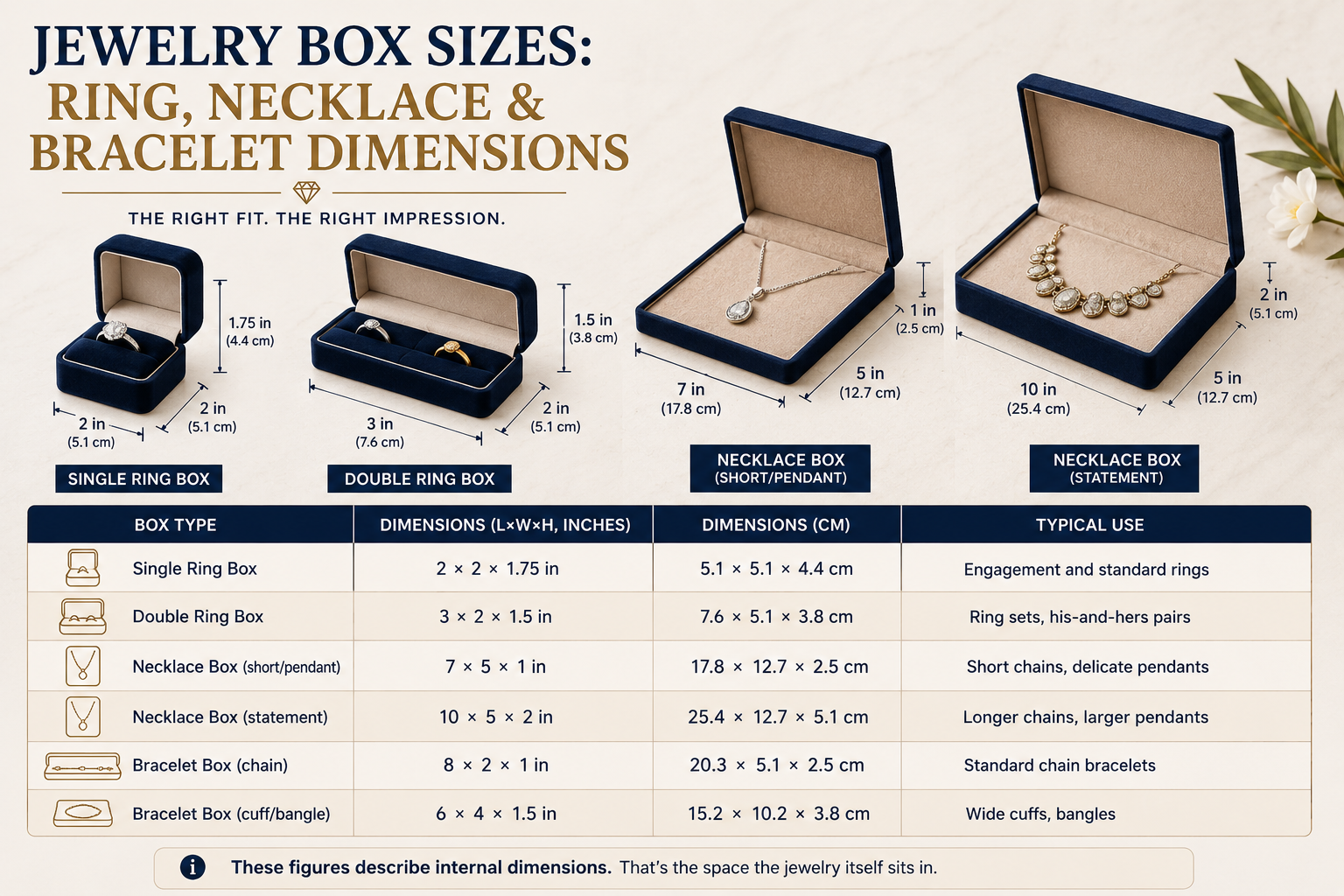
Jewelry box sizes vary more by piece type than any other category in this cluster. A ring box runs about 2 × 2 × 1.75 inches. A necklace box runs anywhere from 7 × 5 × 1 inches up to 10 × 5 × 2 inches. Bracelet boxes sit somewhere in between, depending on the style. This guide charts all three. It also explains why ring boxes work differently from the rest. It’s part of our size guide series alongside our cosmetic box sizes and soap box dimensions guides. For everything else, our full box size guide covers the rest.
Jewelry Box Size Chart
| Box Type | Dimensions (L×W×H, inches) | Dimensions (cm) | Typical Use |
|---|---|---|---|
| Single Ring Box | 2 × 2 × 1.75 in | 5.1 × 5.1 × 4.4 cm | Engagement and standard rings |
| Double Ring Box | 3 × 2 × 1.5 in | 7.6 × 5.1 × 3.8 cm | Ring sets, his-and-hers pairs |
| Necklace Box (short/pendant) | 7 × 5 × 1 in | 17.8 × 12.7 × 2.5 cm | Short chains, delicate pendants |
| Necklace Box (statement) | 10 × 5 × 2 in | 25.4 × 12.7 × 5.1 cm | Longer chains, larger pendants |
| Bracelet Box (chain) | 8 × 2 × 1 in | 20.3 × 5.1 × 2.5 cm | Standard chain bracelets |
| Bracelet Box (cuff/bangle) | 6 × 4 × 1.5 in | 15.2 × 10.2 × 3.8 cm | Wide cuffs, bangles |
These figures describe internal dimensions. That’s the space the jewelry itself sits in. The outer box can run up to half an inch larger on each side. That extra room accounts for the walls and any outer sleeve.
Why Ring Boxes Work Differently Than Other Jewelry Boxes
Every other box on this chart just needs to clear the piece with some room to spare. A ring box needs the opposite. It needs a slot or cushion insert that grips the ring tightly. That grip has to hold firm enough that the ring doesn’t slide or spin during the reveal. That’s a structural requirement, not just a size question.
This is part of why ring boxes stay so small and boxy compared to everything else on the chart. A loose ring rattling in an oversized box looks cheap. It also risks the ring popping loose the moment the lid opens. The insert, not the outer box, does most of the real work here. Jewelry gifting has carried this kind of ceremony for centuries. The tradition around ring presentation still shapes how tightly these boxes get built today.
How to Measure for a Jewelry Box
Measure the piece fully assembled and laid flat. That’s the way it will actually sit inside the box. A necklace measured stretched out in a straight line needs a longer box. Measure it coiled instead, the way most necklaces naturally rest.
Confirm whether a supplier’s spec sheet lists internal or external dimensions before ordering. That half-inch gap between the two matters more than it sounds. It’s enough to turn a snug fit into a loose one, or the reverse. This mismatch is one of the most common ordering mistakes in jewelry packaging.
Bracelets add one more wrinkle. A rigid cuff sits flat and measures easily, the same way a ring does. A soft chain bracelet drapes and coils, closer to how a necklace behaves. Measure a chain bracelet the way it naturally rests. Don’t stretch it taut across a ruler, or the box will run shorter than the piece actually needs.
Slot Insert vs. Pillow Insert: A Real Trade-off
A slot insert cuts a shape directly into foam or card that matches the ring’s band. It holds the ring rigid and looks deliberate, almost ceremonial. That matters for anything tied to a proposal. The trade-off is real, though. A slot insert only fits one ring size well. A much smaller or larger band rattles loose inside that same slot.
A pillow insert uses a soft, slightly raised cushion instead. It’s more forgiving across different ring sizes. It also works better for stackable rings or sets. It doesn’t hold a single ring quite as rigidly, though. Some buyers find it looks less formal for an engagement presentation specifically. I’d default to a slot insert for one known ring size. A pillow works better for anything variable.
Cost separates the two as well. A slot insert usually needs a die-cut foam piece made for that exact band width. That adds a setup step most pillow inserts skip entirely. A brand ordering a single ring size in bulk absorbs that setup cost easily. A brand offering several ring sizes on demand often finds the pillow simpler to stock and reuse.
Custom Jewelry Box Sizes
The chart above covers standard rings, necklaces, and bracelets. Earring sets, watch boxes, and multi-piece jewelry sets all need their own sizing outside this range. A boxed jewelry set that pairs a necklace with matching earrings adds a layout question. That’s on top of the size question, not instead of it.
Easy Box Packaging builds jewelry boxes to the exact piece and insert style a brand needs. Our jewelry packaging spec guide covers that ground in more depth. It walks through slot inserts, foam density, and printing options across every jewelry format.
Frequently Asked Questions
What size box fits a standard engagement ring? Most single ring boxes measure about 2 × 2 × 1.75 inches inside. Confirm whether that figure is internal or external before ordering, since the gap can run up to half an inch.
Do necklace boxes need to match the chain length exactly? Not exactly, but close. A box sized well under the chain’s natural coiled diameter forces the necklace to bunch or tangle. That defeats the point of a presentation box in the first place. It usually shows up in customer unboxing photos too.
The Bottom Line
Jewelry box sizes depend on the piece type first, and the insert style second. That’s more than any other category in this guide. Measure the piece as it will actually sit. Confirm internal versus external dimensions, and pick an insert that matches how forgiving the fit needs to be. None of that guesswork matters once the box is built around the real piece instead of a generic template. Get a quote and get a jewelry box sized to your actual piece.