
A customer picks up a piece of jewelry. They don’t know the metalwork yet. They can’t assess the stone setting from across a counter. What they know — immediately, before any of that — is what the box feels like in their hand.
That moment is worth understanding. The jewelry packaging box is doing value-signaling work before a single word about the piece is read. A ring in a velvet-lined rigid box with a magnetic closure will consistently sell for more than the same ring in a plain folding carton. Not because the piece is different. Because the packaging said it was.
The global jewellery gift box market is valued at approximately $1.5 billion and growing at 7.2% annually. That growth is driven by one thing: buyers and brands both understand that the box is part of the product, not just a wrapper around it.
The Three Jewelry Packaging Box Formats
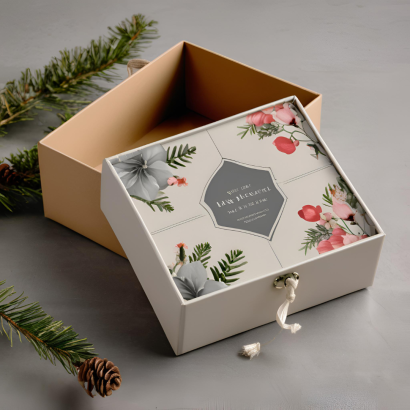
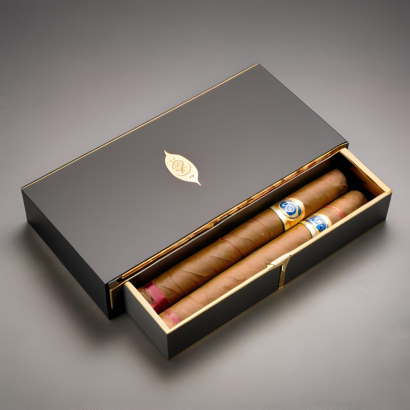
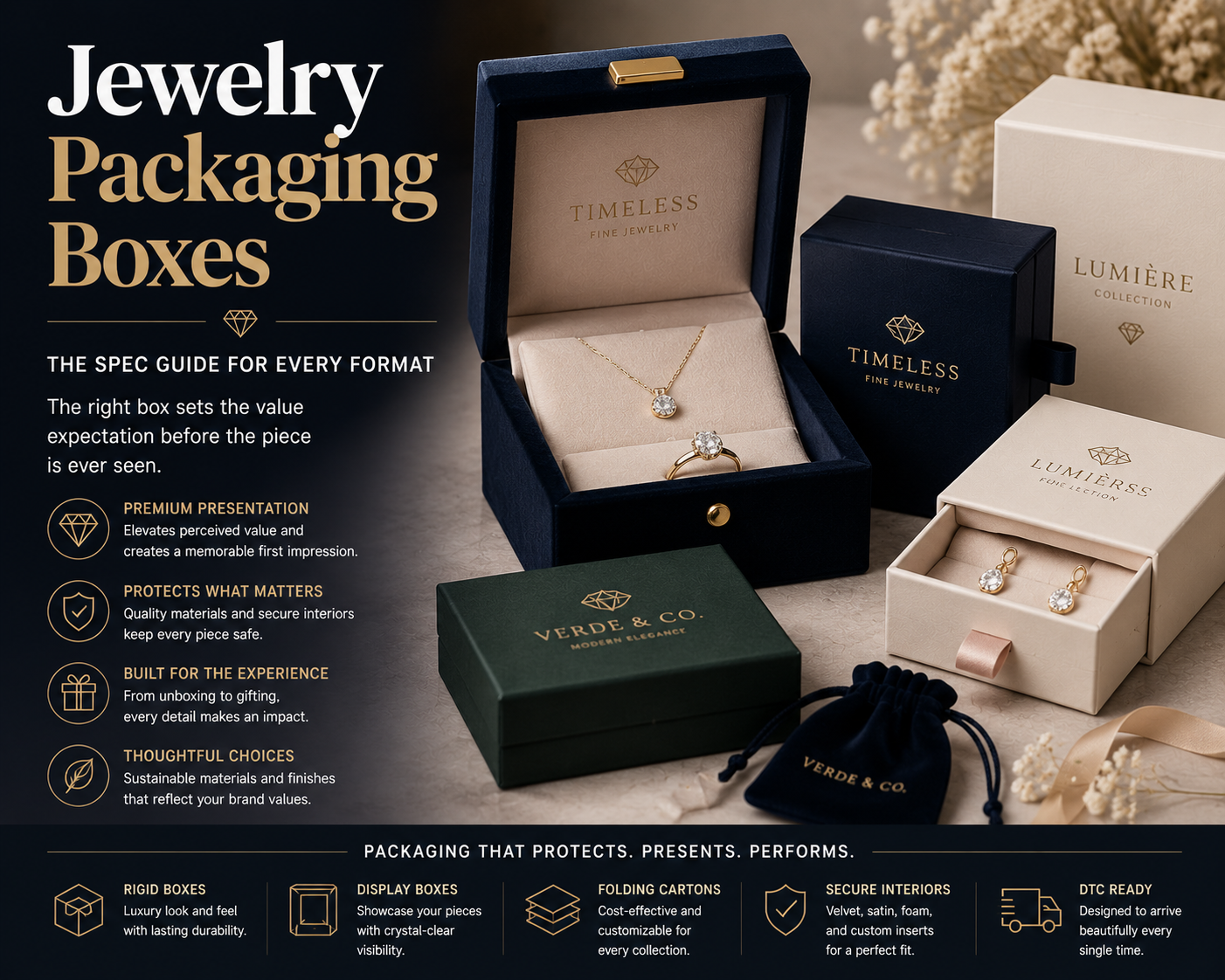
Rigid jewelry boxes. The standard for fine and mid-fine jewelry. Greyboard construction, hinged or lid-and-base format, velvet or satin interior lining. The weight of the box communicates premium before the lid opens. A magnetic closure adds an opening ritual — that soft, controlled seat as the lid closes is one of the strongest tactile luxury signals in retail packaging. Right call for pieces over $80. Below that price point, the economics get tight unless volume is high enough.
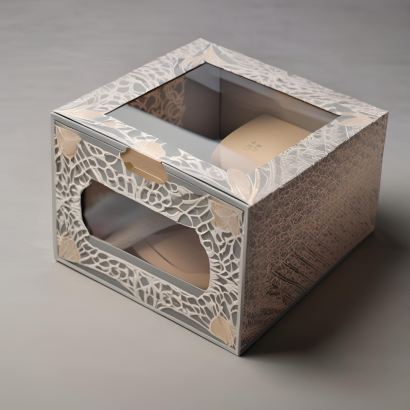
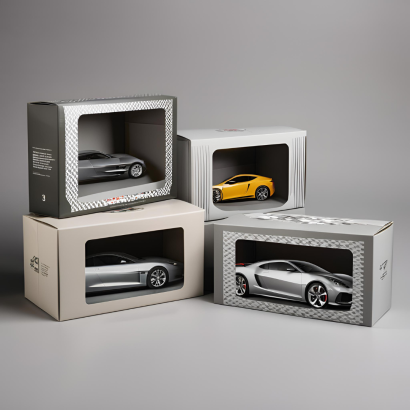
Display boxes with window. For retail counter environments where the piece needs to be visible before purchase — earrings, pendants, rings held in an open-face insert. The customer evaluates the piece without handling it. Reduces the touching problem and the theft risk that comes with it. Works well for silver, mid-market, and costume jewelry. Earrings in particular suit this format — our custom earring packaging boxes use an insert cut to the specific earring style, so a pair stays seated in place and visible through the window instead of sliding around. Less appropriate for fine jewelry where the private reveal is part of the brand experience.
Folding cartons. Lower cost. Fine for accessories, lower price-point pieces, or as outer packaging around an inner jewelry box. As the primary jewelry packaging box, a folding carton reads as functional rather than premium. That’s a valid choice — but it needs to be intentional. I’ve watched brands use plain kraft folding cartons for minimalist sustainable jewelry lines and have it work beautifully. The aesthetic fit was deliberate. If it’s not deliberate, it reads as an oversight.
Interior Spec: The Real Differentiator in Jewelry Packaging Boxes
The exterior of a jewelry packaging box can be perfect and mean nothing if the interior isn’t right.
Velvet flocking is the standard for premium. Soft surface, high perceived value, strong contrast for gold and silver pieces. Black velvet interior against a white or navy exterior puts the piece at the center, not the box.
Satin lining reads slightly softer. Common in bridal and wedding jewelry contexts where warmth matters more than drama.
Cotton fill inserts work for rings and earrings. Lower cost than velvet, appropriate for mid-market pieces.
Custom-cut foam or thermoformed trays hold sets in exact position. An earring and necklace combination in a custom tray feels deliberate. The same pieces in a box with a standard pillow feel assembled. For sets, the insert spec is the decision that separates a premium gift experience from a functional one.
Research on how packaging drives repeat purchases is consistent: the interior is what the customer actually experiences. The exterior gets the box noticed. The interior builds the memory that brings people back.
Sustainability in Jewelry Packaging: 2026 Reality
This matters more than most jewelry brands realise. Over 60% of jewelry brands now require recyclable materials and carbon footprint certification as mandatory supplier criteria. That’s not a trend — it’s the direction the category is moving.
FSC-certified board is the baseline. Paper-based interior finishes as alternatives to synthetic velvet are gaining ground. Soy-based inks and water-soluble adhesives are becoming standard requests in supplier briefs.
One shift worth noting: premium jewelry packaging is increasingly being designed to be kept. Drawer-style boxes that convert to storage. Rigid pouches in vegan leather. Keepsake boxes that outlast the purchase moment. Packaging the customer holds onto keeps doing brand work long after the transaction.
DTC Jewelry: The Two-Box Problem
Shipping jewelry direct-to-consumer means running two packaging jobs at once.
The inner jewelry box creates the brand experience. The outer shipping box protects it in transit.
Most brands get the inner box right and the outer packaging wrong. A beautiful rigid jewellery box inside a plain brown mailer with the inner box sliding around — that’s a common, expensive miss. The inner box needs to fit the outer packaging precisely, with no movement in transit.
The fix: a custom-fit outer corrugated box or a mailer with a foam insert the inner box seats into exactly. Skipping this is one of the most common packaging mistakes in DTC jewelry. Our custom mailer boxes guide covers the outer packaging decision in detail.
Five Specs Before You Order Jewelry Packaging Boxes
1. Hinge or lid-and-base? Hinged boxes stay open — better for retail display. Lid-and-base have a cleaner reveal. Better for gifting and DTC.
2. Interior lining. Velvet for premium and fine jewelry. Satin for bridal. Cotton fill for mid-market. Custom tray for sets.
3. Closure type. Magnetic for premium. Press-fit for standard. Ribbon for traditional fine jewelry contexts.
4. Sustainability spec. Is your buyer asking about materials? Confirm FSC-certified board and paper-based interior options before briefing production.
5. Outer packaging. What holds the inner jewelry box in transit? Confirm before finalising inner box dimensions — they need to work as a system.
Pricing and MOQs vary by specification. Request a custom quote for accurate details.
FAQ
What’s the best jewelry packaging box for retail?
Rigid hinged or lid-and-base boxes with velvet lining for fine and mid-fine jewelry. Display window boxes for counter settings where the piece needs to be visible before purchase. Folding cartons only for lower price points where the economics don’t support rigid construction.
How do I stop jewelry from shifting in the box?
Specify the insert. A cotton pillow holds rings and earrings adequately. A die-cut foam tray holds sets in exact position. A thermoformed insert works for irregular shapes. No insert means the piece moves regardless of how good the outer box is.
What’s the difference between hinged and lid-and-base jewelry boxes?
Hinged boxes stay open on their own — better for retail display. Lid-and-base have a cleaner, more deliberate reveal. Better for gifting and DTC where the opening moment is the experience.
Can jewelry packaging be eco-friendly?
Yes. Specify FSC-certified greyboard, paper-based interior lining, soy-based inks, and water-soluble adhesives. Synthetic velvet flocking is the component hardest to make sustainable — paper-based alternatives exist and are increasingly available from suppliers.
What MOQs should I expect?
Rigid jewelry boxes: typically 100–300 units minimum. Display window boxes: 250–500 units. Folding carton outer packaging: 250–500 units. Confirm with your supplier for your exact dimensions and interior spec.
Jewelry packaging boxes are one of the few packaging categories where the box is doing real selling work — not just containing work. The piece is inside it. The value is communicated by it. The decision to purchase is influenced by how it feels in the hand before the lid even opens. Get the interior right first. Choose the format that matches the price point honestly. And if you’re selling DTC, spec the outer box as carefully as the inner one. That’s the complete job.