
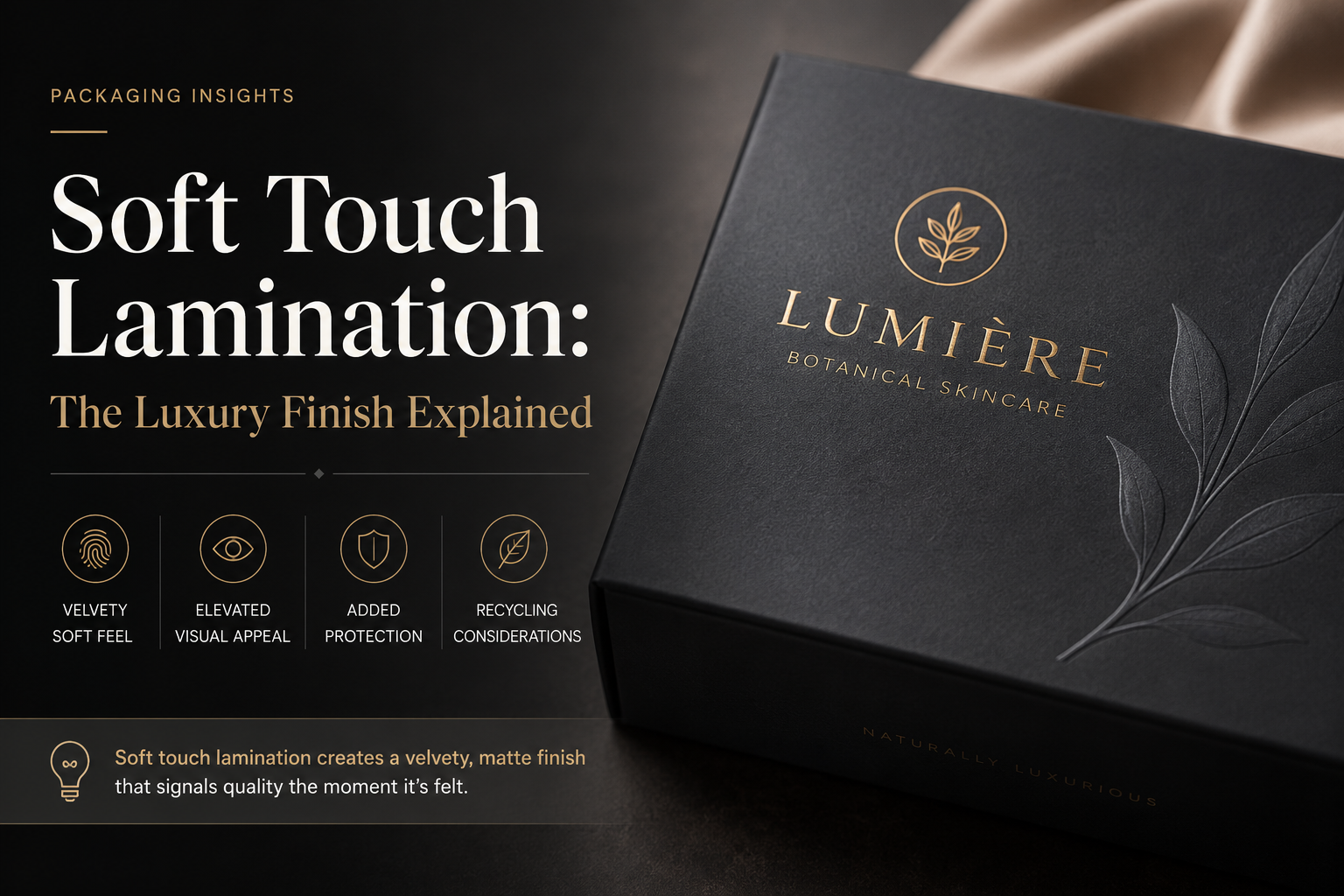
Soft touch lamination is a thin plastic film applied over printed packaging. It leaves a velvety, matte-suede feel under your hand. It’s the finish behind most boxes that feel expensive before you even open them. Run a finger across a soft touch box next to a gloss one. The difference is immediate. One feels like plastic. The other feels like fabric.
That texture comes at a cost, though, and it’s not just the price per unit. Soft touch lamination changes how your colors read. It also changes how easily your box can be recycled. Most vendor pages skip both. They matter more than the swatch in your hand suggests.
What Actually Happens During Lamination
A thin film gets bonded to the printed sheet under heat and pressure. It’s usually BOPP, short for biaxially oriented polypropylene, or something similar. That film carries the soft-touch texture. It sits on top of your artwork as a separate physical layer. It isn’t baked into the ink or the board itself.
That’s the key difference between lamination and a liquid coating. It’s the part most buyers never think to ask about.
Soft Touch Coating vs. Soft Touch Lamination
Soft touch coating is a liquid finish. It gets applied and cured directly onto the printed sheet. The process is similar to the aqueous and UV coatings used elsewhere in packaging. No separate film gets added. The board stays closer to a single, uniform material.
Soft touch lamination works differently. It’s a physical film laminated onto the sheet. It delivers a thicker, more pronounced velvet feel than a coating usually can. That’s why premium supplement brands and high-end cosmetics lean toward lamination specifically. They pay more for that deeper texture on purpose.
Both finishes get compared to fabric, but they don’t feel identical side by side. Coating tends to feel closer to a soft matte paint. Lamination feels closer to actual suede or peach-skin fabric. If you’ve ever handled a hardcover book with a soft touch jacket, that’s usually lamination, not coating.
Here’s the tradeoff nobody puts on the spec sheet next to the price. Coating keeps your box closer to a single-material product. That matters for recycling. Lamination adds a plastic layer instead. That layer has to be separated from the paper fiber before either material can be recycled properly. That separation rarely happens at a normal curbside facility.
Why Bright Colors Look Different Under Soft Touch
Soft touch film mutes color more than gloss or matte finishes do. It’s a subtle shift, but it shows up almost every time. That’s why most soft touch boxes lean toward black, deep jewel tones, or muted pastels. Bold, bright color is rarer on that shelf. Bright, saturated colors read flatter once the film goes on.
I watched a supplements brand learn this the hard way. They wanted a bright citrus-orange box with soft touch lamination. They were aiming for a premium hand-feel on a bold color. The proof looked fine under studio lighting. Once the real run printed, the orange came back noticeably duller and warmer than their actual brand color. The film had knocked back the brightness just enough to matter. They switched that SKU to a soft touch coating instead. The color read true again after that.
If your palette leans bright or pastel, ask for a physical soft touch sample in your real colors. Do this before committing to a full run. A generic swatch in black or navy won’t tell you much. It won’t show how your orange or lime green holds up under real film.
That’s exactly the kind of surprise behind one of those packaging mistakes that kill the unboxing moment. It’s avoidable with one sample request before the print run locks in.
The Recyclability Tradeoff
Laminated paper generally can’t be separated and recycled through standard curbside programs. The film is fused to the fiber. The two materials don’t come apart in a normal recycling stream. Industry recyclability guidelines recommend keeping non-paper laminate content under roughly 5% of total pack weight. That’s the target if curbside recyclability matters to your brand. A full soft touch laminate film runs well past that threshold.
Soft touch coating avoids this problem almost entirely. It doesn’t add a separate plastic layer. The board stays closer to a single recyclable material as a result.
None of this rules lamination out. It just means the choice is a real tradeoff. You’re weighing the deepest version of the feel against one question. What happens to the box after your customer is done with it? Weigh that honestly before it becomes a line item you can’t undo.
Where Soft Touch Actually Earns Its Cost
Soft touch works best when the box itself is part of the product experience. Supplement tubs, cosmetics, and gifting all benefit from that texture. So does anything meant to feel premium the moment it’s picked up. It’s a first-touch signal, before a customer even reads the label.
It’s a weaker fit for anything shipped loose in a mailer. The same goes for boxes that get handled once and thrown away. Building custom mailer boxes that mostly travel through a shipping network? The cost of a deep velvet texture is largely wasted there. Nobody lingers on a shipping carton long enough to notice.
There’s a middle case worth naming too. Subscription boxes and gift sets often get opened once, then photographed and shared right after. That single moment of handling is exactly the kind of interaction soft touch is built for. It doesn’t matter if the box never gets touched again after that first unboxing.
Soft Touch Coating vs. Lamination: Quick Comparison
| Factor | Soft Touch Coating | Soft Touch Lamination |
|---|---|---|
| Application | Liquid, cured onto the sheet | Physical film bonded under heat |
| Feel | Softer touch, less pronounced | Deeper, more velvet-like texture |
| Color impact | Minimal muting | Noticeable muting on bright colors |
| Recyclability | Stays closer to single-material | Complicated by the added film layer |
| Relative cost | Lower | Higher |
Common Mistakes When Specifying Soft Touch
The first mistake is picking soft touch lamination for a bright palette without testing a real sample first. Colors on a screen or a generic swatch rarely match what actually prints.
The second mistake is assuming “soft touch” always means the same process. Coating and lamination deliver a similar feel through very different methods. Their price points and recyclability profiles differ just as much.
The third mistake is choosing lamination purely for the deepest texture. That’s a waste on a box that only gets touched once. That premium feel gets wasted on a shipping mailer nobody lingers on.
A fourth mistake is ignoring recyclability entirely when it’s part of your brand story. A soft touch laminate film undercuts a “recyclable packaging” claim faster than almost any other finish choice.
A fifth mistake is treating this as a one-time decision for an entire product line. A brand’s hero SKU might justify full lamination. A lower-margin line item in the same family might do just as well with a coating instead. That difference adds up across a full catalog.
Which Should You Choose?
Building a rigid box for a premium supplement or cosmetic line, in a dark or muted palette? Soft touch lamination earns its cost there. The deeper texture matches the price point, and dark colors won’t fight the film.
Working with a bright or pastel brand palette, or want to keep recyclability intact? Soft touch coating gets you most of the feel, without the same tradeoffs attached.
Not sure which fits your structure? Our guide to luxury rigid box packaging covers how finish choices interact with box structure in more detail. Easy Box Packaging can walk through sample options before you commit to a full print run.
Soft touch is one of those finishes that photographs well and feels even better in person. Just make sure the version you pick actually fits your colors. It should also fit your box’s real life after checkout, not just the mockup. Getting that match right ties into why packaging drives repeat purchases. It’s rarely just a one-off order.
Soft Touch Lamination: FAQ
Is soft touch lamination the same as velvet lamination? Yes. “Velvet lamination” is just another name for the same thickly-textured, suede-like film finish.
Does soft touch lamination show fingerprints? Less than gloss at first. On a busy retail shelf, though, fingerprints and oils build up as more hands touch the box.
Can soft touch packaging be recycled? Soft touch coating generally can, since it doesn’t add a separate film. Soft touch lamination usually can’t go through standard curbside recycling. The plastic film is fused to the paper fiber, and the two don’t separate easily.
Get a free quote — dieline and design support included.