
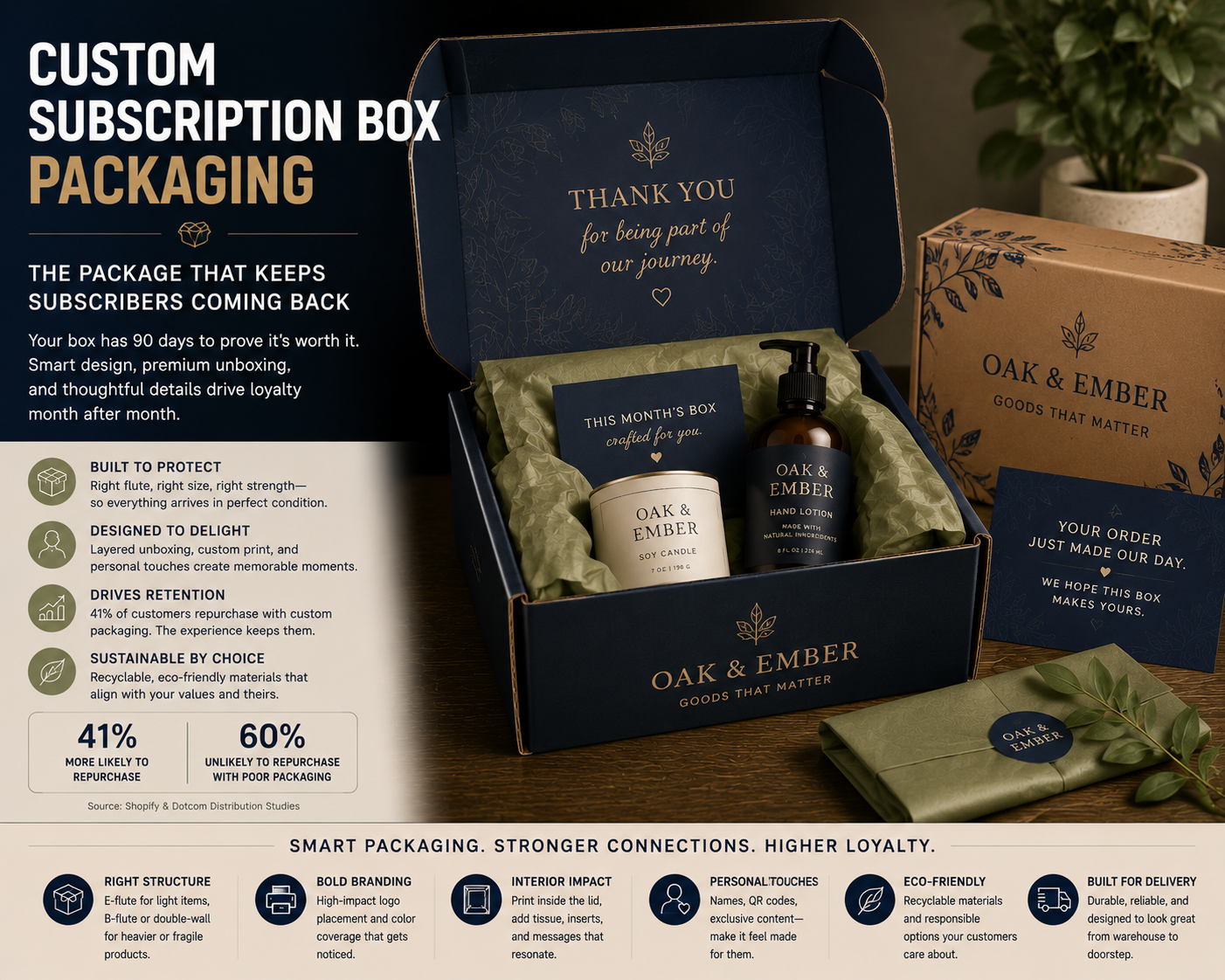
Your custom subscription box packaging has about 90 days to prove it’s worth the line item on a customer’s credit card statement. Research suggests nearly half of all subscription cancellations happen in that first three-month window. Which means the box isn’t just protecting product — it’s running the audition.
The product earns the first order. The packaging earns the twelfth.
I watched a coffee subscription brand — $89/month, specialty roasts from three origins, genuinely excellent sourcing — lose a significant portion of their first-month cohort before the second shipment had even gone out. Not because the coffee was bad. Because the bags were shifting and clacking against thin E-flute walls during transit. Nothing broke. Nothing spilled. But the sound during unboxing told the subscriber something the brand hadn’t intended to say: we didn’t think this through. They switched to B-flute corrugated — heavier board, same exterior footprint — and the cost delta was about $0.22 per unit. The retention improvement made that number look small very quickly.
That’s the lens through which every decision in custom subscription box packaging has to be made: not just what protects the product, but what keeps the subscriber.
The Box Construction Decisions That Actually Matter
Most custom subscription box packaging is built around corrugated mailer boxes — specifically the Roll-End Front Tuck with Dust Flaps format (REFT with DF, if you want the shorthand). It assembles quickly in a fulfillment environment, the tuck closure holds firm in transit, and the dust flaps keep products from migrating toward the opening edge during handling.
The flute choice matters more than it looks like it should. E-flute (1/16″ thick) works for most non-fragile product sets — lighter, compact to store, cost-effective. Move to B-flute or double-wall when you’re shipping glass, ceramics, anything heavy, or anything that could shift and make noise inside the box. This is less about protection than it sounds. A board weight decision is also a sound decision. It’s an unboxing experience decision wearing a spec sheet.
The coffee brand story above isn’t unusual. I’ve talked with enough subscription operators to know that the E-to-B flute upgrade is one of the most under-documented retention moves in the category. It doesn’t show up in product analytics. It shows up in churn rate, three months in.
Size is the other decision that trips brands up. A box that’s oversized for its contents creates a half-empty opening moment — and no matter how good the products are, “there’s a lot of void fill in here” reads as “we grabbed a close-enough box.” It also adds dimensional weight and drives up shipping cost per unit. I’ve watched brands try to save $0.08/unit by undersizing, then spend more on customer service tickets when corners arrived crushed. Spec the box for the product first. Optimize the shipping tier second. Not the other way around.
If you’re still deciding between mailer boxes and standard shipping boxes for your format, our ecommerce packaging guide covers that structural decision framework.
How the Opening Experience Actually Works
The brands that earn unboxing videos plan the opening in layers. Outer box → tissue paper → product wrap → insert card. Each layer slows the opening. Each layer builds the moment before the subscriber actually reaches the product.
This sounds simple written out. The execution is where most brands miss it.
A custom printed outer box with bare chipboard interior, products sitting loose inside, is a box that peaks at the street-side. Everything after the lid opens is a relative let-down. Dotcom Distribution’s packaging consumer study found 60% of consumers are unlikely to repurchase from a brand that delivered a poorly packaged order — for subscription brands, where that box arrives every month, that number should sting. Research on how packaging drives repeat purchases confirms what operators see in their own data: subscribers remember and describe what they found inside the box far more than what the exterior looked like.
The interior lid panel — the first surface visible when the box opens — is the most underinvested print surface in subscription packaging. More brands print the outside bottom (where it faces the carrier’s belt) than the lid interior (where it faces the subscriber’s face on opening). That’s backwards. If you’re choosing where to invest in print coverage, start with the first surface the subscriber sees, not the last.
The insert card is the cheapest element in the box and does more retention work per dollar than almost anything else. Subscriber’s name. A message specific to this month’s box. A QR code to a “this month’s box” video that only paying subscribers can access. None of that is expensive. All of it signals that the brand built this for them specifically — not for subscribers generally.
The Personalization Problem (And the Price Point Trap Inside It)
Industry surveys consistently find that two-thirds of subscribers cite personalization as a primary reason for staying. Most brands hear that and think product curation. The packaging side of personalization usually goes untouched — which is a mistake, because the packaging is the first personalization signal the subscriber encounters, before they even reach the product.
Personalization in the box doesn’t require variable digital printing on every unit. Tissue in the brand’s seasonal color. A printed insert with the subscriber’s first name rather than “valued customer.” A handwritten-style note — even at print-scale, the format reads as intentional. These aren’t expensive decisions. They’re specification decisions.
But the personalization spec has to match the price point, and this is where brands get it wrong regularly. A $15/month snack subscription doesn’t need foil-stamped tissue and a ribbon pull closure. A $120/month skincare subscription does. Mismatch between what the subscriber is paying and what the packaging communicates tells them — accurately, whether you intend it or not — that the brand isn’t spending proportionally to the subscription fee. That’s one of the classic packaging mistakes that cost subscription brands long-term customers.
The single question worth asking: when this subscriber opens the box, does it feel like what they’re paying for it? Not better. Just commensurate.
Sustainability, and Why Monthly Scrutiny Changes the Math
One-off e-commerce brands can make an eco claim and have it pass inspection. Subscription brands can’t. The subscriber receives a box every month, accumulates the tissue paper, stacks the boxes, and eventually reads the fine print. Monthly touchpoints create monthly scrutiny.
Shorr Packaging’s 2025 consumer research found 90% of respondents more likely to buy from brands with eco-friendly packaging. For subscription, that stat has more weight than it does in any other format — because the subscriber will encounter the packaging more times than almost any other customer segment you have.
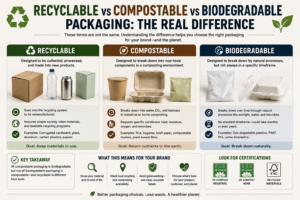
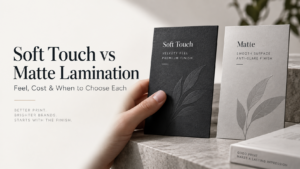
FSC-certified corrugated and soy-based inks are verifiable claims. Aqueous coating over FSC board is recyclable. Soft-touch lamination, depending on the laminate type, is not — and “depends on the type” is exactly the kind of hedged answer that erodes subscriber trust over time. The standard I’d set: if a subscriber asks “can I recycle this?” the answer should be yes, full stop, no footnotes. Any spec that requires a qualifier fails that test. Our eco-friendly packaging cost guide breaks down which sustainability specs actually pay off in subscriber perception versus which ones just add cost for a marketing claim.
What Custom Subscription Box Packaging Actually Costs
Corrugated mailer boxes for subscription use run roughly:
8×6×3″ at 500 units: approximately $1.40/unit with full-color exterior print. 10×8×4″ at 500 units: approximately $1.80/unit. 12×10×5″ at 500 units: approximately $2.30/unit.
Digital printing (no plate setup fees) costs more per unit — $2.50–$4.00 at 100-unit quantities — but makes sense when you’re testing a new box design or launching a subscription tier before committing to a larger flexo run.
The cost mistake that’s easy to make: optimizing the per-unit box cost while ignoring the downstream effects. The $0.10/unit you save on board weight can disappear instantly in filler material, higher shipping zone costs, or customer service volume. The unit cost of the box is visible on the invoice. The cost of a poor unboxing experience isn’t.
Pricing and MOQs vary by specification. Request a custom quote for accurate details.
Five Specs to Lock Before You Order
Box style. Roll-End Front Tuck with Dust Flaps is the right call for most subscription formats. Before finalizing, confirm your fulfillment team can assemble it at real-world speed — the box that looks best in the catalog and the box that moves fastest at a packing bench are not always the same one.
Flute weight. E-flute for standard non-fragile contents. B-flute or double-wall for glass, ceramics, anything heavy, or anything that shifts in transit. The rule: spec for the most fragile product you’ll ever put in the box, not the median product. The median product isn’t what’s going to generate a complaint.
Interior presentation. What’s actually holding products in position? A die-cut corrugated insert runs $0.12–$0.35/unit and eliminates shifting entirely. Without one, the opening experience is only as consistent as your most distracted packing shift. That’s not a standard most brands would accept.
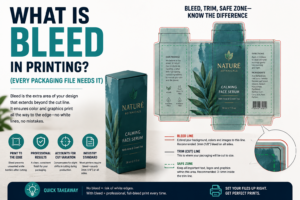
Print coverage. The interior lid panel — first surface visible on opening — deserves more print investment than the exterior bottom. Put the design where the subscriber’s eyes land first. This sounds obvious. It’s still not how most suppliers default their dielines.
Lead time. Custom subscription box packaging typically runs 3–5 weeks in production. Building around Q4, Valentine’s Day, Mother’s Day? Add at least 8 weeks from design brief to first delivery. That’s not being conservative — that’s the actual timeline when you include proofing rounds and sampling. The brands that get caught short almost always had the timeline right, then added one more revision. Our custom mailer boxes guide covers lead time and format decisions in full.
FAQ
What’s the minimum order quantity for custom subscription box packaging?
Flexo-printed corrugated mailer boxes typically start at 500–1,000 units depending on the supplier and spec. Digital printing starts lower — sometimes 25–100 units — with no plate setup cost, at higher per-unit pricing. Confirm MOQs for your exact dimensions and print spec before committing. MOQs vary more than most suppliers advertise.
Does the box style affect what I can print on the interior?
REFT with DF supports full interior and exterior print. The interior lid panel, side panels, and base can all be printed. If you’re planning a reveal print on the interior lid — a brand message, an illustration, a QR code — confirm this on the supplier’s dieline before finalizing the artwork. Not all custom subscription box packaging suppliers print the full interior by default; some treat it as an add-on spec.
The subscription box market is heading toward $22 billion in packaging spend because the box is what makes someone feel like a subscriber, not just a buyer. Get the layered reveal right, match the board weight to what you’re shipping, align the custom subscription box packaging spec to the price point your subscribers expect — and the box does retention work quietly, month after month, without you having to think about it.
The packaging is usually the fastest thing to fix. It’s often the first thing a churning subscriber noticed. And it’s almost always the last thing the brand team updated.