
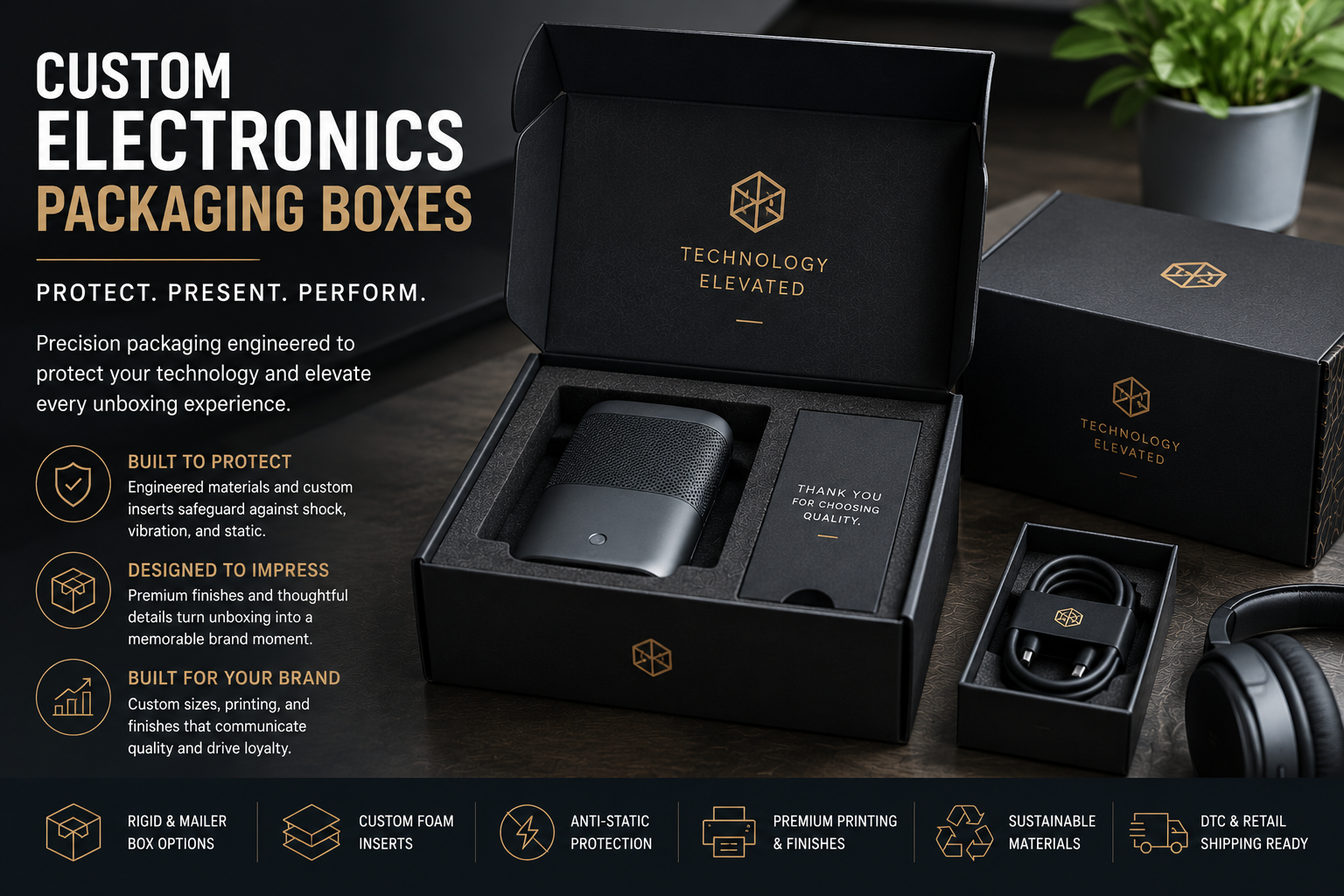
A Bluetooth speaker brand launched their flagship product last year — matte black magnetic lid rigid box, foil-stamped logo, custom foam insert, branded tissue. The unboxing looked exactly right. Sales started well.
Then, six weeks post-launch, a pattern appeared in the reviews. “Speaker died after two months.” “No power after one charge.” Amazon flagged it. The brand ran failure analysis. The control board showed latent ESD damage — the kind that doesn’t kill a component immediately. It weakens it. The device works fine out of the box. It fails weeks later when the damage compounds under normal operating stress.
Their foam insert was generic EPE — expanded polyethylene, the white closed-cell foam most packaging suppliers default to when a customer asks for “foam insert.” It’s not anti-static. The speakers were building up static charge during transit, discharging into the circuit board on unboxing, and nobody noticed because the speakers still powered on.
The fix: carbon-loaded anti-static EPE. It added $0.18 per unit. The brand replaced 22 units at $89 each — $1,958 in replacements, not counting the Amazon reviews or return processing. The total packaging cost to prevent it: $90 on a 500-unit run.
That’s what makes custom electronics packaging boxes different from almost every other category. The decisions that matter most aren’t visible at unboxing. They show up six weeks later in your review tab.
Here’s what the specs actually require.
The Dual-Box Problem Most Tech Brands Solve Only Once
Every electronics product shipped DTC or through retail has two packaging jobs to do. Most brands design for one.
The presentation box — rigid setup box, magnetic lid box, or folding carton — is what the customer sees and opens. It determines the unboxing experience, the perceived value of the product, and whether the customer photographs it. This box is not designed to survive direct transit. It’s designed to impress.
The shipping box — corrugated outer mailer or RSC box — is what actually survives the carrier network. It absorbs drops, stack pressure, and conveyor vibration. For Amazon FBA, it needs to meet ECT-32 board strength minimum, or ECT-44 for products over 20 lbs. This box is not designed to impress. It’s designed to protect.
Brands that try to solve both requirements with one box end up with packaging that handles neither well. A rigid presentation box shipped without an outer corrugated will show corner dents and surface scuffing by the time it reaches the customer. A corrugated box built for transit looks like a brown box inside, which is fine for the carrier and does nothing for the customer experience.
Brief them as two separate design problems. They have different structural priorities, different material specs, and different briefs entirely. Our custom mailer boxes guide covers the outer box decision for DTC electronics brands — what board strength to specify, how to add brand print to the exterior, and what MOQs look like at different volume tiers.
The Insert Decision: Four Materials and When to Use Each
The foam insert is where most custom electronics packaging boxes fail silently. There are four materials in common use, and they’re not interchangeable.
PE foam (Polyethylene) is the default. Closed-cell, durable, good at absorbing shock and vibration. Not anti-static. Cost: lowest of the four. Right call for accessories with no circuit boards — charging cables, protective cases, non-electronic accessories.
EPE foam (Expanded Polyethylene) is lighter and more flexible than PE — the standard cushioning foam most packaging runs default to. Also not anti-static in its basic form. Carbon-loaded or anti-static treated EPE adds approximately $0.12–$0.25/unit depending on size. This is the right call for consumer electronics with circuit boards where light to moderate static protection is adequate — Bluetooth speakers, smart home devices, wearables.
XLPE foam (Cross-linked Polyethylene) is the precision version. Finer cell structure, dust-free surface, approved for sensitive optical and sensor components. Costs more and is harder to source, but right when standard foam leaves surface contamination that damages lenses or sensors. The call for: camera accessories, optical sensors, precision medical-adjacent electronics where the ESD sensitivity rating falls below 500V.
Molded pulp inserts are compressed paper fiber, custom-molded to the exact product shape. No foam chemistry, fully compostable, increasingly required for brands selling in California under SB 54. Molded pulp absorbs shock differently — rigid rather than compressible — so it needs tighter product clearance in the mold design. Tooling costs run $800–$2,500 one-time. For eco-positioned brands, brands selling heavily into California, and anyone planning ahead for 2027 rather than scrambling then — this is the right direction.
The practical test: does your product have a circuit board, battery management system, or sensor array? If yes, specify anti-static treated EPE minimum. If no, standard PE is cheaper and fine. Ask your product manufacturer whether the components carry an ESD sensitivity classification under IEC 61340-5-1 or ANSI/ESD S20.20. Any component rated below 2kV Human Body Model should go in anti-static foam. Most electronics brands never ask this question until a return pattern forces them to.
ESD: The Failure Mode That Shows Up Late
Electrostatic discharge is the transfer of static electricity between surfaces. For electronics packaging, the concern is whether static buildup during transit can discharge into the product’s components.
Not every electronic product is equally sensitive. A charging cable has no ESD-vulnerable components. A consumer speaker has moderate sensitivity. A drone flight controller has high sensitivity. A medical device with precision sensors may need full ESD shielding — Faraday cage bags and conductive foam, an entirely different category from retail custom electronics packaging boxes.
For most DTC electronics brands — speakers, earbuds, smart home devices, fitness trackers — the answer is anti-static treated foam insert, not industrial ESD packaging. The cost difference is small. The outcome difference for sensitive components is significant.
The latent damage problem is why this gets missed. ESD damage that doesn’t immediately kill a component is invisible at inspection. The product passes QC, ships, unboxes without incident, and fails under normal operating conditions weeks later. The brand reads the review, attributes it to a production defect, and runs another batch. The packaging is never examined.
Specifying anti-static foam doesn’t require an engineering background. It requires two words added to the brief: “anti-static EPE.”
The Amazon ISTA-6A Requirement Most Brands Discover Too Late
If your electronics brand sells through Amazon FBA and wants to ship in its own container without Amazon’s additional packaging (called SIOC — Ships In Own Container), you need certification.
For standard products, brands can self-certify. For fragile products — which includes most electronics with glass screens, delicate mechanisms, or circuit boards — Amazon requires an ISTA-6A test report from a lab in their APASS accreditation network. You cannot self-test. Amazon will reject the SIOC enrollment without the lab report.
The ISTA-6A test sequence runs nine drops (height determined by product weight), compression, and vibration — simulating Amazon’s fulfillment network’s actual handling conditions. If the package fails, the lab identifies where and why. You modify the design and retest.
What brands miss: the certification takes 4–8 weeks to arrange and complete. If you’ve already ordered 3,000 units expecting to sell through Amazon and discover the SIOC requirement on submission, those units sit in a warehouse while you run certification. Then you may need to redesign the insert and reorder.
Confirm Amazon’s packaging requirements before finalizing production. If you’re selling electronics through FBA and want to avoid per-unit Amazon prep fees, run your packaging design through the ISTA-6A criteria before committing to a box supplier. An APASS-accredited lab can pre-screen a prototype in 1–2 weeks — a fraction of the cost of a delayed product launch.
What Custom Electronics Packaging Boxes Actually Cost
Rigid presentation boxes with custom foam insert (no ESD treatment):
- Small (4″×4″×2″) at 500 units: $2.20–$3.80/unit
- Medium (8″×5″×3″) at 500 units: $3.00–$5.50/unit
- Add anti-static EPE insert: +$0.12–$0.25/unit
- Add XLPE precision foam: +$0.25–$0.60/unit
- Magnetic lid closure: +$0.25–$0.50/unit
Corrugated outer shipping boxes (plain or custom print):
- Custom print RSC box at 500 units: $0.85–$1.60/unit
- ECT-44 double-wall for products over 20 lbs: +15–25% vs single-wall ECT-32
Molded pulp inserts:
- Custom-molded to product at 1,000 units: $0.45–$1.20/unit depending on cavity complexity
- Tooling cost (one-time): $800–$2,500 for the mold
Full DTC electronics packaging stack — rigid presentation box, anti-static insert, corrugated outer, tissue, insert card — typically runs $4.50–$9.00/unit at 500-unit MOQs. At 2,000+ units: $3.00–$6.50/unit.
Pricing and MOQs vary by specification. Request a custom quote for accurate details.
For the full range of structures and insert options, our electronics packaging boxes product page covers custom options across all sizes, foam types, and corrugated configurations.
The California Foam Transition: Plan for It Now
California’s SB 54 effectively bans polystyrene foam packaging for brands selling in California, with the full EPR program launching January 1, 2027. By 2032, all single-use packaging sold in California must be recyclable or compostable.
Polystyrene foam — the white expanded beadboard most people picture when they think “electronics packing material” — is the material being phased out. EPE and XLPE foam (polyethylene-based) are not polystyrene and are not currently banned under SB 54, though they face longer-term recyclability requirements.
For electronics brands selling to US consumers, California is roughly 12% of the US population. If your packaging uses polystyrene foam and you’re selling into California channels — retail, DTC, Amazon — you’re inside the transition window already.
Molded pulp is the cleanest long-term answer for brands that want to get ahead of this. It handles the presentation layer and insert function in a single compostable material, removes polystyrene from the packaging stack entirely, and reads as intentional rather than compliant. The tooling cost is real but amortizes over volume quickly.
Brands reviewing their eco-friendly custom packaging options for their electronics line will find molded pulp in nearly every 2025–2026 brief. The brands that spec it now won’t need to redesign in 2027 when the regulatory pressure increases.
FAQ
Do I need anti-static packaging for all electronics products?
Not all. Products without circuit boards — cables, cases, non-electronic accessories — don’t need ESD-safe foam. Any product with a PCB, battery management system, sensor array, or microchip does. Ask your product manufacturer whether components have ESD sensitivity ratings under IEC 61340-5-1 or ANSI/ESD S20.20. Any component rated below 2kV HBM testing should go in anti-static treated EPE as a baseline. Upgrade to XLPE for optical components, precision sensors, or anything with a sensitivity below 500V.
What’s the minimum order for custom electronics packaging boxes with foam inserts?
Rigid setup boxes with custom foam typically start at 500 units with boutique suppliers and 1,000 units at higher-volume manufacturers. Molded pulp inserts usually require 1,000-unit minimums due to tooling requirements — but the $800–$2,500 tooling cost amortizes to under $1/unit at 2,000+ units. For launch quantities under 500, die-cut EPE foam is more accessible: standard sheet foam cut to your product dimensions, no tooling required. Easy Box Packaging offers structural prototyping on foam inserts before production, which is worth doing when you’re confirming clearances for multiple SKUs before committing to a full run.
Research on how packaging drives repeat purchases applies directly to electronics: the category has among the highest unboxing documentation rates of any consumer product. Customers photograph and film tech unboxings more than almost any other category. The presentation box is a content asset.
But the content asset is worthless if the product fails due to ESD damage six weeks after delivery. Protection isn’t the alternative to presentation. They’re two separate spec decisions that happen to live in the same box.
Get the insert right — anti-static where components are ESD-sensitive, precision foam where surface cleanliness matters, molded pulp where you’re planning ahead. Get the outer box to ECT-32 minimum. Confirm ISTA-6A requirements before your first Amazon FBA run.
I’ve seen brands design a $6 presentation box and ruin it with $0.08 worth of wrong foam. The box looked right. The reviews didn’t. The packaging mistakes that cost brands customers in electronics rarely announce themselves at unboxing — they appear a month later in one-star reviews about a product that “just stopped working.”
Spec the insert correctly. The rest is finishing work.