
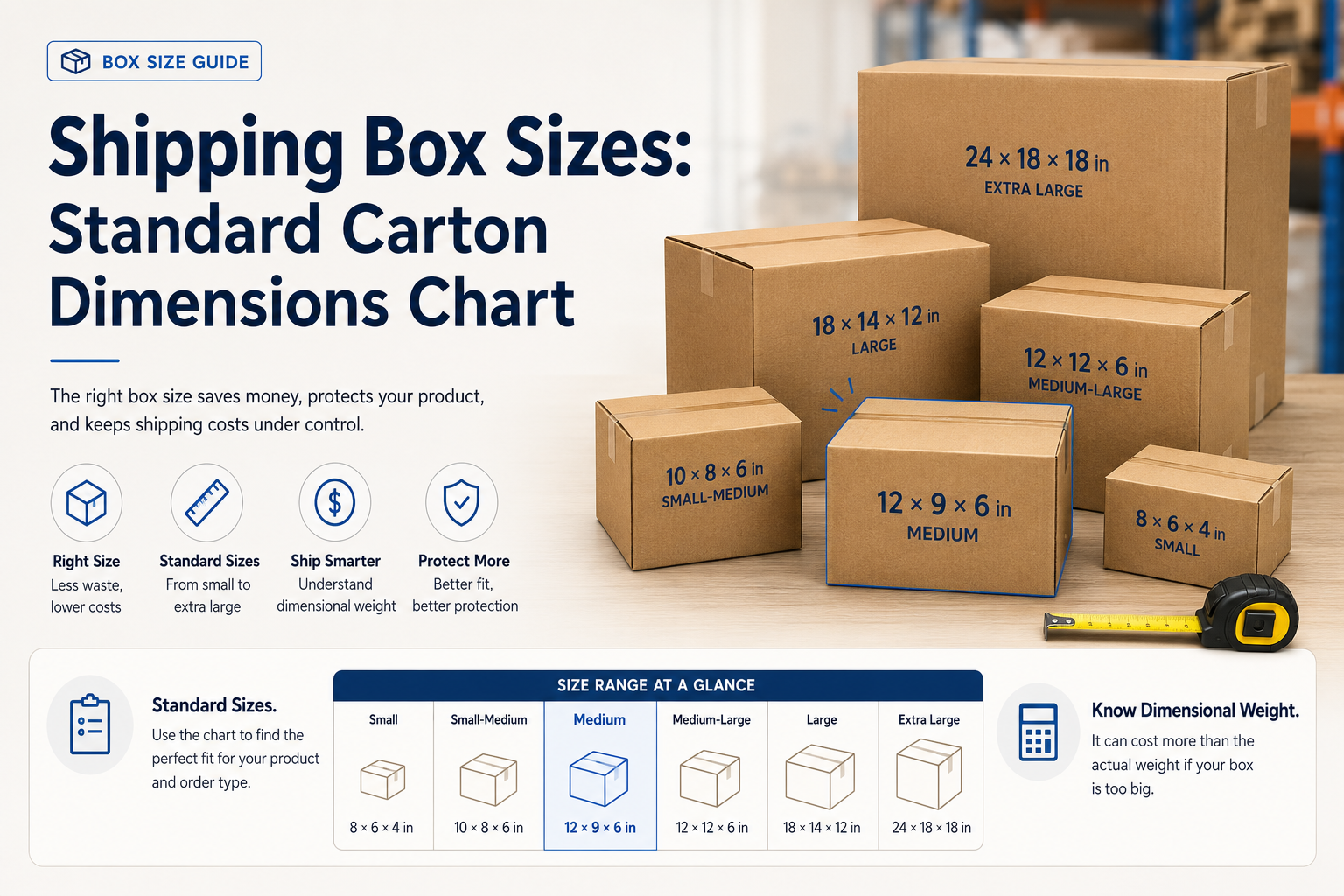
The most common shipping box for single-item e-commerce orders is 12 × 9 × 6 inches. Smaller items drop down to 8 × 6 × 4 inches. Bulk or oversized shipments move up past 24 × 18 × 18. The chart below covers the full range, plus the pricing detail that matters more than the box itself: dimensional weight. This post is part of our size guide series, alongside our cake box sizes and shoe box dimensions guides. For everything else, our full box size guide covers the rest.
Shipping Box Size Chart
| Size Category | Dimensions (L×W×H, inches) | Dimensions (cm) | Typical Use |
|---|---|---|---|
| Small | 8 × 6 × 4 in | 20.3 × 15.2 × 10.2 cm | Jewelry, cosmetics, small accessories |
| Small-Medium | 10 × 8 × 6 in | 25.4 × 20.3 × 15.2 cm | Books, candles, small clothing items |
| Medium | 12 × 9 × 6 in | 30.5 × 22.9 × 15.2 cm | Most common single-item e-commerce order |
| Medium-Large | 12 × 12 × 6 in | 30.5 × 30.5 × 15.2 cm | Multi-item orders, folded apparel |
| Large | 18 × 14 × 12 in | 45.7 × 35.6 × 30.5 cm | Kitchenware, small appliances |
| Extra Large | 24 × 18 × 18 in | 61 × 45.7 × 45.7 cm | Bulk orders, oversized or fragile items |
The medium size sees the most order volume by far. It’s built around a typical single-item order with little wasted space: folded apparel, small electronics, or a paperback book.
The Pricing Detail Most People Miss: Dimensional Weight
A lightweight item in an oversized box can cost more to ship than a heavier item in a right-sized one. Most carriers calculate a dimensional weight alongside actual weight. The formula is usually length times width times height, divided by a carrier-specific divisor such as 139. Whichever number comes out higher, actual or dimensional, is what gets billed.
Here’s what that looks like in practice. Take a 12 × 12 × 6-inch box. Multiply those three numbers and divide by 139, a common carrier divisor. That works out to a dimensional weight of about 6 pounds. That’s true even if the actual product inside weighs only 2 pounds. The carrier bills the box, not the product. Divisors vary by carrier, and by domestic versus international service. The exact number on an invoice can shift a little. It depends on who’s shipping it and where the package is headed. The underlying principle doesn’t change, though: a bigger box costs more to ship, independent of what’s actually inside it.
That means air is expensive. A box with 3 inches of empty space on every side isn’t just wasting packing material. It’s actively inflating the shipping charge on every single order. The fix isn’t a smaller box for its own sake. It’s the closest-fitting box for the actual product.
Right-Sized vs. Oversized: A Real Trade-off
Sizing tight isn’t free of downsides either. A box with zero clearance leaves no room for a protective air pillow or a layer of crumpled paper. Products can shift a fraction of an inch during transit. That’s enough to arrive damaged if a hard corner sits right against the wall.
The sweet spot is usually 1 to 2 inches of clearance on each dimension. That’s enough for real cushioning without triggering a dimensional weight jump to the next carrier bracket. I’ve seen warehouses default to one all-purpose box size for every order, since it’s simpler to stock a single SKU. It’s rarely cheaper once dimensional weight gets factored into every shipment going out the door. The savings from right-sizing tend to compound fast at real order volumes.
Custom Shipping Box Sizes
Standard sizes cover most single-item and small multi-item orders. They don’t cover irregular products or palletized freight, though. They also don’t cover SKUs that fall awkwardly between two stock sizes and waste a full size-up in dimensional weight. Those situations are exactly where a custom box earns back its cost. A car bumper is a good example of an irregular shape that standard sizing can’t serve at all — long, curved, and unsupported along most of its length, which needs a box built around the part’s actual profile rather than a stock rectangle with extra void space.
Easy Box Packaging builds shipping cartons to the exact footprint a product needs. That cuts void space and the dimensional weight charges that come with it. A box built to spec instead of picked from a shelf usually pays for itself within a few hundred shipments. That’s once the freight savings are weighed against the packaging cost itself.
Frequently Asked Questions
What’s the most common shipping box size for e-commerce? 12 × 9 × 6 inches. It fits most single-item orders, folded apparel, and small electronics without much wasted space.
Does box size actually affect shipping cost? Yes, through dimensional weight. Carriers bill whichever is higher: the actual weight or a calculated dimensional weight based on the box’s outer dimensions.
How much clearance should I leave around the product? About 1 to 2 inches on each side is the usual target. That leaves room for cushioning, without jumping the box into a bracket it doesn’t need to be in.
The Bottom Line
Shipping box sizing is really a cost decision disguised as a packing decision. The right size protects the product and keeps dimensional weight from inflating every invoice. Get a quote and get boxes sized to what you’re actually shipping, not the nearest size on a shelf.