
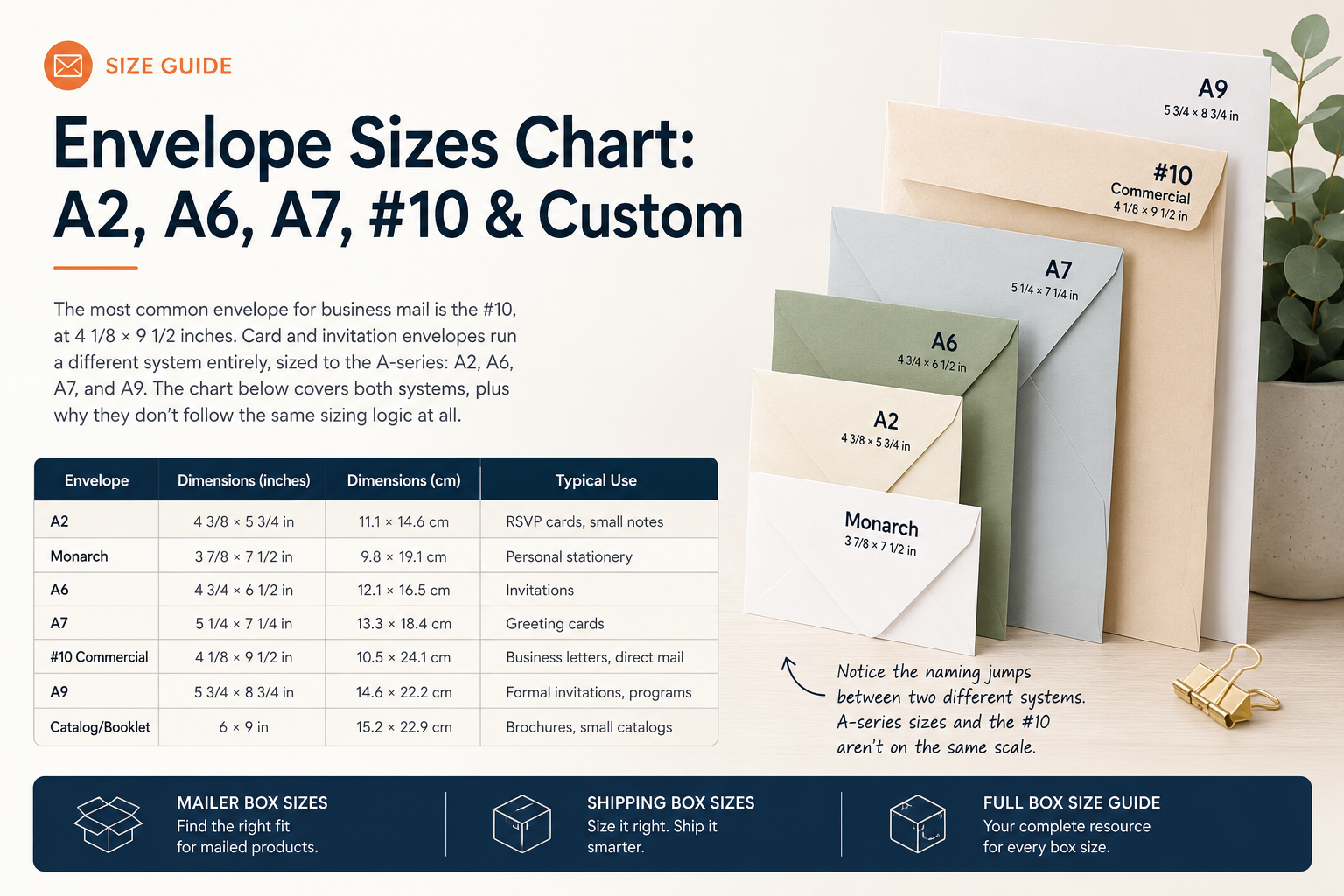
The most common envelope for business mail is the #10, at 4 1/8 × 9 1/2 inches. Card and invitation envelopes run a different system entirely, sized to the A-series: A2, A6, A7, and A9. The chart below covers both systems, plus why they don’t follow the same sizing logic at all. This post is part of our size guide series, alongside our mailer box sizes and shipping box sizes guides. For everything else, our full box size guide covers the rest.
Envelope Size Chart
| Envelope | Dimensions (inches) | Dimensions (cm) | Typical Use |
|---|---|---|---|
| A2 | 4 3/8 × 5 3/4 in | 11.1 × 14.6 cm | RSVP cards, small notes |
| Monarch | 3 7/8 × 7 1/2 in | 9.8 × 19.1 cm | Personal stationery |
| A6 | 4 3/4 × 6 1/2 in | 12.1 × 16.5 cm | Invitations |
| A7 | 5 1/4 × 7 1/4 in | 13.3 × 18.4 cm | Greeting cards |
| #10 Commercial | 4 1/8 × 9 1/2 in | 10.5 × 24.1 cm | Business letters, direct mail |
| A9 | 5 3/4 × 8 3/4 in | 14.6 × 22.2 cm | Formal invitations, programs |
| Catalog/Booklet | 6 × 9 in | 15.2 × 22.9 cm | Brochures, small catalogs |
Notice the naming jumps between two different systems. A-series sizes and the #10 aren’t on the same scale. Mixing them up is the single most common envelope ordering mistake.
Two Sizing Systems, Not One
A-series envelopes are built around cards. An A7 envelope measures 5 1/4 × 7 1/4 inches. That’s sized to hold a standard 5 × 7-inch card with a quarter inch of clearance on each side. A2, A6, and A9 follow the same logic against their own matching card sizes.
The #10 and other commercial envelopes work differently. They’re built around a standard letter sheet folded into thirds, not a fixed card size. That’s why a #10 looks so much narrower and longer than any A-series envelope. Confusing the two systems causes real problems. People end up ordering an A7 for a folded letter. Or they order a #10 for an invitation card that won’t fit inside it at all.
How to Measure for the Right Envelope
Measure the flat item first: the card, the folded letter, or the enclosure itself. For a card, add a quarter inch of clearance on the height and width to find the matching A-series envelope. For a folded letter, work backward from the fold instead. A standard 8.5 × 11-inch sheet folded into thirds becomes roughly 3.7 × 8.5 inches. That’s why the #10 envelope’s 9.5-inch length gives it room to slide in without catching on the way.
Thickness matters too, and it’s the detail most people skip. A single card slides into a standard envelope without issue. Add an insert, a ribbon, or a second card, though, and the same envelope can strain at the seams. It might even refuse to seal flat. When enclosures start stacking up, size up a tier. A forced tight fit just looks bulky in the mailbox, and it can strain the seal during transit.
Window vs. Non-Window: A Real Trade-off
A window envelope shows the recipient’s address printed right on the letter inside. There’s no separate labeling step needed. That’s a real time saver for invoices, statements, and anything mailed at volume.
It comes at a cost for anything meant to feel personal. A window cut looks utilitarian on a wedding invitation or a handwritten note. It also limits exactly where text can sit on the page inside. The address always has to line up with the cutout. Most businesses split the difference the same way. Window envelopes handle transactional mail. Solid envelopes handle anything meant to be opened and appreciated rather than scanned and filed.
Beyond Standard Envelope Sizes
Standard envelopes cover cards, letters, and light inserts well. They stop being the right tool once an enclosure gets bulky. A boxed stationery set needs more structure. So does a multi-card pack, or a press kit with more than paper inside. All three need something sturdier than a fold and a seal.
Easy Box Packaging builds custom boxes for exactly that gap. These are sized for stationery sets, card multipacks, and presentation pieces that have outgrown what any envelope can hold. If what you’re mailing needs real structure, a box is the better call than forcing it into an oversized envelope. Our mailer box sizes guide covers that territory in more depth.
Frequently Asked Questions
What size envelope do I need for a 5×7 card? An A7 envelope, at 5 1/4 × 7 1/4 inches. The quarter inch of clearance keeps the card from jamming on the way in.
What’s the difference between A6 and A7 envelopes? A6 fits a 4 1/2 × 6 1/4-inch card, common for smaller invitations. A7 fits a 5 × 7-inch card, the standard size for most greeting cards.
Does a #10 envelope need a window? No. Plenty of #10 envelopes are solid, especially for anything meant to look personal rather than transactional. Windows are common but optional on this size.
The Bottom Line
Envelope sizing splits into two systems: A-series for cards, numbered sizes for folded letters. Match the system to what’s actually going inside, and the right size stops being a guess. Get a quote if what you’re mailing has outgrown paper entirely.