
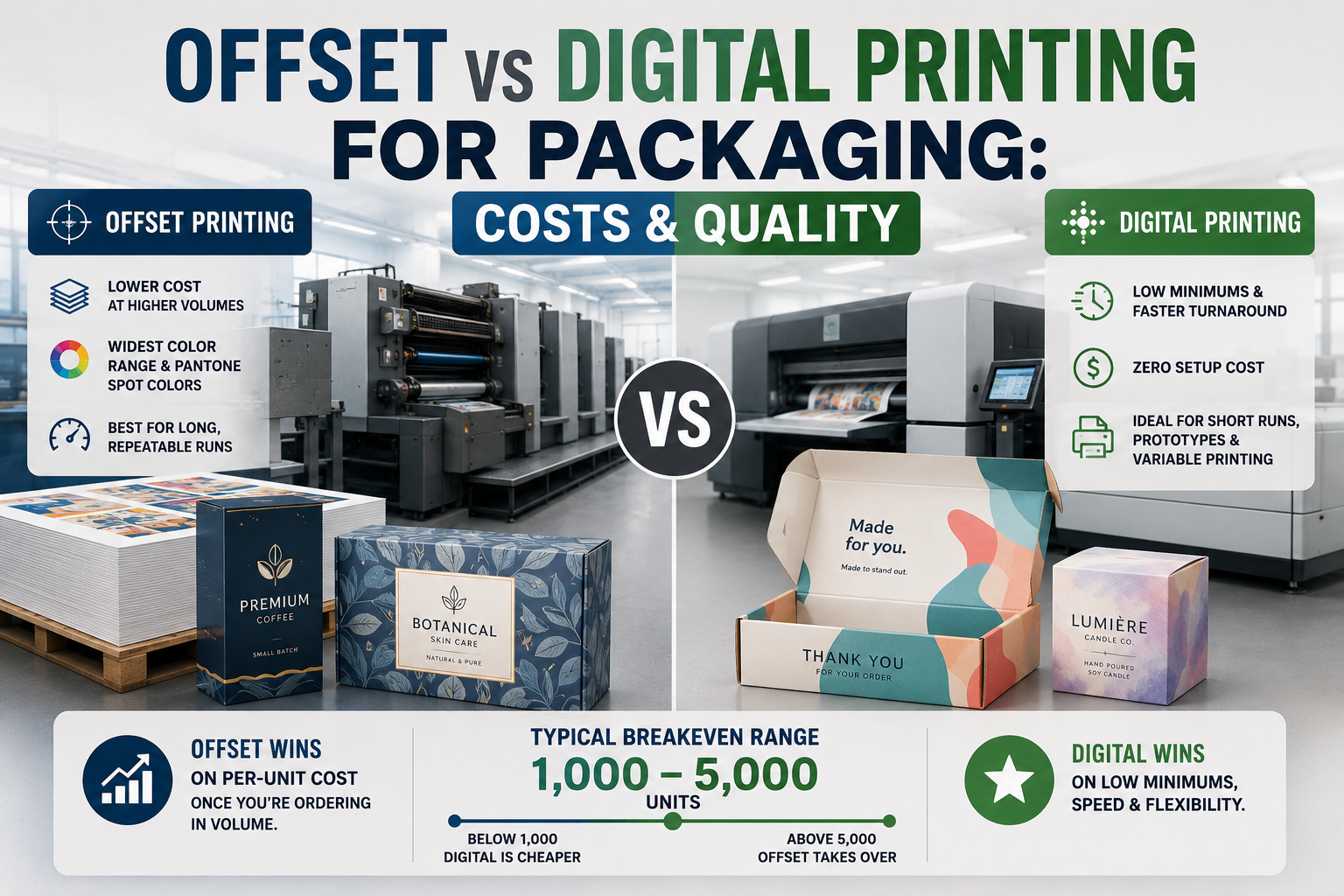
Offset printing wins on per-unit cost once you’re ordering in volume. It also covers the widest color range, including most Pantone spot colors. Digital printing packaging wins on low minimums, faster turnaround, and zero setup cost. For a typical four-color box design, the breakeven usually falls between 1,000 and 5,000 units. Where it lands depends on box complexity and color count. Below that range, digital is almost always cheaper. Above it, offset takes over.
That’s the short answer. The reasons behind it matter more than the number. The breakeven point moves depending on your reorder pattern, not just your first order size.
How Each Process Actually Works
Offset printing transfers ink from metal plates onto paperboard or corrugated sheets. Each color gets its own plate. Setting up those plates is the expensive part. Once they’re mounted and the press is running, ink goes down fast and cheap. That’s why offset rewards volume and long, repeatable runs.
Digital printing skips the plates entirely. It lays down toner or inkjet color straight from a digital file. Think of a high-end office printer, just scaled up for packaging substrates. There’s no plate to make, so setup cost is close to zero. The tradeoff shows up per unit: digital ink costs more per box than offset ink does. That gap doesn’t close much as you print more. It’s why digital suits short run packaging printing so well. Think a first batch of custom mailer boxes for a new product launch, not a 10,000-unit order.
Neither process is “better” in the abstract. They’re built for different order sizes. The right choice depends on where your order actually falls. It also depends on how often you plan to reorder it.
There’s a third option worth a quick mention: flexography, common on shipping cases and larger corrugated runs. It uses flexible rubber plates instead of rigid metal ones. For most retail and ecommerce box orders, though, the real decision still comes down to offset vs digital. Flexo tends to enter the conversation only at very high corrugated volumes. That’s outside the scope of most first-time box orders.
Cost Comparison: Where the Breakeven Really Sits
Offset plates typically cost a few hundred dollars up to around $1,000 or more per job. The exact number depends on how many colors your design uses and which press the printer runs. Digital carries no comparable setup charge. That single difference drives most of what follows.
At small quantities, the plate cost gets divided across too few units to make sense. As the order grows, that fixed cost spreads thinner. Offset’s cheaper per-unit ink cost starts to win out somewhere past that point. Most printers put the crossover in the 1,000 to 5,000 unit range for a standard box. Simpler one- or two-color jobs can tip toward offset sooner. More complex designs, with more plates to make, can push the breakeven higher.
Here’s the part most comparisons skip. Plate cost isn’t tied to your relationship with a printer — it’s tied to the job itself. Banking means the printer stores your plates for reuse on future runs. If your printer doesn’t bank plates, every reorder can get charged a fresh fee. That’s true even when nothing about the design changed. I’ve watched a brand order 800 units offset because a competitor’s box “felt more premium.” Two months later, they reordered 300 units of the same artwork. It came back with a full plate charge attached. That reorder should have been the cheap part. Instead it cost nearly as much per unit as the first run.
If you expect to reorder in modest batches, ask upfront whether your printer banks plates. Also ask for how long. You can map your own reorder cadence against that risk manually before committing to a process. Easy Box Packaging quotes both offset printing boxes and digital runs side by side. We flag where your specific breakeven falls, so you’re not guessing based on a generic industry range.
Color Accuracy: CMYK, Pantone, and What Gets Lost in Translation
Offset printing can run true Pantone spot colors. Each one gets mixed as a single ink rather than built from a four-color blend. That matters most when your brand color is something specific. Think a saturated blue, or a particular shade of green. Those hues are exactly where CMYK struggles.
Digital printing runs on CMYK or a close variant. According to X-Rite’s Pantone Extended Gamut guidance, standard CMYK reproduces roughly 85% of Pantone Matching System colors closely. Some printers add extra ink stations, usually Orange, Green, and Violet, to extend that gamut. That can push accuracy closer to 90% of spot colors. It’s an add-on though, not standard equipment, and it doesn’t fully close the gap.
Some brands have a strict, trademarked color that has to match exactly across every box. For those brands, offset with a dedicated Pantone plate is the safer route. Getting that color right, order after order, is part of what turns a first order into a repeat one. Customers notice when a favorite box looks off. For brands whose colors sit close enough within a normal CMYK build, digital’s convenience usually wins out. If a specific brand color is non-negotiable, ask for a physical proof rather than trusting a screen preview. A monitor and a printed corrugated sheet rarely show color the same way. Easy Box Packaging can walk through prepress proofing options for Pantone-critical designs. This happens before a full run goes to press.
Offset vs Digital at a Glance
| Factor | Offset | Digital |
|---|---|---|
| Setup cost | Plate charge per job (often several hundred dollars+) | Little to none |
| Best order size | Roughly 2,000–5,000+ units | Roughly under 1,000–2,000 units |
| Turnaround | Slower (plate-making adds lead time) | Faster |
| Color range | True Pantone spot colors | CMYK, close Pantone match |
| Reorder cost | Can repeat plate fee unless banked | Same low setup every time |
| Best fit | Large runs, exact brand colors | Small runs, testing SKUs, frequent reorders |
Common Mistakes Brands Make Choosing Between Them
Choosing the wrong print process is one of the quieter packaging mistakes that kill the unboxing moment. The damage happens well before a customer ever opens the box.
The biggest one is picking a process based on order size alone. That ignores the reorder plan entirely. A 3,000-unit first order might make offset look cheaper on paper. But if you’re reordering 500 units every six weeks, repeated plate fees can eat the savings fast.
The second mistake is assuming digital automatically means lower quality. Modern digital packaging presses produce sharp, professional results for most designs. The gap that matters is narrow and specific. It’s exact Pantone matching and certain saturated colors, not overall print sharpness.
The third is skipping a physical proof when a brand color is critical. A color that looks right on a monitor can shift once it hits corrugated or kraft stock. That’s not something you catch by eyeballing a PDF on a laptop screen.
A related mistake is forgetting that substrate affects color too. The same ink or toner can look noticeably different on bright white stock versus natural kraft. If your box uses kraft or a heavily textured board, ask for a proof on that exact substrate. Skip the generic white sample.
A fourth, smaller mistake: assuming short run packaging printing always means digital. A short run of a very simple one- or two-color design can sometimes still favor offset. That’s especially true if the printer already has your plates banked from an earlier order.
Which Should You Choose?
If you’re testing a new SKU, or ordering under roughly 1,000 units, go digital. It keeps upfront cost low and gets you to market faster. That’s a common starting point for e-commerce packaging boxes on a first production run. Placing a large, one-time order above 5,000 units, with a design that won’t change? Offset usually wins on per-unit cost. If your brand color is a specific, trademarked Pantone shade, lean offset regardless of quantity. Or budget for extended-gamut digital where it’s available. If you reorder frequently in small-to-medium batches, run the math on plate-banking terms first. Don’t just assume offset is cheaper long term. Request a quote for exact pricing on your specific run.
Offset vs Digital Printing: FAQ
Is digital printing cheaper than offset for packaging? For small runs, yes. Digital has no plate setup cost, so it’s usually cheaper below roughly 1,000–2,000 units. Above that range, offset’s lower per-unit ink cost tends to win.
Can digital printing match Pantone colors exactly? Not always. Standard CMYK digital printing reproduces about 85% of Pantone colors closely. Some presses add extra inks to push that higher, but true spot-color accuracy still favors offset.
What’s the minimum order for offset printing? There’s no fixed minimum. But plate setup costs make small offset runs expensive per unit. Most printers recommend offset once you’re ordering in the low thousands or more.
Does offset or digital printing take longer? Offset usually takes longer. Plates have to be made and mounted before the press runs. Digital skips that step, which is part of why it suits fast-turnaround or short-run orders.
Do I get charged for plates every time I reorder? It depends on the printer. Some bank plates for future reorders at no extra charge. Others charge a fresh plate fee on every run. Confirm this before committing to offset for a product you plan to reorder.
Is flexography the same as offset printing? No. Flexography uses flexible rubber or polymer plates instead of the rigid metal plates offset relies on. It’s common on larger corrugated shipping cases. For most retail box orders, the practical choice is still between offset and digital.
Get a free quote — dieline and design support included.