
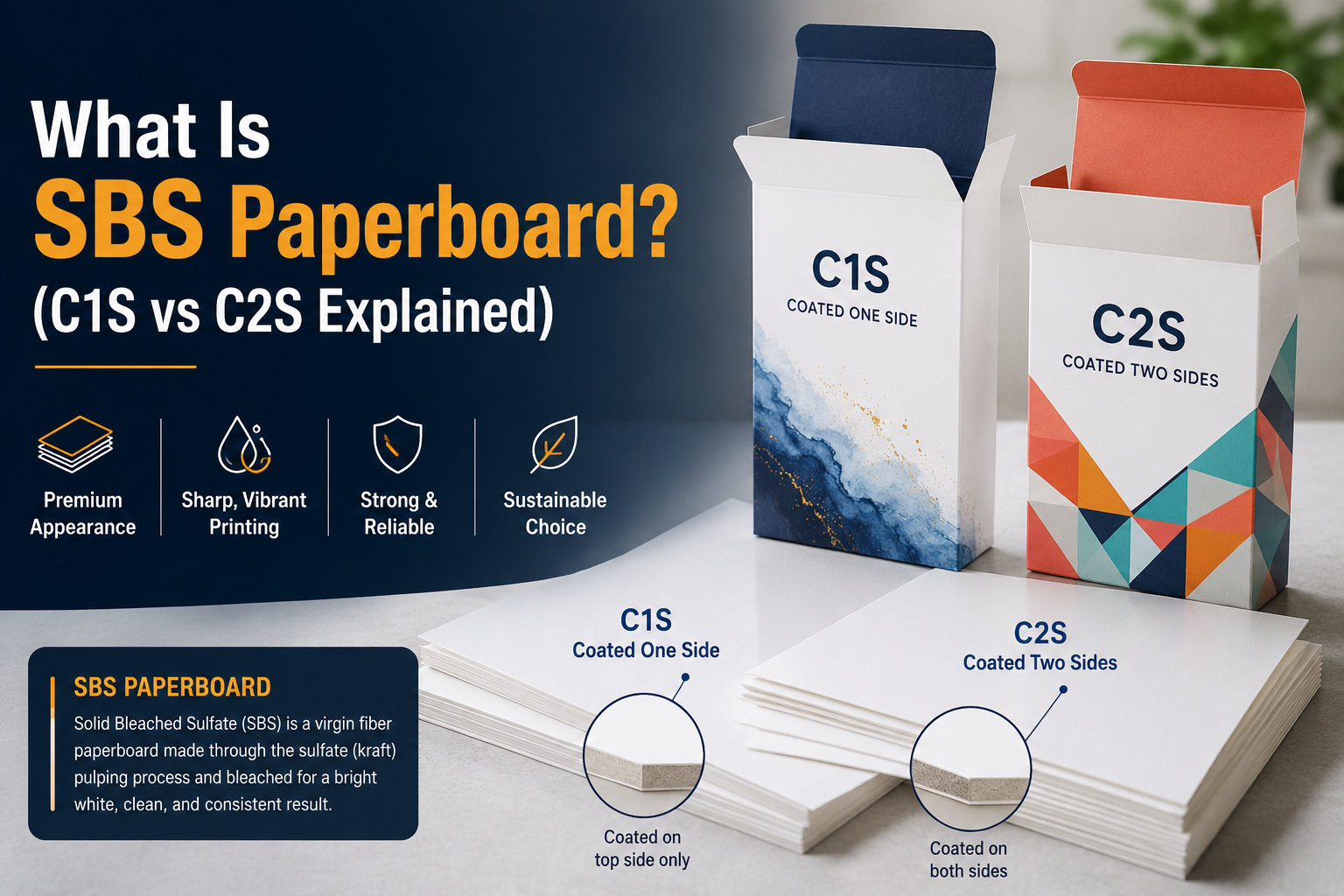
SBS paperboard stands for solid bleached sulfate. It’s a bright white, virgin-fiber board made through the sulfate (kraft) pulping process. That pulp gets bleached until the board is white all the way through, not just on the surface. Printers like it because it takes color sharply and consistently. Brands like it because it looks premium off the shelf. The two grades you’ll see quoted are C1S (coated one side) and C2S (coated two sides). The difference between them decides how your box prints, folds, and holds up over time.
That’s the short version. Most buyers stop there and move straight to price. That’s a mistake. “SBS” on a quote doesn’t always mean what you think it means. One common substitution can cost you a full print run before you even catch it.
What “Solid Bleached Sulfate” Actually Means
The name describes the pulping process, not the coating. “Sulfate” refers to the kraft process used to break down wood fiber. “Bleached” means that pulp gets treated until it reaches a bright white. That’s usually somewhere in the 88-92 range on the TAPPI brightness scale, the standard reference for this grade. “Solid” means the board is made from one type of pulp all the way through. It’s white on the surface, and white in the core too. There’s no darker layer hiding underneath.
That last part matters more than most spec sheets let on. It’s also where the real issue shows up, and almost nobody checks for it. We’ll get to that next.
C1S vs C2S: What the Coating Actually Does
Both C1S and C2S start as the same solid bleached base. The difference is where the clay or pigment coating gets applied.
C1S means coated one side. The front gets a smooth, glossy coating built for print. The back stays uncoated, which means it absorbs ink differently and prints a bit duller. C1S tends to run slightly thicker than C2S at the same weight. That extra thickness holds a crisper fold. It also adds a bit more rigidity for the same paper stock. That matters on boxes that get handled a lot before they ever reach a shelf.
C2S means coated two sides. Both faces get a consistent coating, so both sides print clean and even. That matters most when the inside of your box is visible. Think of an open-lid gift box, or a sheet printed on both faces.
Picking between them mostly comes down to one question: does your customer ever see the inside? If not, C1S usually costs less and holds up better. If they do, C2S earns its higher price.
The Substitution Most Buyers Never Catch
Here’s the part most competitor spec pages skip entirely. Not every board quoted as “SBS” is actually solid bleached sulfate all the way through. Some printers quote FBB, or folding box board, instead. FBB uses a recycled or mixed-pulp core with a bleached virgin layer laminated on top. After printing, it can look nearly identical to real SBS.
The giveaway shows up in one place only: a cut edge or a cracked fold. That’s where FBB’s grey or brown core becomes visible against what should be a solid white cross-section.
This isn’t automatically a scam. FBB is a legitimate, cheaper board grade with its own real use cases. The problem shows up when it gets sold at SBS pricing. It’s also a problem when it gets swapped in quietly. That’s especially true on jobs where the buyer needed the rigidity or brightness that only real SBS delivers.
Ask for a physical sample and check the edge before locking in a full print run. It costs nothing and takes thirty seconds. If the core looks like anything other than solid white, ask directly what grade you’re actually being quoted. This is one of those quiet packaging mistakes that kill the unboxing moment. It happens long before a customer ever opens the box.
What to Actually Check on a Spec Sheet
Caliper, meaning thickness, usually shows up in points on a spec sheet. Basis weight shows up too. Both matter, but neither one confirms the actual grade by itself. A thick board can still be FBB. A thin one can still be genuine SBS.
The number worth asking for is brightness. True SBS typically falls in the 88-92 range on the TAPPI scale. Anything meaningfully lower is a real signal. It usually means the board isn’t pure virgin bleached stock, no matter what the vendor’s paperwork calls it.
Why SBS Shows Up So Often in Food, Pharma, and Cosmetic Packaging
SBS has no taste or odor of its own. That matters for anything packed close to a product people put on their skin or in their mouth. Same goes for anything sitting in a medicine cabinet. It’s why you’ll see it constantly in cosmetic tubes, supplement cartons, and healthcare and beauty packaging more broadly.
It’s not automatically food-safe or compliant on its own, though. Specific certifications and food-contact rules depend on the coating, the printing inks, and the intended use. Confirm those details with your supplier directly. Don’t assume the board grade alone settles the question.
I watched this play out with a supplements brand building a new tub carton. Their first quote came back listed as “premium SBS,” priced accordingly. We pulled a physical cut sample before the print run. The core wasn’t solid white. It had a visible grey band right through the middle, classic FBB. The printer wasn’t necessarily trying to pull a fast one. Their default stock had likely shifted quietly, and nobody flagged it on the quote. Either way, the brand caught it before 20,000 cartons went to press. They switched suppliers for that run.
That’s the value of asking for a sample instead of trusting a line item on a quote. Most brands never think to ask. The ones that get burned usually find out after the boxes arrive. They look a little less premium than the mockup promised.
SBS Board: Quick Comparison
| Factor | C1S (Coated One Side) | C2S (Coated Two Sides) |
|---|---|---|
| Print surface | Front only | Front and back |
| Back-side look | Duller, uncoated | Matches front |
| Best for | Boxes where the inside isn’t seen | Boxes with a visible interior or dual-side print |
| Rigidity | Slightly thicker at same weight | Slightly thinner at same weight |
| Relative cost | Lower | Higher |
Common Mistakes When Specifying SBS Board
The first mistake is quoting “SBS” without asking for a cut-edge sample. A name on a spec sheet doesn’t confirm the actual pulp structure underneath.
The second mistake is choosing C2S by default because it “sounds better.” That extra cost buys nothing if nobody ever sees the inside of your box.
The third mistake is treating brightness as a nice-to-have instead of a real spec. A 15-point drop in TAPPI brightness shows up on a shelf next to a competitor’s box. Most buyers can’t say exactly why one looks cheaper, but they can see it.
A fourth mistake is assuming board grade alone settles food or cosmetic compliance questions. That’s a separate conversation with your supplier. It’s tied to coatings, inks, and your product’s specific contact requirements. A “premium SBS” label doesn’t answer that by itself.
A fifth mistake is treating every carton in a product line the same way. A brand building custom mailer boxes for shipping doesn’t need the same grade as a retail tub carton. A shipping box and a shelf-facing box solve different problems. Match the grade to how the box actually gets used, not just to what looks premium on paper.
Which Should You Choose?
Building a box where only the outside gets seen, like a shrink-wrapped retail carton? C1S usually makes sense. It’s cheaper and slightly stiffer at the same caliper.
Building something where the interior matters, like an open-face gift box or a two-sided printed sleeve? C2S is worth the extra cost.
Not sure what you’re currently being quoted? Ask your printer for a physical cut sample before committing to a full run. Easy Box Packaging can help match board grade to your product line. That covers cosmetic packaging, supplements, and general retail cartons alike. Structural prototyping is available before you commit to a print quantity.
Board grade is one of those decisions that looks minor on a quote sheet. It shows up immediately on a shelf. Get it wrong once, and you’ll notice the difference before your customer even opens the box. Getting it right the first time is part of why packaging drives repeat purchases. It’s rarely just a one-time sale.
SBS Paperboard: FAQ
Is SBS the same as cardstock? Not exactly. Cardstock is a general consumer term for stiff paper. SBS is a specific industrial grade, defined by its pulping process and brightness. It’s what most premium cardstock-style packaging is actually made from.
Does C1S or C2S cost more? C2S usually costs more. Both sides get coated and finished for print.
Can I tell SBS from FBB without cutting it open? Not reliably from the surface alone. The cut-edge or a cracked fold is the clearest way to check. That’s where the core color shows through.
Get a free quote — dieline and design support included.