
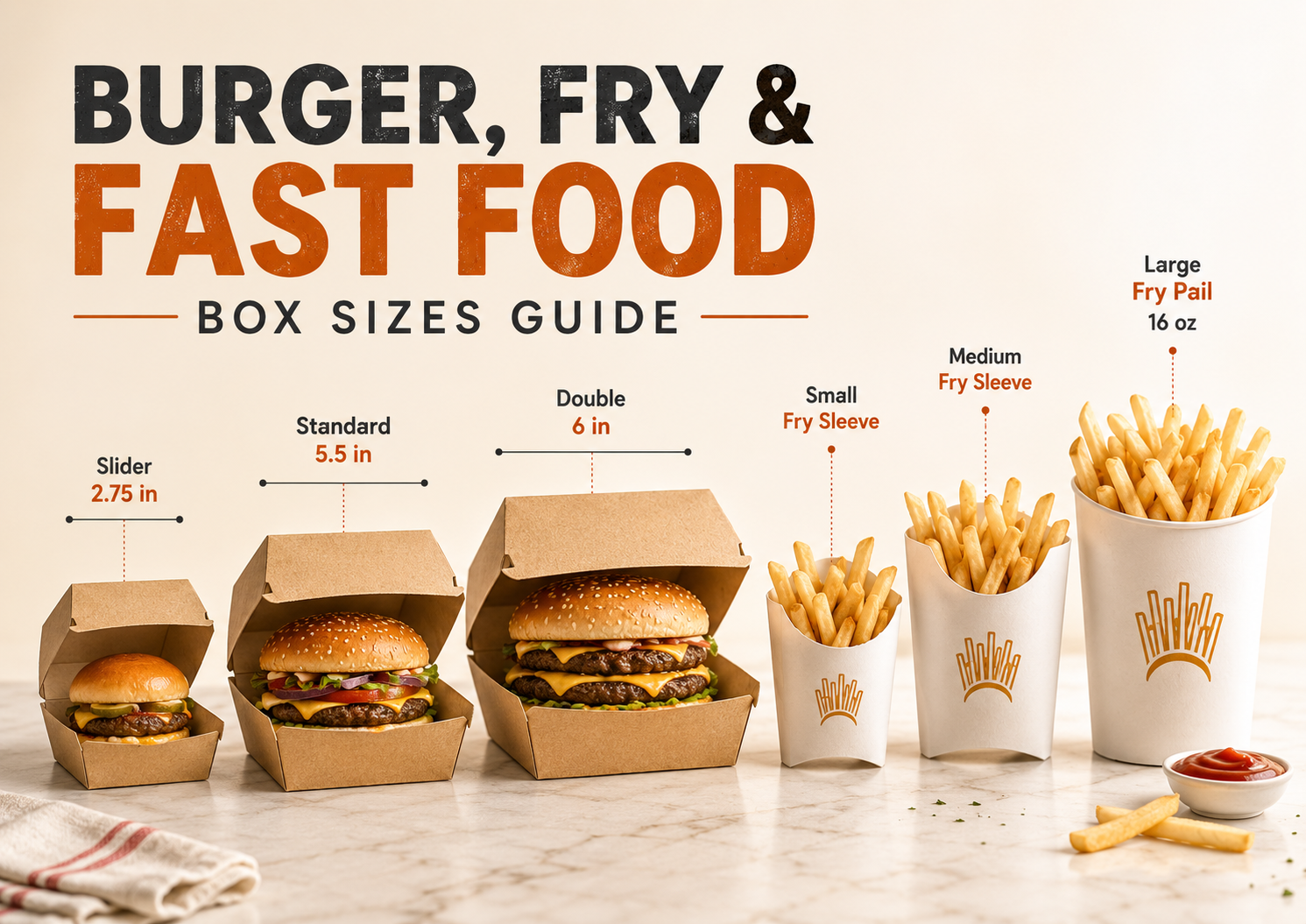
Burger box size runs from 2.75 inches for a slider up to 6 inches for a double patty with toppings. Fry packaging splits into two different formats entirely. Small and medium orders use open sleeves. Large orders switch to standing pails instead. This guide charts both. It also covers the sizing logic behind each one. It’s part of our size guide series alongside our pizza box sizes and mylar bag sizes guides. For everything else, our full box size guide covers the rest.
Fast Food Box Size Chart
| Item | Dimensions (L×W×H, inches) | Dimensions (cm) | Typical Use |
|---|---|---|---|
| Mini/Slider Burger | 2.75 × 2.75 × 2 in | 7.0 × 7.0 × 5.1 cm | Sliders, appetizer-size burgers |
| Standard Burger | 5.5 × 5.5 × 3.5 in | 14.0 × 14.0 × 8.9 cm | Single-patty burgers up to 5 inches wide |
| Double/Loaded Burger | 6 × 6 × 4 in | 15.2 × 15.2 × 10.2 cm | Double patties, heavy toppings |
| Small Fry Sleeve (~4 oz) | 3.15–4.3 × 2.36–2.75 × 3.94–4.7 in | 8.0–10.9 × 6.0–7.0 × 10.0–11.9 cm | Kids’ meals, side portions |
| Medium Fry Sleeve (~5.5 oz) | 3.94–5.1 × 2.76–3.2 × 4.72–5.3 in | 10.0–13.0 × 7.0–8.1 × 12.0–13.5 cm | Standard single order |
| Large Fry Pail (16 oz) | 5.3 × 4.5 × 7.1 in | 13.5 × 11.4 × 18.0 cm | Large or shareable fry orders |
Fry sleeve sources disagree by close to an inch on the small and medium tiers. Both ranges are shown above rather than picking one figure, since real supplier sizing varies that much between brands.
Why Burger Box Size Follows Diameter, Not Weight
A burger box doesn’t care how much the patty weighs. It cares how wide the finished, stacked burger sits once the bun, patty, and toppings are all in place. A 5.5-inch clamshell fits most single-patty burgers for that reason. It doesn’t matter whether the patty itself is a quarter pound or a third pound underneath.
Toppings change the math more than the patty does. A burger with bacon, a fried egg, and two extra sauces stacks taller than a plain version. It can bulge wider too, once every topping is pressed into place. That’s the real reason double and loaded burgers jump straight to a 6-inch box. A slightly bigger single-patty size wouldn’t give the stack enough room. The box needs headroom for everything piled on top, not just the beef itself.
Sleeve, Cone, or Pail: Choosing Fry Packaging
Open sleeves and cones work well for small and medium fry orders. They vent steam as the fries sit, and that venting matters more than people realize. Trapped steam softens a crisp fry fast, a basic fact of food packaging that shapes most hot-food container design. A sealed container holds that moisture right against the fries. An open top solves the problem simply by not being a lid at all.
Pails solve a different problem: capacity. A large order doesn’t fit comfortably in a sleeve without spilling over the top. Pails switch to a wider, standing shape to handle that extra volume. The trade-off is real, though. A pail doesn’t fit in most cup holders. It also takes up more counter space per order than a sleeve does. I’d default to sleeves through the medium tier. Switch to a pail only once the order genuinely needs the extra room.
Delivery orders complicate the choice further. A sleeve rides fine on a short walk from counter to table, since it’s held upright the whole way. A sleeve tossed loose into a delivery bag can tip and spill before it ever reaches the door. Pails hold up better here, even at the small size. The closed sides keep fries contained no matter how the bag gets jostled in transit. The same venting-versus-containment trade-off shows up in fish and chips packaging, where the box needs ventilation cuts for the same steam problem but a locking closure for the same delivery-bag problem — both at once, since fish and chips rarely ships in an open sleeve.
How to Measure a Burger or Fry Box
For burgers, measure the fully assembled sandwich, not just the raw patty. Stack the bun, patty, and toppings the way the kitchen actually builds it. Then measure the widest point across, and the full stacked height on top of that. A box sized off the patty alone runs too short once real toppings go on.
For fries, weigh a filled serving on a kitchen scale rather than guessing from a scoop size. Fry density varies by cut. Shoestring fries pack differently than steak-cut wedges do at the same weight. A box that fits one cut comfortably can look half-empty with the other cut. It can also look overstuffed, even at an identical fill weight.
Menu changes make this worth revisiting regularly. A kitchen that switches from a thin-cut fry to a thicker wedge changes the density of what fills that box. That’s true even for a brief seasonal item.
Custom Fast Food Box Sizes
The chart above covers standard burgers and fries. Chicken sandwiches, wraps, and combo trays all need their own sizing outside this range. A combo tray that pairs a burger with a drink cup cutout adds its own layout problem. That’s on top of the size question, not instead of it. Seasonal limited-time items are the other common gap. A new sandwich shape rarely fits an existing box without at least a small adjustment.
Easy Box Packaging builds burger and fry packaging to a restaurant’s actual menu items, patty size included. Our broader restaurant packaging line covers everything else that ships out the drive-through window.
Frequently Asked Questions
What size box fits a standard burger? Most single-patty burgers fit a 5.5 × 5.5 × 3.5 inch clamshell. Double or loaded burgers usually need the next size up, around 6 × 6 × 4 inches.
Why do fries come in a sleeve instead of a sealed box? An open sleeve lets steam escape. That keeps fries from going soft during the short trip from counter to table. A sealed box traps that same steam right against the fries instead. Avoiding that trapped moisture is the entire reason the sleeve stays open.
The Bottom Line
Burger box size depends on the finished, stacked sandwich. Fry packaging depends on order size and how much venting the fries actually need. Measure the real thing, not the raw ingredients, before locking in a box. Revisit that measurement whenever a recipe or cut changes, even slightly. Get a quote and get fast food packaging sized to your actual menu.