
Corrugated flutes are the wavy paper layer sandwiched between the flat liners of a cardboard box. The letter grade, A, B, C, E, or F, tells you how thick that wave is. It also tells you how many waves pack into each foot of board. Thicker flutes cushion better. Thinner flutes print cleaner and fold sharper. Neither one is automatically the right choice. It depends on what you’re actually shipping, and how it gets handled along the way.
That’s the short version. Most buyers assume thicker always means stronger. It doesn’t always work that way, and getting this wrong costs real money on every single shipment.
The Five Flute Types, By Thickness
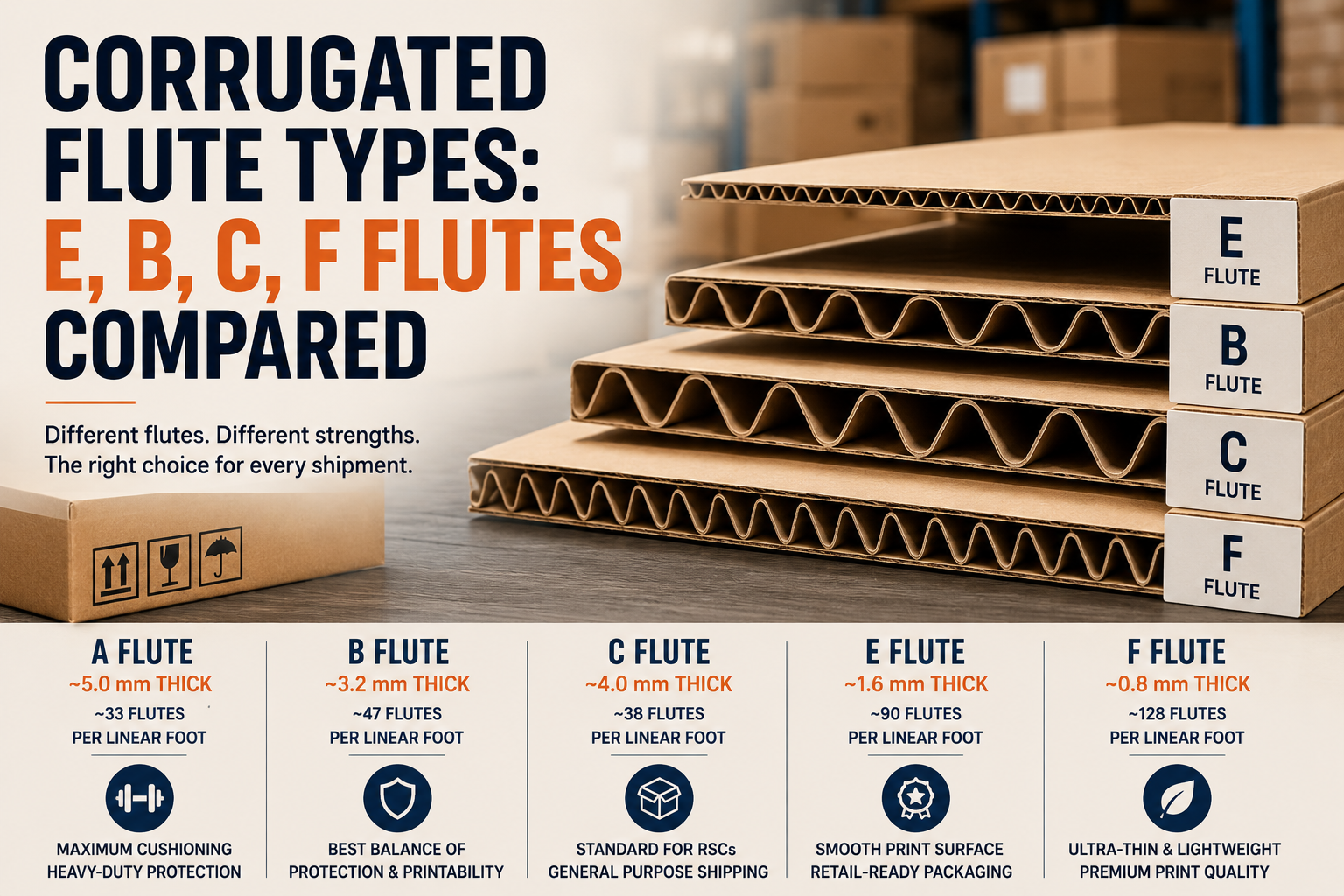
A flute is the thickest common option, at roughly 5 millimeters, with about 33 flutes per linear foot. It’s built for heavy cushioning, but it’s rare in retail-facing boxes today.
B flute measures around 3.2 millimeters, with about 47 flutes per foot. It’s the industry default for most shipping mailers. It balances protection and printability better than any other single flute.
C flute sits around 4 millimeters, with about 38 flutes per foot. It’s the standard choice for regular slotted shipping containers. That’s the classic brown box you see stacked in a warehouse.
E flute runs about 1.6 millimeters thick, with roughly 90 flutes per foot. It’s thinner, but that higher flute density gives it real crush resistance in a slim profile. It’s a common pick for retail-ready boxes and printed folding cartons.
F flute is the thinnest at about 0.8 millimeters, with around 125 flutes per foot. It’s built for small folding cartons where a crisp, precise fold matters more than heavy cushioning.
Single Wall, Double Wall, and Single Face
“Single wall” means one flute layer glued between two flat liners. That’s the standard construction most people picture when they hear the term “cardboard box.”
“Double wall” adds a second flute layer plus a third liner. It’s meant for heavy industrial shipping and tall pallet stacking. Everyday parcels rarely need it.
“Single face” skips one of the outer liners entirely. It’s flexible rather than rigid. It usually shows up as wrap or cushioning material inside a box, not as the box itself.
Thicker Isn’t Always Stronger
Here’s where most buyers get it backward. B flute isn’t the thickest option on the list, but it’s still the real default for e-commerce mailers. That’s not an accident. It hits the best balance of cushioning, printability, and shipping weight for a typical parcel.
I’ve seen a brand default to double-wall corrugated for a lightweight, low-fragility product. Double-wall just “sounded” more protective to them. The extra board weight bumped their dimensional shipping cost on every single order. Their damage claims didn’t drop at all. The product was never actually at risk of crushing in the first place. They paid a premium for strength their shipment never needed.
Match the flute and wall count to your actual product weight and fragility. Don’t upgrade just because a thicker option exists on the spec sheet. That extra cost adds up fast across a full shipping volume. Dimensional weight pricing on most carrier rate cards makes it worse.
Why Thinner Flutes Get Chosen on Purpose
E flute and F flute aren’t compromises. They’re deliberate choices for a different job. Their tighter, denser wave pattern folds sharper and holds a crisper crease than thicker flutes can. That matters for die-cut windows, rounded corners, and any box where print quality has to look retail-ready.
Cosmetics brands and subscription boxes often choose E flute over B for exactly this reason.
The tradeoff is real, though. Thinner flutes cushion less than B or C flute. If your product needs serious drop protection, a thin flute chosen purely for looks can leave you under-protected. A custom mailer box built mostly for a sharp print finish only makes sense for the right product. Something genuinely fragile needs cushioning first.
The Spec Sheet Doesn’t Always Match Reality
Every flute has an ECT, or Edge Crush Test rating. It measures how much stacking weight the board can handle before crushing. That number gets printed on a spec sheet once, at the time of testing.
Flute height can compress permanently after months of storage under stacked pallets in a warehouse. Nobody re-tests a box after it’s been sitting under weight for half a year. The real-world crush resistance can end up lower than what the original spec sheet promised. That’s especially true near the bottom of a tall stack.
If your boxes sit in long-term storage before shipping, build in a strength margin. Don’t spec the bare minimum ECT your product technically needs on paper. That buffer is cheap insurance against a number that quietly drifts over time.
Combination Flutes Exist Too
Some boxes use two flute types glued together in one double-wall board, like BC flute or EB flute. BC flute pairs B and C, landing around 6 to 7 millimeters thick. It’s built for heavy stacking where a single wall isn’t enough. EB flute pairs E and B, running about 4.5 millimeters. It keeps E flute’s clean print surface on one side while adding B flute’s cushioning underneath. These combination boards cost more than a single flute. They’re worth that extra cost only when your product genuinely needs both traits at once.
Corrugated Flute Comparison
| Flute | Thickness | Flutes Per Foot | Typical Use |
|---|---|---|---|
| A | ~5mm | ~33 | Heavy cushioning, less common today |
| C | ~4mm | ~38 | Standard shipping containers (RSC) |
| B | ~3.2mm | ~47 | Most e-commerce mailers |
| E | ~1.6mm | ~90 | Retail-ready boxes, printed cartons |
| F | ~0.8mm | ~125 | Small folding cartons, sharp folds |
Common Mistakes When Choosing a Flute Type
The first mistake is assuming thicker always beats thinner. B flute outperforms A flute for most shipping jobs, despite being less thick.
The second mistake is picking double-wall by default, without checking your actual product weight and drop risk first. That extra protection often goes unused.
The third mistake is choosing E or F flute purely for print quality. That backfires on a product that actually needs real cushioning. Beautiful printing doesn’t stop a fragile item from arriving cracked.
A fourth mistake is trusting an ECT rating as a permanent number. Long-term warehouse storage can quietly erode that number below what’s on the spec sheet.
A fifth mistake is treating every SKU in a catalog the same way. A heavy, fragile flagship product and a light, sturdy accessory rarely need the same flute and wall count. That’s true even if they ship in a similar-looking box.
Which Should You Choose?
Shipping a standard e-commerce parcel with moderate fragility? B flute is almost always the right default. It’s exactly why corrugated wins for most ecommerce shipping in the first place.
Building retail-ready packaging with die-cut details or a premium print finish? E flute gives you the sharpest fold and cleanest print. That works best as long as your product doesn’t need heavy cushioning.
Shipping something genuinely heavy or fragile, or stacking pallets for freight? C flute or double-wall construction earns its extra cost there.
Not sure what your product actually needs? Easy Box Packaging can help match flute type and wall count to your real shipping weight and fragility. That applies whether you’re building e-commerce packaging or a retail-facing box. Sample testing is available before you commit to a full run.
Flute choice is one of those decisions that looks like a rounding error on a spec sheet. It shows up directly in your shipping cost and your damage rate, every single month. Getting it right the first time ties into why packaging drives repeat purchases, not just a costly reprint.
Corrugated Flute Types: FAQ
Which flute is strongest? A flute is the thickest and offers the most raw cushioning. B flute is the more practical default for most shipping needs, though.
Is E flute good for shipping? It can be, for lighter or less fragile products. For anything genuinely fragile, B or C flute usually protects better.
What’s the difference between single wall and double wall? Single wall has one flute layer between two liners. Double wall adds a second flute layer and a third liner, built for heavier loads and taller stacking.
Get a free quote — dieline and design support included.