
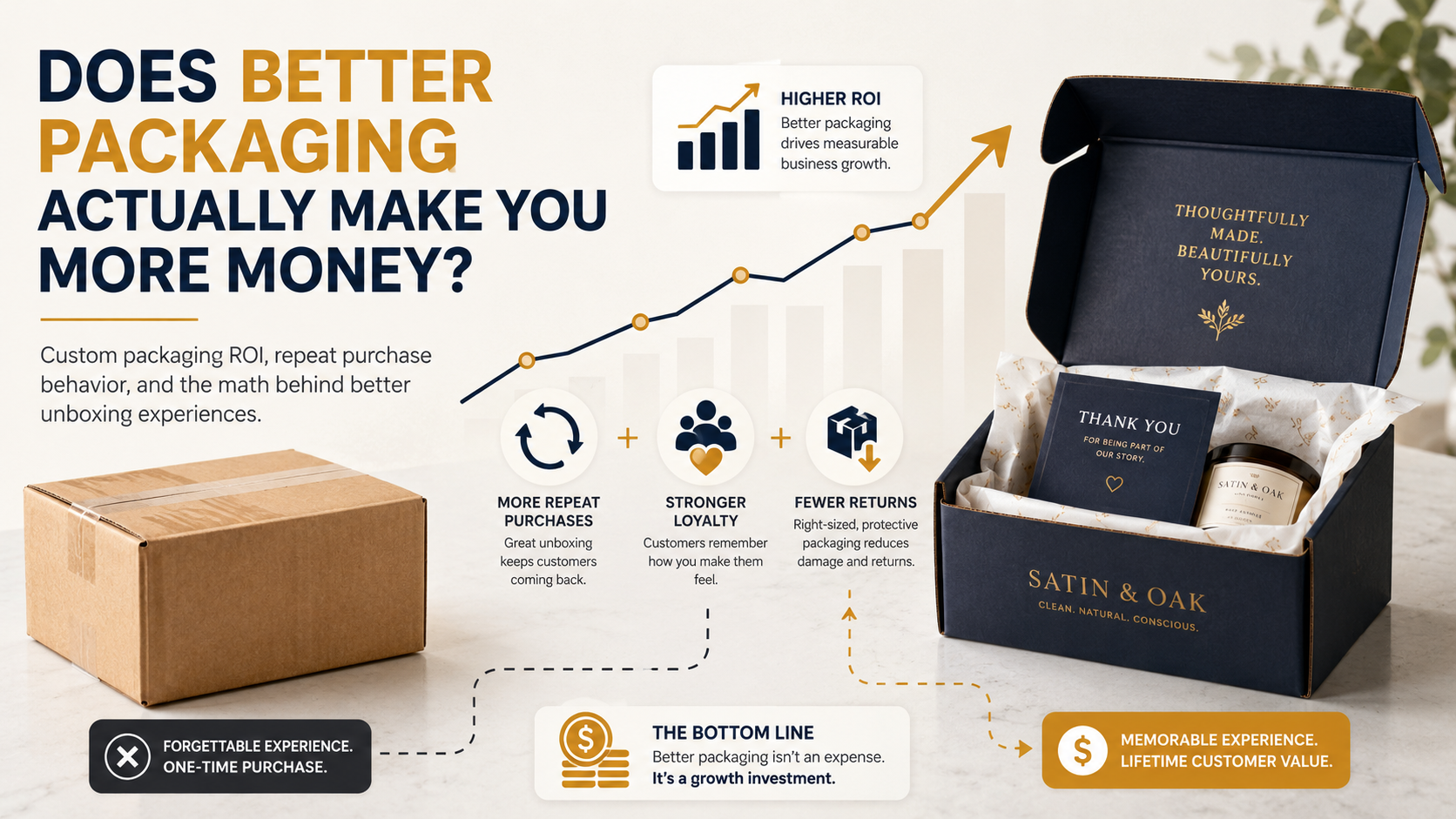
The cost of better packaging is easy to calculate. The return on it is not. A custom mailer box at $1.40 per unit shows up on a spreadsheet as a line item. The repeat purchase it might generate, the return it might prevent, the post a customer might share — those don’t show up anywhere unless you’re looking for them.
I’ve been in enough conversations with brand owners to know how this usually goes. They see the per-unit cost of upgrading from a generic brown shipper to a branded mailer and do the math on a thousand units. It looks expensive. What they don’t do is model what happens to customer lifetime value if 10% more of those customers come back for a second order.
Here’s a clear-eyed look at the custom packaging ROI case — what actually moves the numbers, what the math looks like in practice, and where the argument breaks down.
The Repeat Purchase Signal
The most direct packaging ROI mechanism is repeat purchase behavior. When a customer opens a package and the experience matches or exceeds what they expected, it reinforces their decision to buy. When it doesn’t — when the box is crushed, generic, or undersized — it introduces doubt about the brand they just paid.
Dotcom Distribution has run ecommerce packaging surveys for years. Their research consistently shows that branded, gift-like packaging increases repeat purchase intent among a meaningful share of customers. The exact number varies by category and price point, but the direction is consistent: customers who receive well-packaged orders come back at higher rates than customers who don’t.
The math on this is simple once you apply it to real numbers. Take a brand with a $55 average order value and a 20% repeat purchase rate. If better packaging moves that rate to 25%, that’s one additional order per 20 customers acquired. At a customer acquisition cost of $40 — a reasonable figure for mid-funnel paid social — each of those additional orders represents $40 in acquisition cost you didn’t have to spend.
The packaging upgrade cost in this scenario might be $0.80–$1.20 per unit. Over 1,000 units, that’s $800–$1,200. If 5% of those customers repeat at a $55 AOV, you’re looking at 50 orders × $55 = $2,750 in incremental revenue from the repeat purchase lift alone. The more detailed breakdown of how packaging drives repeat purchases is worth reading before you build your own version of this model.
Returns and Damage Claims: The Hidden Cost
Returns are a second ROI mechanism that brands consistently undercount. The standard way to think about returns is as a percentage of orders — a line item in the P&L. What’s less visible is how much of that return rate is driven by packaging failure rather than product dissatisfaction.
Inadequate packaging generates two kinds of returns. Direct returns: the product arrives damaged and the customer requests a replacement or refund. Indirect returns: the product arrives intact but the presentation was so underwhelming that the customer questions whether they bought the right thing. The first type is easy to model. The second shows up in post-purchase survey data and review sentiment, and it’s harder to catch.
Each ecommerce return costs money to process — reverse logistics, restocking, customer service time. Depending on your carrier contracts and warehouse setup, a single return can cost $12–$25 to handle before you’ve even looked at whether the product can be resold. If better packaging prevents one damage-related return per 100 orders, and each return costs $15 to process, that’s $150 in saved cost per 1,000 orders. Stack that against the packaging upgrade spend.
The packaging mistakes that generate the most returns tend to be structural: boxes too small for the product with excess void fill movement, tape closures that fail in cold-weather transit, inadequate cushioning for fragile items. These are spec decisions, not design decisions. They’re also fixable without a major packaging overhaul.
Earned Media and the Unboxing Effect
A third ROI mechanism is harder to model but worth understanding: organic content generation from a good unboxing experience.
Unboxing is not a niche content format. It’s one of the most searched and watched categories on YouTube and TikTok across virtually every product type. When a customer films their delivery, shares it to Stories, or tags a brand in a post, that’s earned media at zero cost-per-impression. The packaging earned it. The brand didn’t pay for it.
I’m not suggesting every brand needs a theatrical unboxing production with nested tissue and ribbon closures. But there’s a wide gap between “nothing worth filming” and “full ceremony.” Most brands are sitting far closer to the first end than the second. A single intentional detail — a printed interior, a brand color system that carries through to the mailer, a custom tape strip — gives a customer something worth showing. A plain brown box with a packing slip gives them nothing.
The custom mailer box generates this kind of content more reliably than any other shipping format, for a simple reason: self-locking construction creates a reveal moment. You don’t just open a flap — you unfold the box. That physical interaction is what customers film. It’s not coincidence that mailer boxes dominate unboxing content across almost every DTC category.
The Actual Math: A Framework You Can Use
Here’s a working model brands can apply to their own numbers.
Step 1: Your current unit economics. What does a customer cost to acquire (CAC)? What’s the average order value (AOV)? What’s your current repeat purchase rate at 90 days?
Step 2: The packaging cost delta. What does it cost to upgrade from your current shipper to a branded alternative? Moving from generic corrugated to a digital-print custom mailer typically runs $0.50–$1.50 per unit at standard volumes. That’s your investment per order.
Step 3: Model the repeat purchase lift conservatively. Don’t use the top-line numbers from packaging research. Use 3–5% as your working assumption. A 5% lift on a 20% base rate gets you to 21%. Apply that to 1,000 customers at your AOV. How many additional orders does it represent?
Step 4: Add the return rate offset. If better packaging prevents one damage-related return per 100 orders, and each return costs $15 to process, that’s $150 in recovered cost per 1,000 orders. Not dramatic, but real.
Step 5: Estimate earned media as upside, not baseline. If 1 in 200 customers posts about your packaging and each post reaches 400 accounts, that’s 2,000 organic impressions per 200 orders. What would those impressions cost in paid social? Leave it as a sensitivity item rather than a hard number — it’s real, it’s just harder to attribute cleanly.
For most ecommerce brands running this model at volumes above 500 orders per month, the packaging upgrade pays for itself through repeat purchase lift and return reduction alone. The earned media is incremental upside.
The detailed breakdown of what to spend on packaging at different revenue stages is worth reading before you finalize your model. The right packaging investment number isn’t the same for a $15K/month brand as it is for a $300K/month brand.
When Packaging ROI Doesn’t Work Out
The ROI case for packaging isn’t universal. There are three scenarios where the math breaks down.
Over-speccing for the category. Soft-touch lamination and foil stamping on a $9 product that ships to a customer who discards the box immediately is not an investment — it’s a brand exercise that costs more than it returns. Premium finishes need to match the product value and the customer’s purchase context. A $9 order has a different packaging ceiling than a $90 order, and pretending otherwise doesn’t make the math work.
Packaging that misreads the customer. I’ve watched brands invest in premium packaging that was completely at odds with their positioning — a sustainability brand shipping in non-recyclable coatings, a premium brand using the same box format as a discount competitor. The packaging has to be right before it can be premium. A well-produced box that sends the wrong signal generates confusion rather than loyalty. Understanding what eco-friendly packaging actually costs versus conventional alternatives is part of making the right call for sustainability-positioned brands.
Not tracking the numbers. The ROI case for packaging requires knowing your CAC, AOV, and repeat purchase rate. Brands that don’t track these metrics can’t model packaging ROI — and they can’t tell whether an upgrade worked. Fix the measurement infrastructure before spending on packaging, or you’re operating blind in both directions. According to Bain & Company research, increasing customer retention by just 5% can increase profits by 25–95%. That’s the underlying dynamic packaging taps into — but only if you’re measuring it.
The ROI Case for Sustainable Packaging
One version of this question comes up specifically around sustainability: does eco-friendly packaging pay off, or is it just an added cost?
For brands selling to sustainability-conscious consumers — outdoor, wellness, natural food, premium DTC — the data is consistent. Customers in these segments respond to FSC-certified board, recycled content, and plastic-free void fill in ways that directly affect repeat purchase behavior and social sharing. They notice what your packaging is made of. They factor it into whether they come back.
For those brands, sustainable packaging is not a cost premium — it’s a positioning signal that reduces churn. The ROI mechanism is the same as for premium packaging generally, just with a different customer segment driving the lift. The cost difference between FSC-certified recycled-content corrugated and virgin corrugated is small enough at standard volumes that the ROI case usually makes itself once you apply it to real retention numbers.
FAQ: Custom Packaging ROI and Revenue
Does better packaging actually increase sales?
Not directly in the way a promotion does. Packaging doesn’t close first-time sales. What it does is increase the probability that a customer who already bought comes back. The ROI mechanism is lifetime value, not conversion rate on the first order.
How do I measure packaging ROI?
Track repeat purchase rate before and after an upgrade using customer cohorts — customers who received new packaging versus customers who received old packaging — and compare their 90-day and 180-day reorder rates. It takes 90–180 days to get clean data, which is why most brands skip it. Run the analysis once and you’ll have a benchmark you can build on.
What order volume makes the ROI case work?
At 200+ orders per month, the math starts to hold reliably. Below that, the per-unit upgrade cost is harder to absorb and the sample sizes are too small to measure repeat purchase lift cleanly. Digital printing at 50–100 unit minimums lets early-stage brands test branded packaging before committing to a full-volume run.
Do customers actually care about packaging?
Yes, in most consumer DTC categories. Categories where this is consistently true: food and beverage, beauty and personal care, wellness and supplements, gifting. Categories where it matters less: commoditized utility products, B2B replenishment orders, low-ticket items bought purely on price. Match the investment to the category.
Is premium packaging worth it for a $20 product?
Depends on the LTV, not the AOV. A $20 product with a 4x reorder rate has an $80 LTV. A $20 product with a 1x reorder rate has a $20 LTV. The packaging investment case is different for those two brands even though they’re selling the same $20 item. Model the LTV, not just the order value.
What packaging upgrade delivers the best ROI?
For most ecommerce brands, the move from an unbranded RSC corrugated shipper to a custom-printed mailer box delivers the strongest ROI relative to cost. It’s a meaningful brand step up at a manageable cost delta. Adding interior print to an existing mailer box is a close second — it creates the moment customers share, at a very low incremental cost per unit.
How long before packaging ROI shows up?
90–180 days for repeat purchase lift — customers need time to reorder. Return rate improvement shows up faster, in 30–60 days, if the upgrade addressed a structural failure. Earned media shows up whenever it happens — you’ll see it in social mentions before the cohort data matures.
The Question Isn’t Whether Packaging Pays Off — It’s Whether You’re Measuring It
Most brands that invest in better packaging believe it’s working. Most that resist the investment treat it as a pure cost. The difference between those positions usually isn’t packaging quality — it’s measurement. The brands that built the model know what their packaging is worth. The ones that haven’t are guessing in both directions.
The custom packaging ROI revenue case is real and it’s modelable. Run the numbers for your CAC, AOV, and repeat purchase rate. Use conservative assumptions. If the math works at a 3% repeat purchase lift and one return prevented per 100 orders, you have your answer — and you don’t need to believe in packaging to act on it.
See our ecommerce packaging options to build the model around actual specs and costs. The unit economics shift at different order volumes, and it’s worth talking through what makes sense for where your brand is right now.