
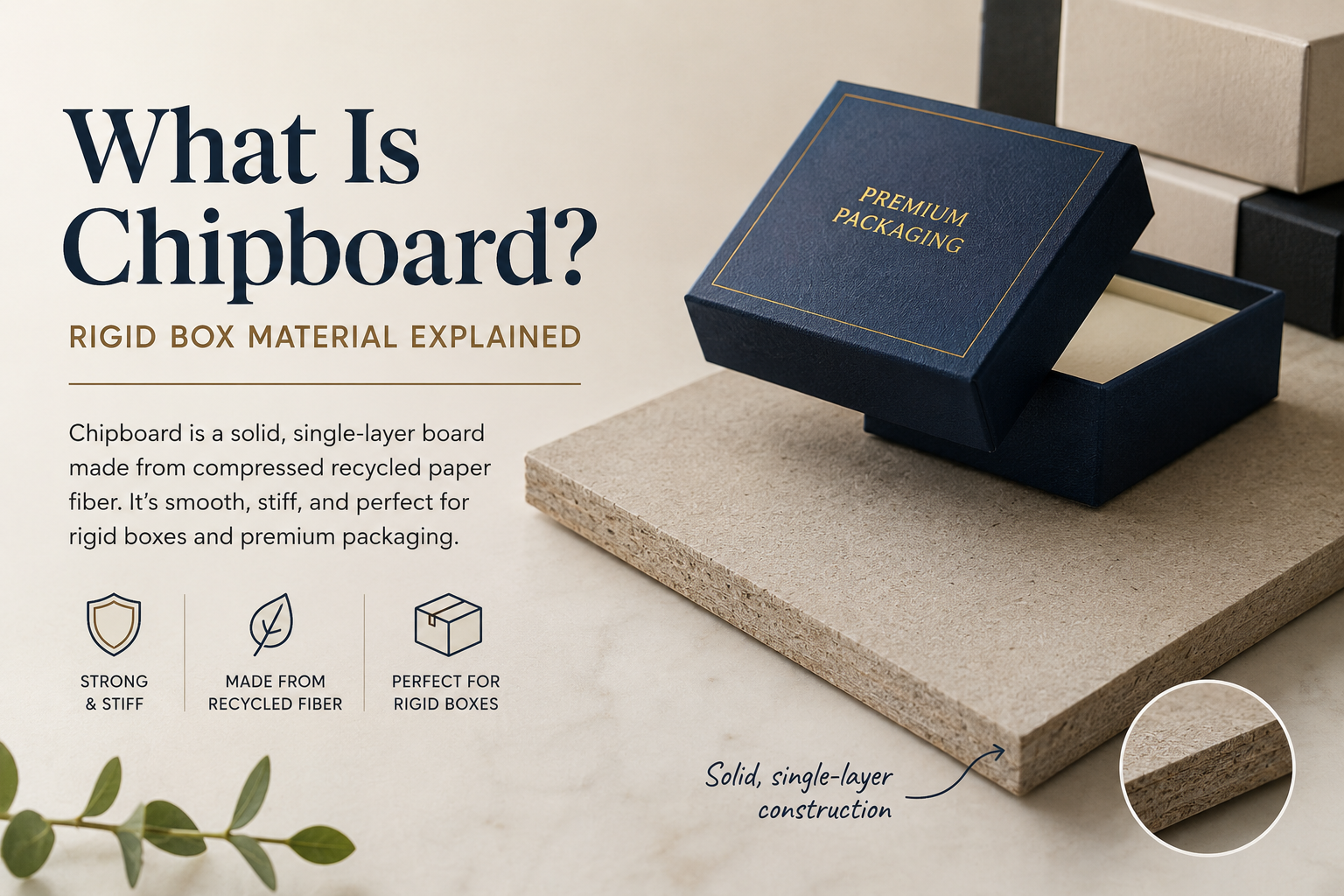
What is chipboard? It’s a solid, single-layer board made from compressed recycled paper fiber. There’s no wavy flute layer inside it. That’s different from corrugated cardboard. That single detail explains most of what chipboard can and can’t do. It’s smooth and stiff. It’s dense enough to hold a shape. It’s not built to absorb heavy impact, though, the way corrugated board is.
Have you ever picked up a rigid gift box and felt a firm core under the paper wrap? That core was likely chipboard, or a close relative of it. This article covers what chipboard actually is. It also covers how chipboard differs from cardboard and greyboard. There’s a naming inconsistency between vendors too, one that can catch buyers off guard.
What Is Chipboard, Exactly?
Chipboard gets made by compressing recycled paper fibers under heat and pressure. The result is a single, solid sheet. There’s no fluting. There are no air gaps. There aren’t multiple layers glued together either. It’s one dense sheet, start to finish.
That construction gives chipboard a smooth, even surface. It takes a paper wrap or foil lamination well. That’s why it shows up so often as the hidden core of rigid gift boxes and jewelry boxes. Premium retail packaging relies on it too. You rarely see raw chipboard on its own. You see it wrapped in printed paper, doing the structural work underneath.
So what is chipboard, in practice? It’s the quiet backbone behind a lot of packaging. It looks far more solid than a folded carton ever could on its own.
Chipboard vs. Cardboard: The Real Structural Difference
Cardboard, in the corrugated sense, has a fluted layer sandwiched between two flat liners. Those flutes create air gaps. Those gaps absorb impact and resist crushing under weight. That’s what makes corrugated cardboard the standard for shipping boxes.
Chipboard has none of that. It’s a single, solid layer with no air gaps at all. It resists denting well. It holds a crisp shape too. It doesn’t cushion an impact the way a fluted structure does, though. Chipboard and corrugated cardboard solve different problems. One protects a shape. The other protects against a drop. That distinction is really the short answer to what is chipboard good for, versus what corrugated handles instead.
Chipboard vs. Greyboard: Where Vendors Disagree
Here’s a naming problem most guides skip entirely. Some vendors use “chipboard” and “greyboard” interchangeably. Others treat greyboard as a distinct, denser product. That version gets built from multiple compressed layers rather than one.
Greyboard, where the distinction holds, generally runs denser than standard chipboard. It often falls in a 1,200 to 2,400 GSM range for rigid box cores. Chipboard tends to run lighter and thinner instead. There’s no single industry-wide rule enforcing that line, though. You can’t assume every vendor draws it the same way.
I’ve seen a brand order “chipboard” for a rigid box core from one vendor. They placed a repeat order later, using the same spec sheet, at a second vendor. The second batch felt noticeably less rigid in hand. Neither vendor had done anything wrong technically. They simply had different internal standards tied to the same word. The brand caught it comparing physical samples side by side. They fixed it going forward by specifying an exact GSM range, instead of just naming the material.
Ask for the GSM or caliper number directly. Don’t just ask for “chipboard” by name, if consistent rigidity matters across production runs or across vendors. That single question resolves most of what is chipboard confusion before it ever reaches your production floor.
Where Chipboard Earns Its Place
Chipboard earns its spot inside rigid gift boxes and jewelry boxes. It works anywhere a wrapped, printed exterior sits over a firm internal core. It holds a shape under a paper wrap far better than a folded, single-ply cardstock could manage alone.
It also works well for point-of-sale displays and backing boards. Puzzle and game boxes rely on it too. Anywhere a flat, rigid surface matters more than shock absorption, chipboard tends to be the answer. That’s the practical version of what is chipboard actually for, beyond the textbook definition.
Where Chipboard Falls Short
Chipboard isn’t built for shipping protection. It can’t absorb a drop the way corrugated cardboard’s fluted structure can. If your product needs to survive a parcel carrier’s handling, chipboard alone isn’t the right core material.
It also costs more than plain corrugated for an equivalent size. It’s a denser, purpose-built rigid material, not a bulk shipping commodity. That extra cost buys shape and shelf presence. It doesn’t buy shipping durability. Anyone asking what is chipboard rated for in drop testing will find the honest answer is: not much. Skipping this check is one of those quiet packaging mistakes that kill the unboxing moment. It shows up as damage claims, not just a bad review.
Answering What Is Chipboard for Specific Product Types
Cosmetics and skincare brands lean on chipboard constantly for that firm, premium hand-feel under a wrapped exterior. Jewelry brands use it for the same reason. It’s often paired with a soft touch or foil finish on top. Electronics packaging sometimes uses it for a rigid inner tray. Foam or molded pulp usually takes over from there, once actual cushioning matters more than shape.
Chipboard vs. Greyboard vs. Corrugated: Quick Comparison
| Material | Structure | Density | Best For |
|---|---|---|---|
| Chipboard | Single solid layer | Moderate | Rigid box cores, wrapped packaging |
| Greyboard | Multiple compressed layers (where distinguished) | High | Premium rigid box cores |
| Corrugated Cardboard | Fluted layer between liners | Low-Moderate | Shipping, impact protection |
Common Mistakes When Specifying Chipboard
The first mistake is assuming “chipboard” means the same product at every vendor. Ask for a GSM or caliper spec instead of trusting the name alone. That question alone answers most of what is chipboard confusion between suppliers.
The second mistake is using chipboard where shipping protection actually matters. It holds a shape well. It won’t cushion a drop the way corrugated will, though.
The third mistake is confusing chipboard with corrugated cardboard entirely, since both get called “cardboard” casually. They solve different problems. Mixing them up in a spec conversation leads to the wrong material showing up in production.
A fourth mistake is skipping a physical sample when switching vendors mid-production. Rigidity can shift even when the paperwork looks identical.
Which Should You Choose?
Building a rigid box for a premium product where shape and shelf presence matter most? Chipboard or greyboard, specified by GSM, gets you there.
Shipping something that needs to survive a parcel carrier’s handling? Skip chipboard for the outer structure. Lean on corrugated cardboard instead.
Not sure what your current supplier means by “chipboard”? Our guide to luxury rigid box packaging covers how core material choices affect the finished box. Easy Box Packaging can also help you specify an exact GSM range and test a sample first. That’s the safest step before a full production run. Getting it right ties into why packaging drives repeat purchases, not just a one-time order.
Chipboard does one job extremely well. It gives a wrapped, printed box a firm, consistent shape. Ask the right question about it. What is chipboard rated at in GSM? That single question avoids the inconsistency that catches so many buyers off guard.
What Is Chipboard: FAQ
Is chipboard the same as cardboard? Not structurally. Cardboard usually means corrugated board with a fluted core. Chipboard is a solid, single-layer board with no flutes at all.
Is chipboard recyclable? Generally yes. It’s made from recycled paper fiber. It can typically be recycled again after use too.
Why do vendors sometimes call chipboard “greyboard”? There’s no single industry standard separating the two terms. Some vendors treat them as the same material. Others reserve “greyboard” for a denser, multi-layer version.
Get a free quote — dieline and design support included.