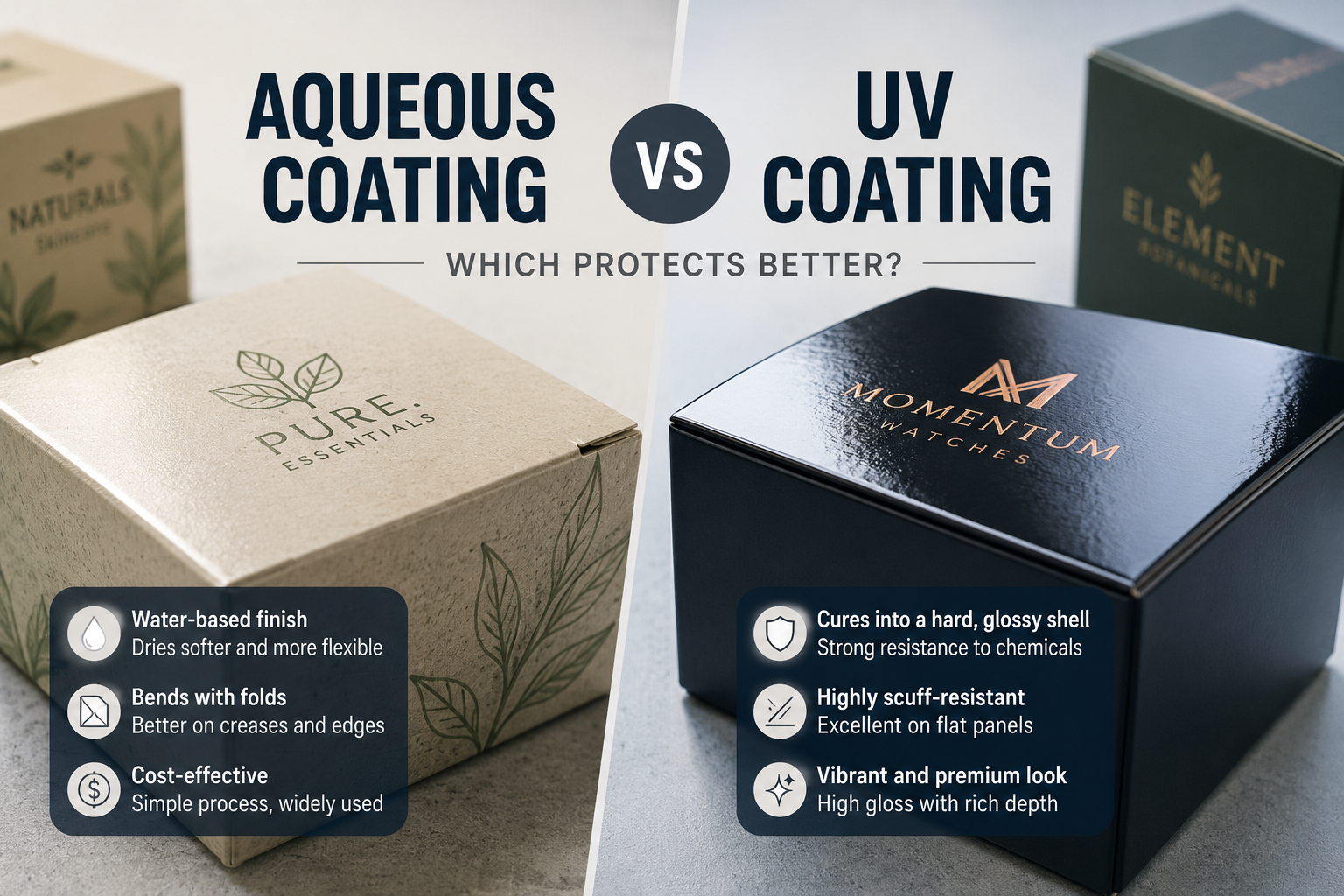
Aqueous coating and UV coating protect a box in different ways. UV coating cures into a hard, glossy shell with strong resistance to chemicals and scuffs. Aqueous coating is water-based. It dries softer and more flexible. Neither one wins outright. UV holds up better against wear on a flat panel. Aqueous holds up better along a fold. Which one “protects better” depends on your box shape, and on what’s inside it.
That’s the short version. The real answer depends on how your box gets used. It’s not just about how shiny you want it to look. Structure and contents both play a bigger role in this choice than most buyers expect going in.
What Aqueous Coating Actually Is
Aqueous coating is a water-based finish. Printers apply it right after ink, then dry it with heat or air. It adds a light sheen. It also adds a thin layer of protection against moisture and light scuffs.
It’s more flexible than most other coatings, too. That matters on a box with creases, tuck flaps, or hinges. Aqueous coating tends to bend with the fold instead of fighting it.
Cost-wise, aqueous coating usually runs cheaper than UV. It’s a simpler process. No special curing lamps are needed. Many printers already run it as a standard finishing step.
Aqueous coating also comes in a few sheen levels. These range from a soft matte feel to a brighter satin look. None of those levels get as glossy as UV. They still add real shelf appeal, without the fold risk that comes with a harder finish.
What UV Coating Actually Is
UV coating starts as a liquid too. But it cures under ultraviolet light, instead of drying with heat or air. That light locks the coating into a hard, glossy film almost right away.
The result is a tougher surface. UV coating resists chemicals, scuffs, and fingerprints better than aqueous coating does. That’s why you see it on retail boxes meant to look sharp on a shelf.
The tradeoff is flexibility. A hard, cured film doesn’t bend as well as a softer, water-based one. On a flat panel, that’s rarely a problem. On a sharp fold, it can be.
UV coating also comes in a few finish types. Options range from a full-gloss shine to a satin or soft-touch feel. Full gloss shows off color the most. Softer UV finishes trade a little shine for a more premium feel in hand. They still carry the same fold risk as glossy UV, though.
UV coating also cures almost instantly under the light, which speeds up production compared to air-dried finishes. That speed is one reason printers like using it for high-volume runs. The fold tradeoff still applies, though.
The Fold-Cracking Tradeoff Most Guides Skip
Here’s the part most comparisons leave out. UV coating’s biggest strength is that hard, cured shell. That same shell is also its biggest risk on a folding box. Bend a hard coating too sharply, and it can crack right along the fold line.
I’ve seen a brand pick UV coating for a tuck-top mailer. It looked glossier on a flat proof. Once the boxes got folded and assembled, hairline cracks showed up along every fold. The proof never showed the problem. Proofs rarely get folded the same way a finished box does.
Before locking in UV coating on any box with folds, flex a folded sample by hand first. Check the crease lines closely under good light. If cracking shows up on a sample, that same cracking will show up across your full order too. Easy Box Packaging can recommend a coating based on your box’s actual fold pattern. That’s more reliable than judging a flat panel in a proof.
Food Contact and Coating Choice
Coating choice isn’t only about looks and durability. It can also touch on food safety rules. That depends on what your box actually holds.
Aqueous coatings generally meet FDA rules for both dry and wet or greasy food contact, since they’re water-based. UV coatings are a different story. Outside a narrow set of approved formulations, most UV coatings aren’t approved for direct food contact.
That gap matters most for boxes that touch food directly. It matters less for boxes that just hold a wrapped or bagged product. If your box holds unwrapped food, ask specifically whether the coating is food-contact approved, not just food-adjacent.
Verify food safety and industry-specific rules with a qualified professional before production. Rules and approved formulations can vary, and they can change over time. Easy Box Packaging can flag which coating options fit food packaging boxes as part of your quote. That guidance comes alongside the same compliance reminder above.
Aqueous vs UV Coating: Quick Comparison
| Factor | Aqueous Coating | UV Coating |
|---|---|---|
| Durability | Moderate scuff resistance | High scuff and chemical resistance |
| Flexibility | Bends well on folds | Can crack on sharp folds |
| Cost | Lower | Higher |
| Food contact | Generally FDA-compliant | Usually not, outside approved formulations |
| Look | Light, natural sheen | Bold, glossy shine |
Common Mistakes When Choosing a Coating
The first mistake is picking a coating based only on a flat proof. Folds change everything. Always test on a folded sample, not a flat sheet.
The second mistake is assuming UV coating is always the premium choice. It looks bolder on a shelf. That doesn’t make it the right pick for every structure, or every product inside the box.
The third mistake is skipping the food-contact question entirely. That’s one of the quieter packaging mistakes that kill the unboxing moment. A compliance issue can surface long after a design is locked and printed.
The fourth mistake is treating “coating” and “lamination” as the same thing. Coatings are thin liquid finishes applied and cured in the printing process. Lamination adds a separate plastic film layer on top. They solve similar problems in different ways, at different costs.
A fifth mistake is assuming a higher sheen always means better protection. UV coating looks glossier. But gloss level and actual chemical resistance don’t always move together. Ask your printer for real durability specs, not just a shine comparison.
A sixth mistake is applying one coating choice to an entire product line, without checking each structure. A rigid box lid and a folding mailer can call for different coatings, even under the same brand. Review fold patterns box by box, not just once for the whole line.
Which Should You Choose?
Building a box with sharp folds, tuck flaps, or hinges? Lean toward aqueous coating. Or test UV carefully on a folded sample first. Want a bold, glossy shelf presence on a mostly flat panel, like a rigid box lid? UV coating usually wins there.
Packing food that touches the box directly? Lean toward aqueous coating. Confirm food-contact approval with your printer, since most UV options fall outside FDA clearance for that use. Building custom mailer boxes that fold and travel through the mail? Aqueous coating’s flexibility usually serves that structure better than a hard UV shell.
Still not sure? Request a folded sample in both coatings before committing to a full print run. Getting this choice right the first time matters. That’s part of why packaging drives repeat purchases. A box that arrives cracked or flawed rarely earns a second order.
Aqueous vs UV Coating: FAQ
Which is better, aqueous or UV coating? Neither wins outright. UV coating offers more shine and scuff resistance on flat panels. Aqueous coating bends better on folds and tends to fit food-contact rules more easily.
Does UV coating crack on folds? It can. UV coating cures into a hard, glossy film. That film doesn’t flex as well as aqueous coating. Sharp folds are where cracking most often shows up.
Is aqueous coating food safe? Aqueous coatings generally meet FDA rules for food contact. Always confirm with your printer and a qualified professional for your specific product and use case.
Is UV coating food safe? Usually not, outside a narrow set of FDA-approved formulations. Most standard UV coatings aren’t cleared for direct food contact.
What’s the difference between coating and varnish? “Varnish” gets used loosely to mean any clear liquid finish. That includes aqueous and UV coatings. In practice, aqueous and UV are the two most common coating types used in custom packaging today.
Get a free quote — dieline and design support included.