
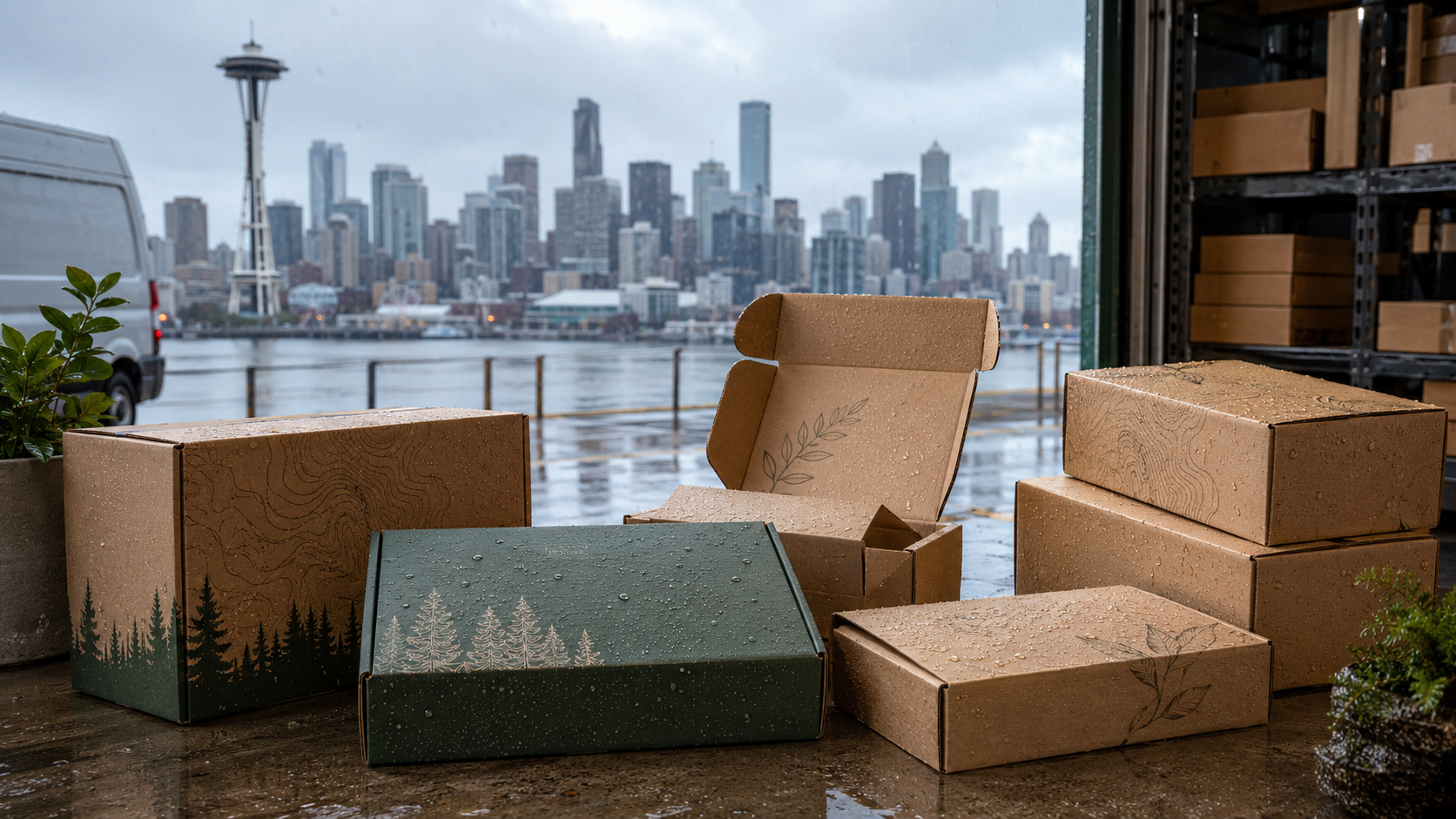
Seattle has a packaging challenge that most guides treat as a footnote: it rains here. A lot. Not dramatically — just relentlessly. One hundred and fifty-plus days of rain per year, packages sitting on wet porches, humidity that hangs in the air all winter. That moisture problem, combined with one of the most sustainability-conscious consumer bases in the country and a tech-adjacent DTC scene that’s surrounded by Amazon, creates a specific set of packaging demands that brands operating out of Seattle should be thinking about.
The brands getting it right aren’t the ones with the biggest budgets. They’re the ones that understood their market before they spec’d their boxes.
Here’s what’s actually working for custom boxes in Seattle and across Washington state — from the moisture specs that matter to the port advantage most brands don’t use.
What Seattle Rain Does to Corrugated Packaging
Corrugated board is an engineered paper product. It performs extremely well in normal conditions. What it doesn’t handle well is sustained moisture — and Seattle delivers sustained moisture from October through May with minimal interruption.
The structural issue: corrugated’s ECT (edge crush test) rating — the number that tells you how much compression load a box can handle before buckling — degrades dramatically with humidity. At 85% relative humidity, corrugated loses around half its dry ECT stacking strength. Seattle’s average winter humidity regularly hits that range. Packages stacked in a delivery vehicle, on a wet porch, or in a damp receiving area are not operating under dry lab conditions.
What this means for Seattle brands:
Moisture-resistant coatings matter here more than in most markets. Standard corrugated has no moisture resistance. Water-resistant sizing treatments — applied during the paperboard manufacturing process — slow moisture uptake significantly. For brands shipping heavy items or anything stacked multiple units high, specifying moisture-resistant board is worth the slight material cost premium. The alternative is ECT failure under normal Seattle delivery conditions in January.
Self-locking construction reduces moisture failure points. Standard RSC (regular slotted container) shippers sealed with tape are only as waterproof as the tape adhesive. Hot-melt tape adhesive loses bonding strength in sustained moisture and low temperatures — which describes a Seattle porch in November precisely. Self-locking mailer box construction eliminates the tape dependency. The box holds its form through moisture exposure without relying on adhesive bond.
Coating and lamination protect exterior print. Standard corrugated with printed exterior runs the risk of print degradation when wet — especially with water-based inks on uncoated board. Aqueous coating (water-based, applied in-line during printing) or lamination protects the print surface and gives the box enough moisture resistance to survive a Seattle front porch without the brand elements washing out.
The Amazon Effect on Seattle Packaging Standards
I’ve talked with a lot of DTC founders about packaging. The ones in Seattle have a different baseline expectation than founders in most other cities — because they live and work in the same city as Amazon, surrounded by people who think about ecommerce packaging as a professional discipline, not an afterthought.
This matters for two reasons. First: Seattle consumers have opened more well-packaged Amazon boxes than almost any other customer base in the country. Their reference point for what a delivered package looks and feels like is higher. A brand that ships a generic brown box to a Seattle consumer in South Lake Union is competing against the unconscious benchmark of thousands of Prime deliveries.
Second: Seattle’s startup and tech ecosystem produces DTC founders who have often worked in ecommerce, logistics, or product development. They arrive at packaging decisions more informed than the average first-time brand owner. That’s good for packaging quality and bad for anyone hoping to cut corners on spec and have customers not notice.
The practical result: Seattle DTC brands invest in custom mailer boxes at higher rates than comparable-stage brands in other markets. The unboxing experience is not treated as optional — it’s treated as table stakes for a market that has seen too many well-executed boxes to be impressed by a generic one.
Washington State Sustainability: Regulation and Consumer Expectation
Washington state passed SB 5022 in 2021 — one of the most comprehensive plastic packaging producer responsibility laws in the US. It establishes extended producer responsibility for plastic packaging, meaning brands selling into Washington have real regulatory incentives to shift toward recyclable and compostable packaging materials. This is not hypothetical future regulation — it is current law with implementation timelines.
Beyond the regulation: Seattle consumers actively care about packaging sustainability in ways that translate into purchase behavior. Seattle has one of the highest residential recycling rates in the US. Customers here will notice non-recyclable packaging. They will mention it in reviews. They will choose between two otherwise similar brands based on packaging sustainability signals.
For brands shipping from Seattle, this shapes the spec in concrete ways:
FSC-certified corrugated is a visible signal that resonates with the Pacific Northwest consumer base in the same way it does in Colorado — but with the added weight of actual state-level regulation pointing the same direction. Recycled content board (post-consumer recycled fiber) is widely available and prints cleanly. The cost difference from virgin board is minimal at standard ordering volumes.
Plastic dunnage — the airbags, plastic foam peanuts, and bubble wrap that fill void space in shippers — gets particularly poor reception from Seattle customers. Kraft paper crinkle fill, tissue paper, and corrugated honeycomb void fill are the alternatives that read as intentional rather than cheap. Understanding what eco-friendly custom packaging actually costs versus conventional alternatives is the starting point for making that call without guessing at the budget impact.
The Port of Seattle Advantage Most Brands Don’t Use
Seattle is one of the largest container ports on the West Coast. Ocean freight from major manufacturing hubs in China and Vietnam arrives in Seattle 14–18 days after departure — compared to 28–35 days for the same cargo to reach East Coast ports via the Panama Canal. For brands sourcing custom packaging from Asia, that’s a 2-week lead time advantage built into Seattle’s geography.
Most Seattle DTC brands don’t consciously factor this into their packaging sourcing decisions — they use domestic suppliers by default, or they order from Asia without realizing the freight timeline to Seattle is materially different from the timeline their Chicago or Atlanta counterparts are planning around. The port advantage is real. If you’re placing 5,000-unit corrugated runs at scale and your design is stable, international sourcing to Seattle competes more favorably on total lead time than it does for most of the country.
The counter-consideration: if you’re still iterating on design or product, domestic digital printing at 200–500 units lets you move fast without committing to a large international run. The port advantage only applies when you’re ready for volume.
Pacific Northwest Outdoor Brands: Heavy Products, Wet Conditions
REI is headquartered in Bellevue. The Pacific Northwest produces more outdoor gear DTC brands per capita than most regions in the country — camping equipment, hiking gear, technical apparel, water sports equipment. These brands have specific corrugated requirements that differ from standard DTC ecommerce.
Outdoor gear is heavy. A single tent or sleeping bag system can weigh 4–6 lbs. Technical footwear runs 2–4 lbs per pair. Layering this weight into a corrugated shipper that’s also going to encounter Seattle’s moisture conditions means the structural spec needs to account for both load and humidity simultaneously. Single-wall corrugated at standard ECT ratings is not sufficient for heavy outdoor products that will sit on wet Seattle porches. Double-wall board, moisture-resistant sizing, and self-locking construction should all be in the spec for outdoor gear brands shipping from the Puget Sound region.
The consumer expectation for outdoor brands specifically is also worth noting: outdoor consumers are among the most attentive to packaging waste. A brand that makes technical gear for Leave No Trace camping and ships it in non-recyclable packaging with plastic dunnage has an obvious mismatch that Seattle’s outdoor customers will identify immediately. The packaging should reflect the values of the product — which in the Pacific Northwest outdoor category means minimal, recyclable, and durably functional.
Washington Craft Beverage Packaging
Washington produces more apples than any other state, which has made it the center of the US craft cider industry. It’s also the second-largest craft brewing state in the country, with Seattle, Spokane, Bellingham, and Olympia all supporting significant brewing scenes. Pacific Northwest wines from Walla Walla and Yakima Valley ship direct-to-consumer. All of these categories have packaging requirements that differ from standard ecommerce corrugated.
For craft beverage brands shipping direct from Washington — and I’ve seen this spec go wrong more often with Washington brands than almost anywhere else, usually because someone reused a dry-climate box spec without adjusting for the condensation inside a beverage shipper in a Pacific Northwest winter:
Food-safe board is non-negotiable. The corrugated shipper around bottled or canned products must use food-safe board stock — FSC-certified kraft or SBS with food-safe coatings. This also affects FBA eligibility for brands selling through Amazon (relevant given Amazon’s local presence and the number of Seattle brands selling through that channel).
Weight-rated construction for bottles. A case of twelve 22oz bomber bottles weighs over 16 lbs before packaging materials. Single-wall corrugated at standard ECT ratings is not sufficient. ECT-32 minimum; double-wall for distribution stacking. Chipboard partitions or corrugated cell packs prevent bottle-to-bottle contact and breakage during transit.
Moisture resistance for beverage shippers. Canned and bottled product condensates in transit, especially in Seattle’s climate. The interior of a beverage shipper encounters moisture from both outside (rain, humidity) and inside (condensation on cans and bottles). Moisture-resistant board spec is especially justified for beverage packaging in the Pacific Northwest.
Seattle Neighborhoods and What They Signal About Customer Expectations
Seattle’s DTC brand ecosystem is concentrated in a handful of distinct areas, and where your customer base is changes what your packaging needs to communicate.
South Lake Union / Capitol Hill: Tech-adjacent, younger, design-literate. High expectations for packaging quality and brand consistency. These customers have seen a lot of well-executed DTC packaging and will notice the difference between a thoughtfully designed custom mailer and a generic corrugated box. Premium finishes — matte lamination, soft-touch, clean structural design — land here.
Fremont / Ballard: Artisan-leaning, sustainability-forward, craft brand sensibility. Kraft packaging with minimal ink and recycled content board performs well here. Excessive print coverage and non-recyclable coatings get negative feedback from this segment. The intentional minimalism aesthetic plays.
Bellevue / Eastside: Higher median income, premium brand expectations, tech professionals. Rigid box and premium corrugated finishes are appropriate. This segment notices construction quality — a wobbly box closure or soft-touch laminate that’s peeling reads as cheap in a way that corrugated-focused markets further down the income scale don’t register.
Getting the Spec Right for Washington Shipping
Across Seattle and Washington state broadly, these are the decisions that separate brands that ship well from those that don’t:
Moisture-resistant board for anything heavy, stacked, or high-value. Seattle’s humidity makes this a standard consideration, not a premium one. The cost difference is small. The failure mode — a box that loses structural integrity on a wet porch — is not small.
Self-locking construction over tape closures. Same principle as Colorado’s freeze-thaw problem, applied to moisture: tape adhesive fails in sustained wet conditions. Self-locking corrugated doesn’t need tape. For anything shipping to Seattle addresses between October and April, this is the right structural call.
Recyclable or compostable void fill. Plastic alternatives aren’t optional in the Pacific Northwest — they’re what Washington state regulation is moving toward and what Seattle consumers already expect. Kraft crinkle, tissue, honeycomb paper, and corrugated inserts cover most void-fill applications.
FSC certification where possible. Washington consumers are among the most likely in the country to notice and respond positively to FSC-certified board. It’s a low-cost signal that resonates with the sustainability expectations of the market.
The packaging mistakes that damage the unboxing experience are the same everywhere — but in Seattle’s moisture-heavy climate, the structural ones compound faster than they do in drier markets.
Why Seattle Brands Spend More on Packaging Than the Numbers Suggest They Should
The data on how packaging affects repeat purchase behavior applies universally. But in Seattle it runs into an additional factor: the consumer base here is disproportionately aware of what good DTC packaging looks like, because they live in the city where Amazon perfected it. The bar is higher. The penalty for falling below it is steeper.
Seattle brands that invest in custom packaging — proper mailer construction, moisture-appropriate spec, recyclable materials — aren’t doing it purely for aesthetics. They’re doing it because their customer’s baseline expectation, shaped by years of well-executed ecommerce deliveries, makes the alternative visibly inadequate. That’s a strong business case for the packaging investment, even before you model the repeat purchase lift.
FAQ: Custom Boxes in Seattle, Washington
Does Seattle’s rain really affect corrugated packaging?
Yes — meaningfully. Corrugated ECT stacking strength degrades with moisture exposure. At high relative humidity (85%+), which Seattle winters regularly hit, corrugated loses a significant portion of its dry strength. For heavy products, stacked units, or anything that will sit on a wet porch, moisture-resistant board spec is the right call.
What’s the best box construction for Seattle’s wet climate?
Self-locking construction — auto-lock bottoms, tuck-top mailer boxes — removes tape from the equation. Tape adhesive fails in sustained moisture. Self-locking corrugated holds its form regardless of surface moisture. Pair that with moisture-resistant board sizing for anything heavy or high-value.
Does Washington SB 5022 affect my packaging decisions?
If you’re selling into Washington state, yes. SB 5022 establishes extended producer responsibility for plastic packaging. Brands should be moving toward recyclable, compostable, or reduced-plastic packaging to meet both the regulatory trajectory and Seattle consumer expectations. FSC-certified corrugated and paper-based void fill are the practical starting points.
Is the Port of Seattle actually useful for smaller brands?
For brands ordering 5,000+ units with stable designs, the 14–18 day ocean freight window from Asia to Seattle (vs 28–35 days to East Coast ports) is a real lead time advantage. For smaller brands still iterating on design, domestic digital printing at 200–500 units is more practical regardless of port proximity.
What sustainability certifications matter most to Seattle consumers?
FSC (Forest Stewardship Council) certification is the most widely recognized. Post-consumer recycled (PCR) content labeling — showing what percentage of the board is recycled fiber — is also noticed. “Curbside recyclable” labeling matters because Seattle has one of the US’s most rigorous recycling programs and customers use it consistently.
What’s the minimum order for custom packaging in Seattle?
With digital printing, 50–100 units is achievable with many suppliers at no plate setup cost — the right range for early-stage brands testing formats. Offset printing makes economic sense at 500–1,000+ units. For Seattle brands with access to the port, international sourcing at 3,000–5,000 units can deliver meaningful per-unit savings once the design is locked.
Does outdoor gear packaging need different specs than standard ecommerce?
Yes. Outdoor gear is heavy, and outdoor consumers are attentive to packaging waste. Double-wall corrugated for anything over 8–10 lbs; moisture-resistant sizing given Seattle’s climate; die-cut or molded pulp inserts for fragile technical gear; recyclable or paper-based void fill. The packaging should reflect the values of the product category.
Seattle Ships in All Weather — Your Packaging Should Too
The brands getting it right here aren’t fighting the climate — they’ve spec’d for it. Moisture-resistant board, self-locking construction, recyclable materials: these aren’t upgrades for Seattle. They’re the baseline spec for a market that delivers through wet winters and holds packaging to standards shaped by proximity to the world’s largest ecommerce operation.
Get those fundamentals right and the packaging stops being a logistics problem and starts being a brand signal. That’s when it starts doing real work for you.
Easy Box Packaging works with DTC brands throughout Washington state — from Seattle fulfillment operations to Pacific Northwest outdoor brands to Washington craft beverage producers shipping direct. See our ecommerce packaging options to talk through what your products and your market specifically need.
If you’re a Pacific Northwest brand thinking through the regional packaging picture, the Denver packaging guide covers Colorado’s comparable outdoor-brand and sustainability-driven packaging market, and the Michigan packaging guide addresses the humidity and moisture ECT degradation problem from a Great Lakes manufacturing perspective.