
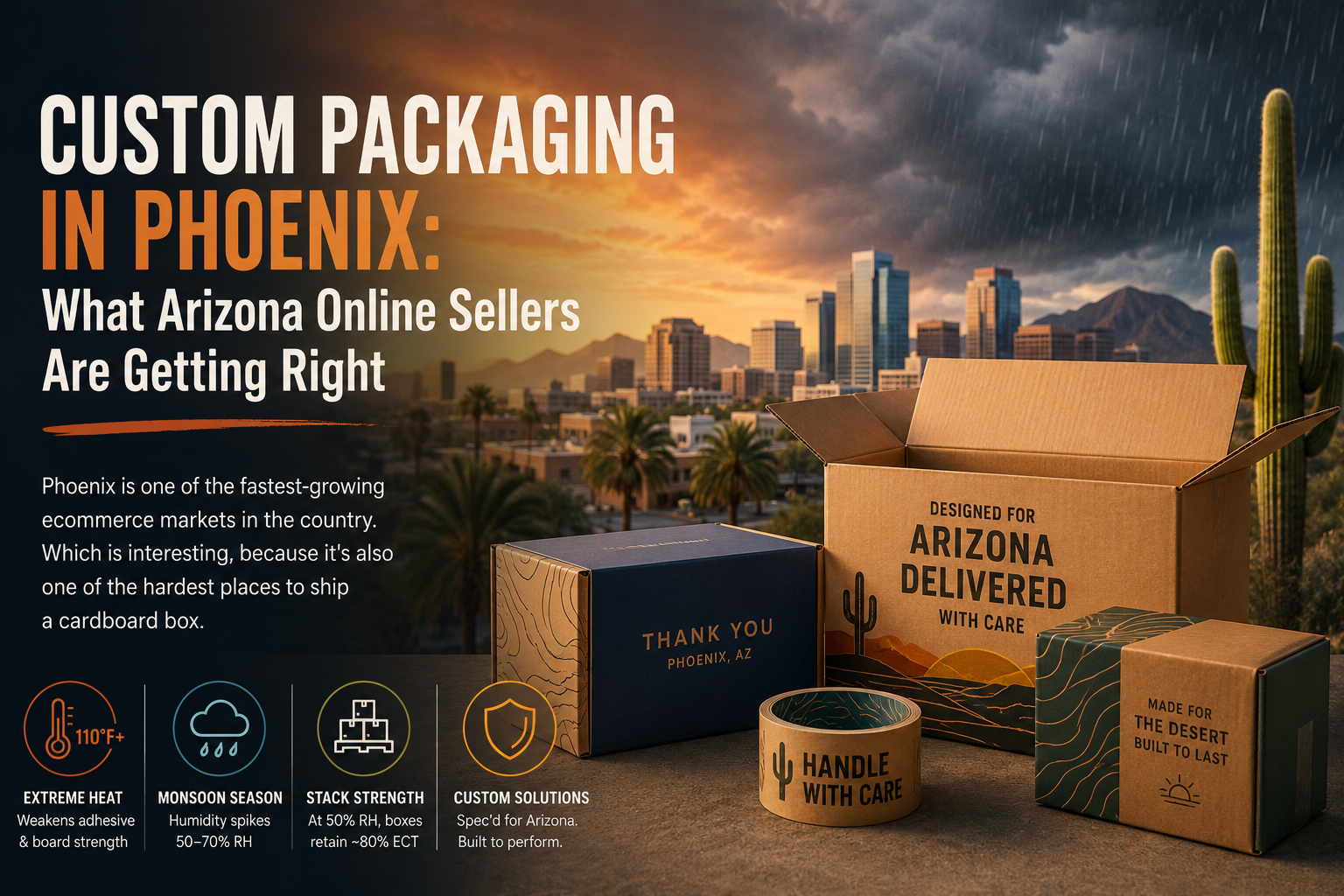
Phoenix is one of the fastest-growing ecommerce markets in the country. Which is interesting, because it’s also one of the hardest places to ship a cardboard box.
If you’re running a DTC brand, a subscription service, or a product-based business out of Phoenix, Scottsdale, Tempe, or anywhere in the metro area, your packaging decisions aren’t just about aesthetics. The climate puts real stress on your boxes — in ways that most packaging guides don’t mention.
This is what Arizona ecommerce brands are actually ordering, what’s working, and what the heat and monsoon season do to your corrugated boxes that nobody tells you upfront.
The Arizona Packaging Problem Nobody Talks About
Everyone says Arizona is hot. That’s true. Summers in Phoenix regularly hit 110°F, and some years push past 115°F. That heat degrades standard corrugated packaging — the starch adhesive that holds corrugated board together weakens at sustained high temperatures, and boxes stored in non-climate-controlled warehouses become brittle, prone to collapse, and structurally unreliable.
But the heat isn’t actually the hardest problem for corrugated packaging in Arizona. The monsoon season is.
From July through September, Arizona’s dry heat gives way to the North American Monsoon. Humidity spikes from the desert’s usual 10–20% relative humidity to 50–70% in Phoenix and higher in southern Arizona. That moisture attacks corrugated packaging in a specific way: it breaks down ECT (Edge Crush Test) compression strength. Research on corrugated board performance shows that boxes stored at around 50% relative humidity retain roughly 80% of their original stacking strength. At higher humidity, the drop is steeper. For brands stacking boxes in a Phoenix warehouse between July and September, that’s a real structural problem.
I’ve watched brands lose full pallets of product during monsoon weeks because their corrugated spec was designed for dry California shipping, not Arizona summer. The boxes looked fine. They just couldn’t hold the stack weight anymore.
Arizona ecommerce brands face a dual climate problem: intense dry heat that weakens adhesive and causes brittleness from May through June, then monsoon humidity that attacks stacking strength from July through September. Spec your packaging for one and you’re exposed to the other.
The practical fix: double-wall corrugated construction handles both scenarios better than single-wall. The added flute layer provides structural redundancy when adhesive weakens and maintains ECT strength better under humidity exposure. For brands shipping through Arizona summers, single-wall is a cost savings that can become a liability.
What Scottsdale Brands Expect From a Box
Scottsdale runs a different kind of ecommerce market than the rest of the Phoenix metro. Wellness brands, luxury skincare, health supplements, lifestyle products — the consumer base here has high expectations, conditioned by Scottsdale’s retail environment. Old Town galleries, Fashion Square, the resort boutiques — this is a market where packaging is part of the product, not a shipping container.
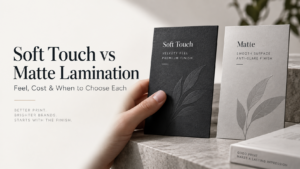
Scottsdale DTC brands tend to order toward the premium end of the corrugated spectrum: rigid boxes for gifting SKUs, soft touch lamination on mailer boxes, full-color interior printing, magnetic closures for subscription tiers. These brands understand that how packaging drives repeat purchases is directly tied to the unboxing experience, and they invest accordingly.
The other specific issue for Scottsdale brands with any outdoor retail presence — farmers markets, Art Walk, pop-up events — is UV fading. Phoenix gets over 300 days of sunshine per year, and intense UV radiation fades exterior print color noticeably faster than it would in coastal markets. A box with vibrant CMYK colors that looks sharp off the press can show visible fade after a few weeks of outdoor display.
For brands selling at outdoor events or in south-facing retail locations, matte or gloss lamination isn’t just a finish choice — it’s UV protection. Unlaminated print fades fastest. Lamination extends color life significantly, and the cost difference is modest.
What Phoenix DTC Startups Are Ordering
The Phoenix metro has built a genuine DTC startup scene. Brands across apparel, consumer goods, specialty food, and home goods are shipping direct to customers across the Southwest and beyond.
The workhorse box for Phoenix DTC operations is the custom mailer box. They stack flat for warehouse efficiency, ship without extra material, and open cleanly for the customer. Most Phoenix fulfillment operations run mailer boxes in one or two sizes for their core SKUs, occasionally adding a corrugated shipper for heavier or fragile items.
What’s different in Phoenix compared to coastal markets is the lead time reality. A brand on the East Coast can get emergency replenishment stock relatively quickly from regional corrugated manufacturers. Phoenix is geographically isolated. Replenishment orders from domestic suppliers typically take 3–5 weeks. International orders take 8–14 weeks and are subject to port delays through LA and Long Beach.
The practical rule for any Phoenix DTC brand: carry a minimum 6-week buffer on packaging inventory. In summer, when boxes are also being put through heat and humidity stress, having to wait four weeks for replenishment while running on degraded stock is a hard position to be in.
Tempe, Supplements, and the Food-Safe Packaging Question
Tempe has a cluster of supplement, sports nutrition, and health product brands tied to the Arizona State University research community and the broader Phoenix wellness industry. These brands have a specific challenge: their products are often heat-sensitive, and their boxes sit in non-climate-controlled environments during shipping and storage.
For brands shipping capsules, powders, or liquid supplements, the outer corrugated shipper needs to handle Arizona’s summer storage conditions. Double-wall corrugated handles warehouse heat better than single-wall, but the real gap is often in labeling — pressure-sensitive labels on bottles inside the box degrade in sustained heat even when the corrugated holds up fine. That’s a product-side issue that shows up as a packaging problem when customers open the box.
FDA food contact material guidelines apply to secondary packaging for ingestible products — FSC-certified kraft or SBS board with food-safe coatings is the standard, and it’s also required for Amazon FBA eligibility for ingestible products. This isn’t just a compliance question; it’s what Tempe supplement brands need to maintain distribution optionality as they grow.
Tucson and the Small-Run Artisan Market
Tucson runs a different scale of ecommerce from the Phoenix metro. Artisan food brands, ceramics, regional craft products, specialty goods — many Tucson sellers are ordering 200–500 units at a time, not 5,000.
At those volumes, digital printing is the right call. No plates, no setup costs, fast turnaround. The per-unit cost is higher than offset runs, but the flexibility to change the design, run a seasonal version, or test a new format without carrying unusable inventory makes the math work.
The specific issue for Tucson artisan brands selling at farmers markets and craft fairs is the UV fading problem I mentioned for Scottsdale. If your product sits on a table in the Tucson sun for six hours, the packaging takes visible wear. Brands that laminate their boxes — even matte lamination at modest cost — see their packaging hold up through a full market season. Unlaminated kraft or uncoated SBS shows UV fade and surface scuffing within a few weeks of outdoor display.
Getting the Spec Right for Arizona Shipping
Across the Phoenix metro and Arizona broadly, these are the spec decisions that matter most:
Wall construction. Single-wall corrugated (B or E flute) is fine for most shipments in most markets. For Arizona summer shipping — especially heavier products or items shipped in bulk pallets through Phoenix fulfillment — double-wall construction is worth the cost increase. The structural redundancy matters in both heat and high humidity.
Exterior finish. Kraft exterior hides surface wear better than white in transit. White SBS with lamination holds up better for brand-forward packaging. For any outdoor retail use, lamination is not optional — matte or gloss both provide meaningful UV protection over uncoated stock.
Closure type. Standard pressure-sensitive tape adhesive weakens significantly above 100°F. Self-locking mailer box constructions — auto-lock bottoms and tuck-top closures that don’t rely on tape — are more reliable for Arizona summer shipping. One brand I’ve worked with switched from tape-sealed poly mailers to self-locking corrugated mailers specifically because their Arizona summer return rate from open or damaged packages was cutting into margin.
Monsoon window planning. July through September is your highest-risk period for corrugated performance. If you have a large packaging shipment arriving during that window, store it in climate-controlled space if possible. If your warehouse is non-climate-controlled, test your stacking configurations during the highest-humidity weeks rather than assuming peak-season performance.
Common Arizona Packaging Mistakes
Knowing the common packaging mistakes that hurt the unboxing experience matters everywhere — but in Arizona, the climate amplifies the consequences. Here’s what comes up most often:
Ordering single-wall from a national supplier without Arizona context. Many online packaging suppliers default to single-wall B-flute for corrugated mailers. For most of the country, that’s fine. For Arizona summer shipping, it’s undersized. Ask your supplier specifically about ECT ratings and heat performance if you’re running through summer months.
Not accounting for DIM weight when adding insulation. Brands shipping temperature-sensitive products sometimes add foam inserts or thermal pouches inside the corrugated box. That increases outer dimensions without increasing actual weight, which triggers dimensional weight billing from UPS and FedEx. Run the DIM weight math (L × W × H ÷ 139 for domestic) before finalizing a box size with insulation.
Assuming the print spec will look the same here as it did in a sample approval. Print proofing at a supplier’s facility and print performance on an Arizona retail shelf are different things. If you’re selling at outdoor markets or retail locations with south-facing windows, factor UV exposure into your finish decision before signing off on the proof.
Sitting on 6+ months of inventory in a non-climate-controlled warehouse. In Arizona’s climate, packaging stock degrades faster than it would in stable storage. Corrugated mailers at the bottom of a pallet in an un-air-conditioned Phoenix warehouse can deform or weaken significantly by month six. Rotate stock regularly and keep your buffer at 6–8 weeks, not 6 months.
FAQ: Custom Packaging in Phoenix, Arizona
What box construction is recommended for Phoenix summer shipping?
Double-wall corrugated handles Arizona’s combined heat and monsoon humidity season better than single-wall. The ECT compression strength holds up better under humidity, and the structural redundancy compensates for adhesive weakening in sustained heat above 100°F.
Do Arizona brands need to use a local packaging supplier?
No — most custom packaging for Arizona ecommerce brands is produced outside the state and shipped in. What matters is lead time planning. Phoenix’s geographic position means 3–5 week domestic replenishment lead times are standard. Build your inventory buffer around that reality.
What print finish is best for outdoor use in Arizona?
Matte or gloss lamination both provide meaningful UV protection over uncoated stock. Unlaminated print fades noticeably under Arizona sun, especially for brands selling at outdoor markets or in south-facing retail locations. Matte lamination also resists surface scuffing from table contact during market events.
How does monsoon season affect corrugated packaging?
Arizona’s July–September monsoon brings humidity spikes to 50–70% relative humidity, which degrades ECT compression strength in corrugated board. Boxes stored in non-climate-controlled environments during this period may fail at stack weights they handled fine during dry season. Double-wall construction mitigates this significantly.
What’s the minimum order for custom packaging in Phoenix?
With digital printing, many suppliers have no minimum order or minimums as low as 50–100 units. That makes small-run orders practical for Tucson artisans and Phoenix startups testing new formats. Offset printing makes financial sense starting around 500–1,000 units depending on box spec.
Is kraft or white corrugated better for Arizona?
Both work, for different applications. Kraft exterior hides surface wear better in transit. White SBS with lamination is better for brand-forward packaging that needs to look sharp on arrival. For outdoor retail, laminated white SBS outperforms unlaminated kraft for UV resistance.
What packaging do Scottsdale wellness and supplement brands typically use?
Scottsdale wellness brands tend to order toward the premium end: soft touch lamination on mailer boxes, interior full-color printing, and rigid boxes for gifting SKUs. Food-safe board stock is required for ingestible products. The Scottsdale consumer base expects premium presentation — it’s a market where underinvesting in packaging shows up in repeat purchase rates.
What Arizona Brands Know That Others Don’t
The Phoenix metro is a real ecommerce market — and a genuinely demanding one for packaging. The brands getting it right here aren’t just picking the cheapest corrugated option. They’re speccing for both the dry heat season and the monsoon window, laminating their exterior print for UV protection, running self-locking constructions instead of tape closures, and planning their inventory buffers around the geographic reality of shipping from the desert.
That’s not excessive. That’s just knowing where you are.
Easy Box Packaging works with ecommerce brands across Arizona — from Phoenix DTC operations to Scottsdale wellness brands to Tempe supplement companies running subscription fulfillment. See our ecommerce packaging options to see what works at the volumes and specs Arizona brands actually need.
If you’re working out the right budget split between packaging investment and per-unit cost, our custom packaging budget guide breaks down the math for brands at different growth stages — including the small-run and growing-volume scenarios common in the Phoenix market.
For context on how regional climate affects packaging decisions beyond Arizona, what Ohio brands face with their own seasonal conditions is a useful comparison — different climate problem, same principle of speccing for where you actually ship from.