
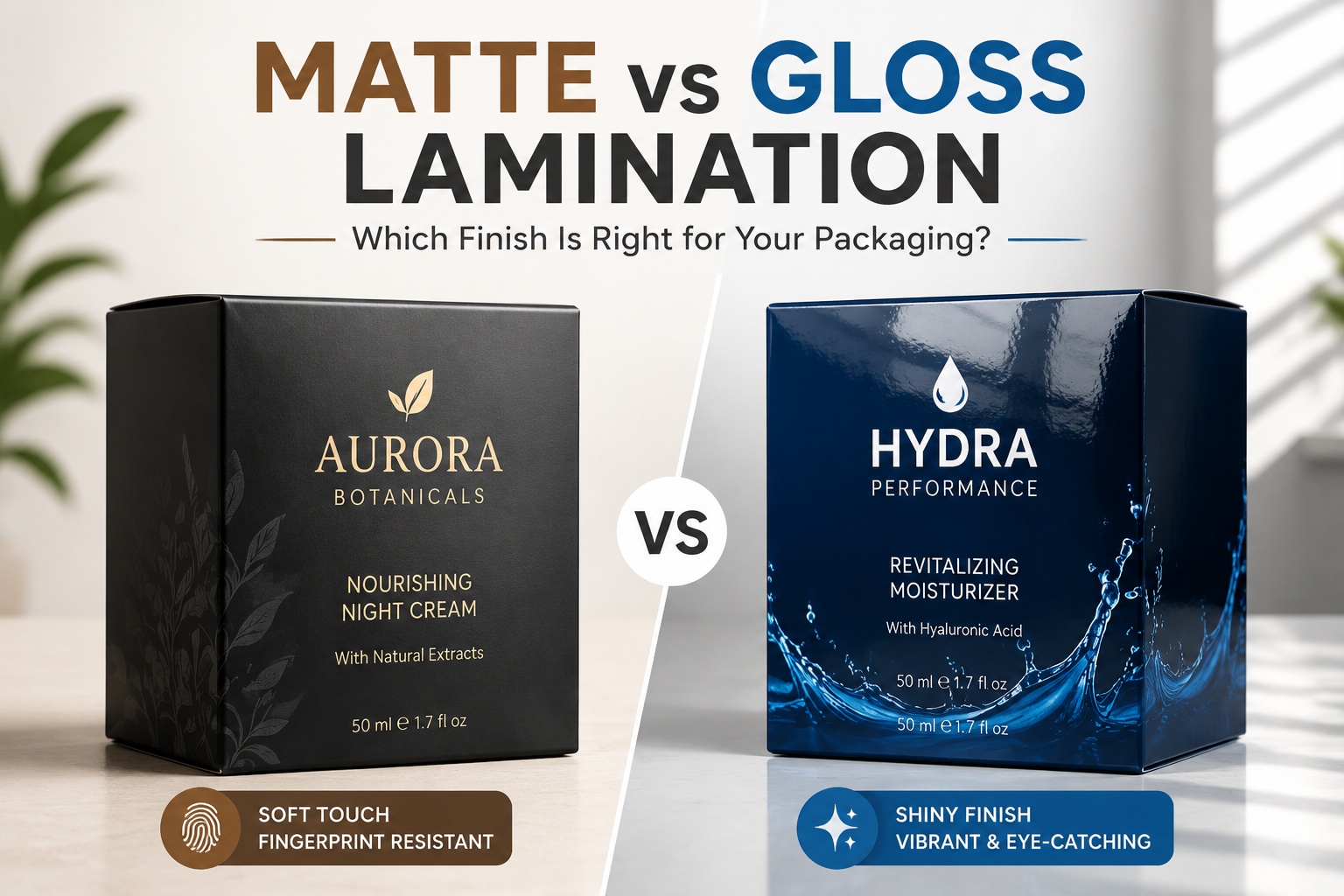
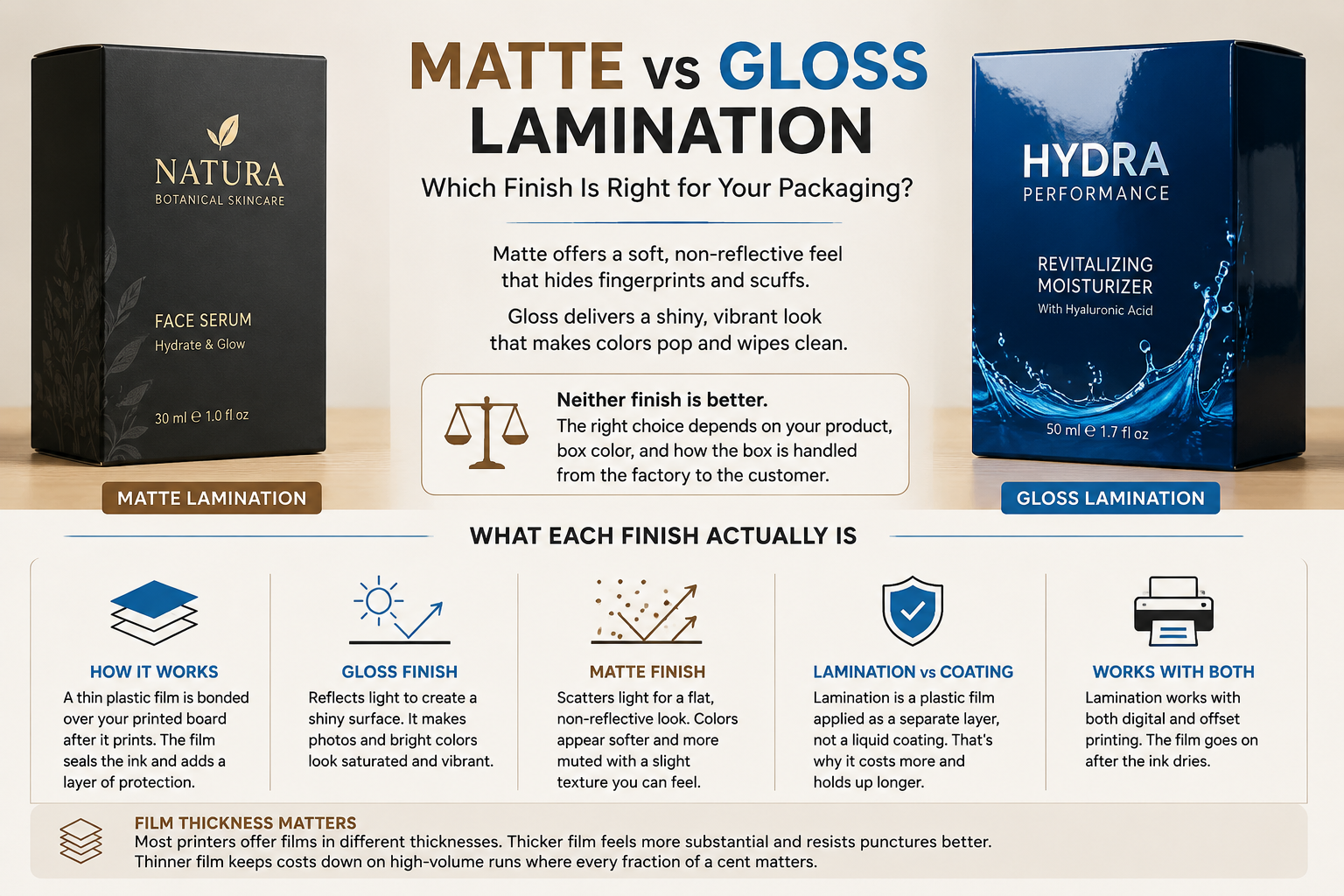
Matte vs gloss lamination comes down to one trade-off: shine versus scuff resistance. Gloss lamination is a shiny plastic film bonded over your printed box. It makes colors pop and wipes clean easily. Matte lamination uses the same idea with a flat, non-reflective film instead. It feels softer, and it hides fingerprints better. Neither finish is objectively better. The right pick depends on your product and your box color. It also depends on how the box gets handled between the factory and the customer’s hands.
What Each Finish Actually Is
Both finishes work the same basic way. A thin plastic film gets bonded over your printed board after it prints. That film seals the ink and adds a layer of protection on top of it.
Gloss film reflects light. It makes photos and bright colors look saturated, almost wet. Matte film scatters light instead. Colors look softer and more muted. The surface also has a slight texture you can feel under your fingertips.
Lamination isn’t the same as coating, even though people mix up the terms. Aqueous and UV coatings are liquid finishes cured directly onto the print. Lamination is a separate film layer, glued on as its own step. That’s why lamination usually costs more than a coating, and why it holds up longer under real handling. Lamination works with both digital and offset printing. The film goes on after the ink dries either way. Your printing method doesn’t limit which finish you can choose.
Most printers offer both finishes in a couple of film thicknesses. Thicker film feels more substantial and resists punctures better. Thinner film keeps costs down on high-volume runs where every fraction of a cent matters.
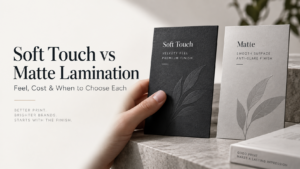
There’s also soft-touch lamination, a matte variant with an extra velvety feel. It costs more than standard matte. It belongs in its own conversation rather than this one. It solves a different problem: touch, not just look.
Matte vs Gloss Lamination Compared
Here’s how the two stack up on things that matter for a box, not a brochure.
| Factor | Matte | Gloss |
|---|---|---|
| Look | Soft, understated, muted colors | Shiny, bold, colors pop |
| Fingerprints | Hides them well | Shows them fast |
| Scuffs on dark boxes | Can show white marks without anti-scuff film | Wipes clean, resists scuffs |
| Cracking on deep creases | More flexible, resists cracking | Can crack or lift on sharp folds |
| Typical cost | Slightly higher | Generally the more budget-friendly option |
Notice the durability row runs in both directions. Matte wins on everyday handling and fingerprints. Gloss wins on structural folding and moisture. Most competitor guides only tell you half of that trade-off.
Where Each One Actually Wins
Here’s what most guides leave out entirely. Gloss laminate uses a more rigid polymer film. Fold it too sharply, especially on a deep crease or score line. It can crack or lift right at the fold. That’s a manufacturing problem, not a handling one, and it shows up before the box ever ships.
Matte film uses a more flexible, rubberized resin instead. It survives sharp folds and automated scoring without cracking nearly as often. That’s one reason matte shows up so often on rigid boxes and folding cartons with tight structural folds.
But matte has its own failure mode. Standard matte film on a dark background — black, navy, deep green — shows white scratch marks fast. It happens the moment the surface scuffs. I’ve seen a beautiful matte black box look worn straight out of the shipping case. Nobody had specified anti-scuff film. That’s one of the packaging mistakes that kill the unboxing moment before a customer even opens the lid.
If your box is dark and matte, ask your printer for anti-scuff matte laminate specifically. It costs a little more. It’s worth every penny on a box that gets handled before it reaches a shelf or a doorstep. According to Printivity’s comparison of the two finishes, gloss still holds up better against moisture and casual scuffing. That’s why it wins for boxes that travel loose in a shipping case. Matte tends to do better on boxes that sit still on display.
Matte and Gloss on Different Box Materials
Folding cartons take both finishes well. Cosmetics, food, and retail shelf boxes use matte and gloss about equally, depending on the brand’s positioning.
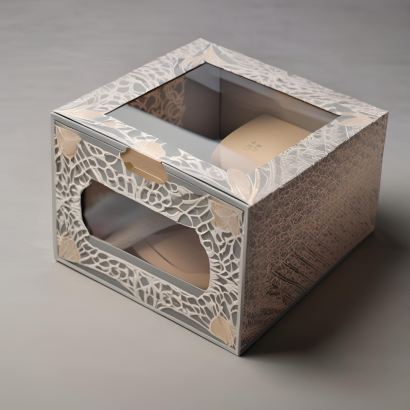
Rigid boxes lean matte more often. The thicker board underneath needs a finish that survives deep structural folds on lids and bases. Matte’s flexible film handles that better than gloss. That’s also why window boxes with magnetic closure usually pair a matte body with the clear window rather than gloss — the magnet closure area sees repeated flexing at the fold, and matte film tolerates that better over the life of the box.
Corrugated shipping boxes rarely get either finish. The fluted board isn’t a great surface for lamination film. Most brands reach for a simple coating, or no finish at all, on plain shipping cartons. Custom mailer boxes fall into that same category. The corrugated material and shipping-first purpose make a coating the more sensible choice here. Kraft board rarely gets full lamination either. The natural, unlaminated look is the whole point of kraft, so covering it in film defeats the purpose. Spot coatings work better there if you want any shine at all.
Save lamination budget for the retail-facing box, not the outer shipper.
What Lamination Adds to Your Quote
Matte lamination often runs slightly more than gloss. The film itself costs a bit more to produce. Anti-scuff matte film costs more again on top of that. Gloss remains the more budget-friendly lamination option in most quotes.
The bigger cost driver isn’t matte versus gloss, though. It’s lamination versus coating generally. Any lamination costs more than aqueous or UV coating. That’s because it’s a separate film layer, not a liquid finish cured onto the print. Request a quote for real numbers on your box size and quantity. Anyone quoting a flat lamination rate without knowing your dimensions is guessing. Turnaround shifts slightly too. Lamination is a separate production pass. It can add a day or two versus a coated or unfinished box. Build that into your timeline if you’re working toward a launch date.
You can compare both finishes yourself with a couple of physical swatches before committing to one. Easy Box Packaging can send matte and gloss samples on your actual board stock. You end up deciding by feel, not by guessing from a screen.
Which Should You Choose?
Selling something premium — cosmetics, jewelry, electronics accessories? Matte is the safer default. It reads as expensive, and it survives structural folds better on rigid and gift boxes. Just specify anti-scuff film if the box itself is dark.
Need colors to jump off a shelf next to competitors? Gloss wins that fight. Food packaging, kids’ products, and anything competing on bold color usually goes gloss for a reason. It also handles rough transit better than standard matte film.
Building a gift line with deep creases or a fold-over lid? Lean toward matte or soft-touch. Gloss is the finish most likely to crack there.
Shipping through a retail supply chain before a customer ever sees the box? Gloss’s scuff resistance matters more than its shine in that scenario.
If you’re stuck between the two, order both as swatches. The finish that makes you want to pick the box up and touch it is usually right. That’s not a small detail. It’s exactly the kind of thing that turns a first order into a repeat one.
Matte vs Gloss Lamination: FAQ
What is the difference between matte and gloss lamination?
Gloss reflects light and makes colors look bold and saturated. Matte scatters light for a softer, more muted look. Both are plastic films bonded over your printed box after it prints.
Is matte or gloss lamination more durable?
It depends what you mean by durable. Gloss resists scuffs and moisture better. Matte resists fingerprints and cracks less often on deep folds. Pick based on how your box actually gets handled.
Does matte lamination scratch easily?
Standard matte film can show white scratch marks on dark colors. Anti-scuff matte film fixes this, and it’s worth the small upcharge on any dark box.
Can you combine matte and gloss on the same box?
Yes. A small gloss or spot UV area over a matte base is a popular way to add contrast. Ask your printer whether they call it spot UV or spot gloss — the terms get used interchangeably.
Does lamination affect recycling?
Yes, some. The plastic film has to separate from the paper fiber before recycling. That makes laminated board harder to process than an uncoated one. If recyclability matters more than the finish, ask about a coating instead. It recycles more easily than a full laminate film.
Matte and gloss aren’t really a style preference. They’re a handling bet. Pick matte for a premium feel and fold-heavy structures, with anti-scuff film on anything dark. Pick gloss for color pop and rougher handling along the way. Get it wrong, and the finish either scuffs in the first week or cracks before it even ships.