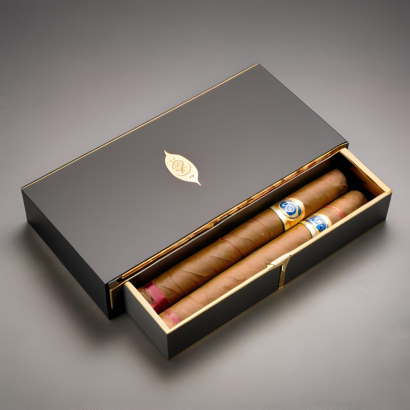

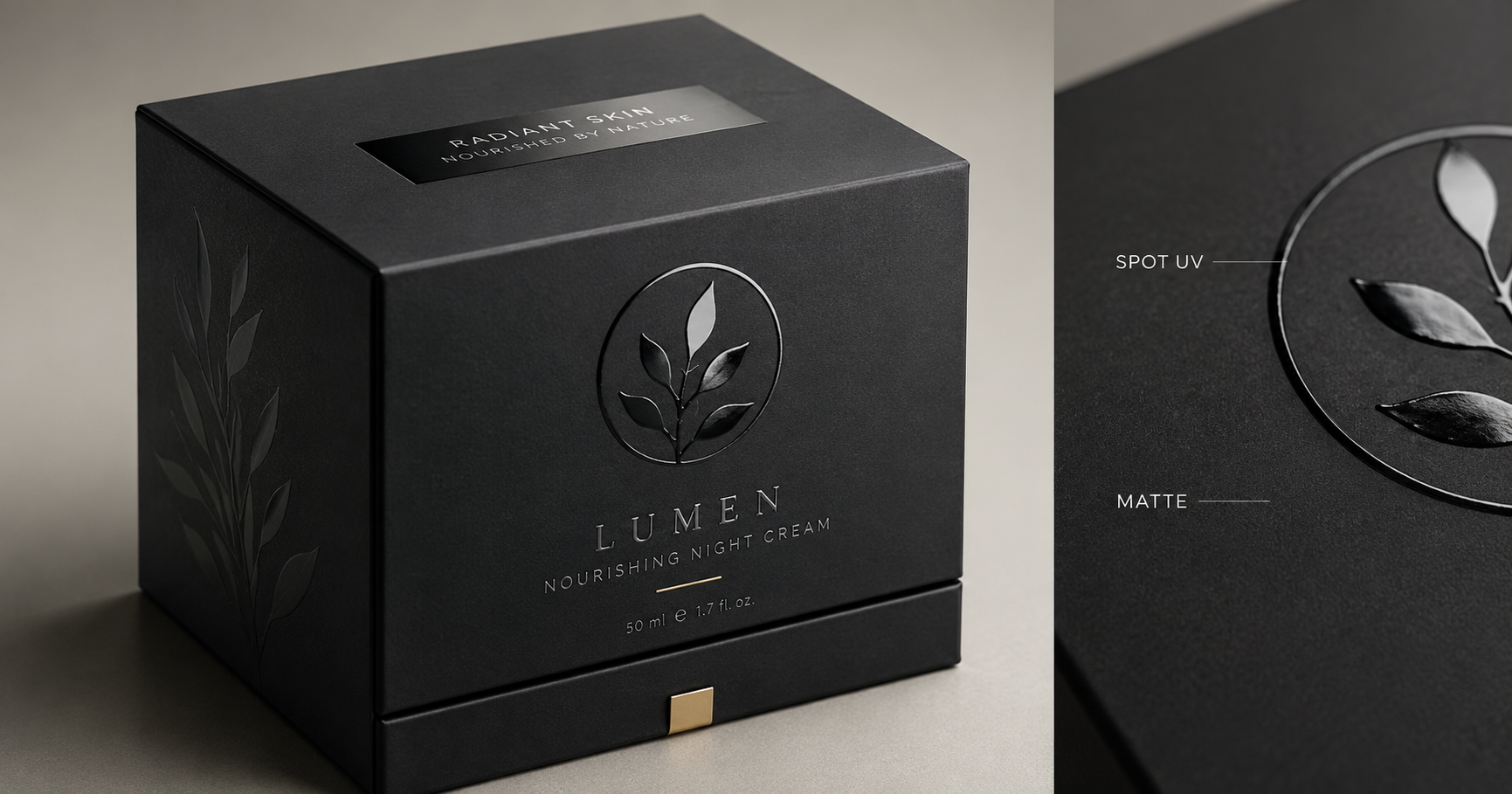
What is spot UV coating? It’s a glossy finish applied to specific areas of a printed box, not the whole surface. A printer builds a separate file layer for just the shapes that need it. That layer runs under ultraviolet light, which cures the varnish in seconds. The result is a sharp contrast between the shiny “spot” and the matte board around it. That contrast is the entire point. It’s not the same as embossing, which changes the texture of the board itself. It’s not foil stamping either, which adds metallic color. Spot UV only adds gloss.
Spot UV is worth paying for when one element needs to catch light. A logo. An icon. A headline. It’s the wrong choice spread across a whole panel. Flood UV or lamination does that job for less money.
How Spot UV Actually Works
Spot UV printing runs after the box prints, whether that’s offset or digital. Your printer separates the artwork into two layers. One layer is your design. The other is a spot-color shape marking only the areas getting the coating. That second layer feeds through a UV coating unit. Ultraviolet light cures the liquid varnish almost instantly.
This is why spot UV skips the multi-hour air-dry window aqueous coating needs. The gloss shows up exactly where that layer says, and nowhere else. Everything outside the coated shape stays matte. That boundary between glossy and flat is what makes the finish work. It reads from three feet away on a shelf. That’s the whole job of a finish like this. Digital presses handle short runs of spot UV well. Offset still wins on very large orders, where per-unit cost matters more than setup time.
A physical proof matters more here than with most finishes. Screen previews don’t show gloss the way the actual coating looks under real light.
Spot UV vs Raised UV vs Flood UV Coating
Three finishes get lumped together in conversation. Most quotes don’t explain what separates them.
| Finish | What It Is | Best For | Relative Cost |
|---|---|---|---|
| Spot UV (flat) | Gloss coating on select areas only | Logos, icons, small text you want to pop | Baseline |
| Raised UV (3D) | Spot UV built up in layers until it sits above the surface | Premium logos you want felt, not just seen | Higher — extra passes and cure time |
| Flood UV | Gloss coating over the entire printed sheet | Whole-box shine at volume, no single element to highlight | Comparable per unit at scale, but loses contrast |
Raised UV costs more for a specific reason. It needs multiple coating passes to build height. You’re paying for extra curing time, not extra ink. Flood UV can run cheaper per unit at high volumes. The whole sheet gets one coating pass instead of a targeted one. But you lose the exact thing spot UV is good at: contrast. Business cards use these same three finishes. Boxes behave differently under handling and shipping, though. That difference is why the coverage math matters more on a box than a card. Choosing flood UV to save money on a box that needed one glossy logo is a common miss.
What Spot UV Adds to Your Quote
Exact pricing depends on three things. Box size, order quantity, and how much of the panel the coating covers. Request a quote for real numbers — anyone quoting a flat rate without seeing your art is guessing.
Coverage area matters first. A full logo lockup costs more than a small icon. Order volume matters next; cost per unit drops as quantity climbs, the same as most finishing work. Flat versus raised matters too, and raised always costs more. Turnaround shifts a little too. Adding a coating step means one more pass through production. Ask your printer how it affects your ship date before you lock in a deadline.
You can map this out yourself. Send your printer a proof file with the spot-UV layer isolated. Ask for pricing against a couple of coverage options before you commit to final art. If you’d rather skip that back-and-forth, Easy Box Packaging quotes spot UV alongside your base print run. You see one number instead of two separate negotiations.
Spot UV on Different Box Materials
Spot UV performs differently depending on what’s underneath it.
Folding cartons with a matte or soft-touch laminate show the sharpest contrast. That’s the classic use case, and it’s why cosmetics and food boxes reach for it so often.
Rigid boxes hold spot UV well too, especially raised UV on a logo. The thicker board gives the coating a stable base. That matters more on 3D spot UV than flat. Anyone building out a rigid box line should ask about raised UV specifically. It’s one of the few finishes that genuinely justifies the higher price point.
Corrugated board is the exception. The fluted surface underneath isn’t flat enough for crisp spot UV. Most printers skip it there and reach for foil or a simpler coating instead. If your box is corrugated, spend the budget on structure before finishing.
Where Spot UV Goes Wrong
Across the 10,000+ brands we’ve quoted, thin logo strokes cause most spot UV problems. Presses run roughly ±0.3mm of registration variation. Any stroke or line under about half a point in weight won’t hold the coating cleanly. It either misses the mark, or it blurs into a smudgy halo around the letters.
I’ve watched a clean logo turn into a mess on press. Nobody flagged the stroke width before the file went to the die. That’s an avoidable mistake, and it’s the kind you usually only learn about after a bad run.
Two placement rules matter as much as the artwork itself. Never put spot UV directly over a crease line. The coating cracks the instant the box folds, and there’s no fixing that after the run. Keep the coated area clear of the trim line too. A die cut running through a coated edge can peel the UV layer right off.
Neither of these shows up in most spot UV explainers. Both are far cheaper to catch in a design file than in a reprint. Both belong on the short list of packaging mistakes that kill the unboxing moment before it starts. If you’re using raised UV for the first time, ask for a physical proof before the full run. That’s a small delay against a full reprint.
Which Should You Choose?
Small logo or icon you want to pop against matte board? Spot UV is the default. Most printers will quote it that way without you asking.
Want that logo to feel raised under a thumb the moment someone picks up the box? Pay for raised UV instead. That’s the detail that makes a premium unboxing experience feel premium, not just look it.
Cosmetics and jewelry brands use raised UV more than anyone else. Their customers handle the box before they ever open it. That first physical impression is tied to whether the customer comes back for a second order. It’s not just about whether they like the product inside. Gift and electronics accessory boxes fall somewhere in between. A little raised UV on the brand mark works well there too, without needing it on every panel.
Running a high-volume shipping box with nothing specific to highlight? Flood UV is the more economical call.
If you’re on the fence, look at your product before your budget. A $12 lip gloss box earns raised UV back in perceived value fast. A bulk mailer carton rarely does.
Spot UV Coating: FAQ
What is spot UV coating used for?
Making one design element stand out with a glossy finish against a matte background. Usually that’s a logo, an icon, or a headline. It’s a highlight tool, not a whole-box upgrade.
Is spot UV worth the extra cost?
Yes, on one focal element on a premium or shelf-facing box. The contrast reads as quality from a distance. Spread across a whole panel, flood UV or lamination gets a similar look for less money.
Can you put spot UV on kraft or matte boxes?
Yes, and it often looks better there than on glossy stock. The contrast between coated and uncoated areas is what sells the effect. Matte and kraft board show that contrast clearly.
How is spot UV applied — before or after printing?
After. The box prints first, then the spot-UV layer runs through a separate coating unit. Trying to coordinate it any other way invites registration problems.
Does spot UV scratch or wear off over time?
It resists fingerprints and light scuffing well. It’s not indestructible, though. Heavy abrasion in transit can dull it, the same as any coating.
Spot UV earns its cost when it does one specific job: making a logo or icon pop. It’s money wasted spread across a whole box hoping to look expensive on its own. Treat it as a highlight. Spec it correctly: flat strokes, clear of creases and trim lines. Do that, and it pays for itself in shelf presence.