
Most brands pick the wrong printing method. Not because they’re careless — because nobody explains the tradeoffs before they get a quote.
You receive a price for 300 custom mailer boxes. It feels high. You get a second quote. Also high. What you don’t know yet: both suppliers quoted offset printing, with plate fees, for an order size where digital would cost 35% less total. The per-unit rate on digital looks higher, so you assume offset is better. It isn’t. Not at that volume.
Custom packaging printing methods are genuinely confusing because the terminology comes from commercial print production, not ecommerce. Nobody explains what flexographic means, or why it matters whether you run digital vs. offset when all you want is your logo on a box.
Here’s the actual breakdown — what each method is, when it wins, what it costs, and how to make the call for your order size.
The Three Custom Packaging Printing Methods, Fast
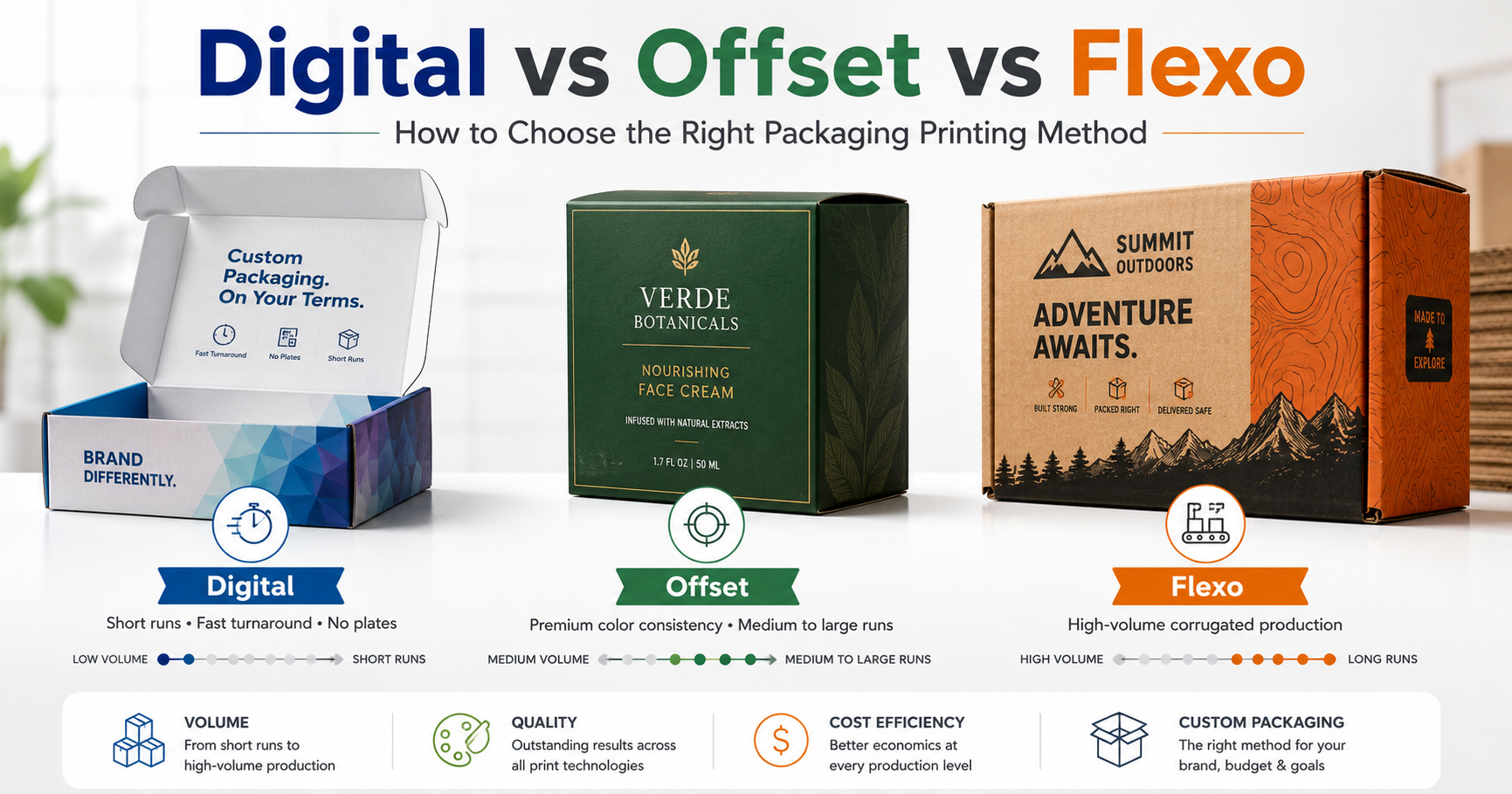
Digital printing works like a scaled-up high-end inkjet. No plates. No setup costs beyond file prep. The machine reads your file and prints directly onto the substrate. Per-unit cost is higher than offset, but total cost on short runs is almost always lower because there’s no plate investment to absorb.
Offset lithography — usually just called “offset” — uses metal plates inked with each color, then transfers ink through a rubber blanket onto the substrate. It produces excellent, consistent color across long runs. The downside: plate fees of $80–200 per color, plus a minimum run size that makes it expensive under 1,000 units.
Flexographic printing (flexo) is the industrial method for high-volume corrugated packaging. Flexible rubber plates, fast speeds, and strong adhesion on uncoated surfaces make it the dominant method for large corrugated runs. Not what a DTC brand ordering 300 mailer boxes should worry about — but very relevant at 3,000+ units per run.
Three methods. Three cost structures. Three different volume thresholds where each one wins.
When Digital Is the Right Custom Packaging Printing Method
Digital is underused by brands that calculate per-unit cost instead of total cost. The per-unit rate looks higher. Total cost often isn’t.
On a 250-unit run of a custom corrugated mailer with two colors:
- Digital: $100–150 file prep + $1.30/unit = $425–475 total
- Offset: $300–400 plates + $0.80/unit = $500–600 total
Digital wins by $75–$175, even though the per-unit number is higher.
That math holds up to roughly 800–1,000 units for a two-color design. For a four-color CMYK job, digital stays competitive up to 1,500–2,000 units — because the plate investment for CMYK offset is $300–400, and it takes more units to amortize that.
Digital also wins on turnaround. No plate production means lead times of 7–10 business days for most suppliers. Offset runs 3–4 weeks. For new product launches, seasonal packaging, or test runs on a new design iteration, that speed advantage is real.
The main limitation: digital on heavily textured or uncoated surfaces can show visible dot patterns at close range. On coated SBS board and E-flute corrugated, you’ll get excellent results. On natural kraft or heavy B-flute, review supplier print samples before committing to a production run. The screen-to-press gap on uncoated materials is significant enough to warrant a physical sample.
Under 500 units, push for digital. Any supplier quoting you offset plates on a 200-unit run is either not set up for short-run digital work or is hoping you don’t know the difference.
When Offset Is the Right Custom Packaging Printing Method
Offset earns its place when you’ve hit scale and your design is stable. The total cost equation flips fairly quickly once you’re running 1,500+ units with a multi-color design.
On a 2,000-unit corrugated mailer run with four colors:
- Digital: $0.90/unit = $1,800 total
- Offset: $350 plates + $0.55/unit = $1,450 total
Offset wins by $350. At 3,000 units, the gap is $600+.
Where offset really earns its keep is color consistency. Digital color can shift slightly between batches. Offset, once plates are set, prints the same color on unit 1 and unit 2,000. For brands with strict Pantone requirements, regulated label colors, or retail shelf standards, offset is often the right call regardless of volume.
Offset works best on coated SBS board (standard for folding cartons, cosmetic boxes, retail packaging), E-flute corrugated with a clay-coated liner, and paper-wrapped rigid boxes. It’s not well-suited to uncoated corrugated. Ink absorbs unevenly on uncoated B-flute or C-flute, producing muddy colors. For standard shipping corrugated, flexo handles that better.
When Flexo Is the Right Custom Packaging Printing Method
Flexo is where you land when you’re running serious corrugated volume. The major fulfillment operations — corrugated shipper boxes that move millions of units through distribution centers — almost universally run flexo.
The economics work at scale because per-unit costs are the lowest of any method at 3,000+ units, flexo runs at high speed for large production batches, and it handles uncoated corrugated surfaces that offset can’t print cleanly.
The significant downside is plate investment. Flexo plates run $200–1,500 per color — far more than offset. A four-color design means $1,000–$6,000+ in plates before a single box is printed. You need volume to amortize that investment.
Most DTC brands don’t operate at flexo scale. If your monthly order volume hasn’t reached 2,000–3,000 units per SKU, flexo probably isn’t your right method yet. Our custom packaging phase guide maps when each transition makes sense as volume grows.
Side-by-Side Comparison
| Factor | Digital | Offset | Flexo |
|---|---|---|---|
| Plate / setup cost | $0–180 file prep | $250–400 CMYK | $1,000–6,000+ |
| Min. practical order | 25 units | 500–1,000 units | 1,000–3,000 units |
| Best volume range | Under 500 units | 1,000–5,000 units | 3,000+ units |
| Color consistency | Good (slight batch variation) | Excellent | Excellent |
| Turnaround time | 7–10 business days | 3–4 weeks | 3–5 weeks |
| Works on uncoated corrugated | Limited | Poor | Yes |
| Works on SBS / coated board | Yes | Yes | Limited |
| Pantone color matching | Limited | Yes | Yes (varies by supplier) |
The Pantone Problem Most Brands Hit Too Late
If your brand has specific Pantone color requirements, the method choice gets complicated — and more expensive if you pick wrong upfront.
Digital uses CMYK or expanded gamut printing. It gets close to Pantone colors but not always exact. For most brands, “close” is fine. Customers aren’t holding a Pantone chip next to your box at the doorstep. But for heavily branded retail packaging, product lines with regulatory color requirements, or brands where the specific blue or red is non-negotiable, the gap matters.
Offset handles Pantone directly. You specify the color, the printer mixes ink to match, the plate prints that exact color. This is why high-end folding cartons and pharmaceutical packaging almost universally use offset.
I’ve watched brands run five rounds of digital samples trying to hit a specific Pantone blue that simply required offset to reproduce correctly. If Pantone accuracy is a hard requirement, spec offset from the start and save yourself the iteration cost and sample fees.
Flexo also handles Pantone, but color precision varies by supplier and press condition. For utility corrugated — plain shipper boxes, functional corrugated mailers — color precision rarely matters. For retail corrugated on store shelves, ask to see supplier-matched Pantone samples before committing to a run.
How Material Choice and Print Method Interact
Your printing method constrains your material options — and vice versa. Choosing them independently is how brands end up with muddy four-color graphics on the wrong substrate.
SBS board (standard for folding cartons, cosmetic boxes, retail packaging): works well with both digital and offset. Gives you the cleanest print results with either method.
E-flute corrugated (thin, smooth-faced): works with digital and offset. The smooth liner allows near-offset print quality. This is why E-flute is common for premium custom mailer boxes with detailed interior printing.
B-flute and C-flute corrugated (standard shipping corrugated): best printed flexo or with simplified digital methods. Detailed multi-color graphics are difficult. The corrugated liner is uncoated and absorbs ink inconsistently.
Natural kraft (uncoated, brown finish): most compatible with digital for short runs, flexo for volume. Expect slightly muted colors compared to screen previews — the fiber absorbs ink in ways that shift color. Worth ordering samples before any run over 200 units.
Mismatching method and material is one of the most common custom box ordering mistakes. Brands order detailed four-color offset printing on kraft and don’t understand why the colors look dull. The substrate was incompatible with the expectation.
For technical standards on corrugated material testing and packaging performance, the Technical Association of the Pulp and Paper Industry (tappi.org) publishes packaging-specific test standards that reputable suppliers should reference.
How Printing Method Affects Your Overall Packaging Budget
The print method is the single largest swing in your custom packaging budget — more than material choice, more than box size, more than finish options. Getting it wrong in both directions costs real money.
Too-early offset: paying $400 in plates for a 300-unit run when digital would have saved $200 and given you the flexibility to change the design next order.
Too-late digital: paying digital per-unit rates at 3,000 units a month when offset would cut per-unit cost by 35% and the design hasn’t changed in six months.
Quick decision framework:
- Under 500 units → digital, no exceptions
- 500–1,500 units → run total cost math on both; digital usually still wins unless you’re running four-color on SBS board
- 1,500–3,000 units → offset starts making real sense; get competitive quotes from both
- 3,000+ units on corrugated → ask for flexo pricing alongside offset
For custom mailer boxes — the starting format for most DTC brands — digital is the right method until you’re consistently running 800+ units per order. The ability to iterate your design without scrapping plates is worth the per-unit premium at early scale.
Packaging quality directly affects repeat purchase rates — but only if print quality makes a visual impression on arrival. A muddy flexo run on the wrong substrate doesn’t create the brand moment you’re aiming for. Match method to material. Match material to the moment.
You can browse our ecommerce packaging options to see structure types and materials before narrowing down to a print method.
Frequently Asked Questions
Can I switch printing methods between orders without losing my design files?
Yes. Your artwork files are yours. Moving from digital to offset on your third order — once volume justifies the plate investment — is standard practice. If you switch suppliers, you’ll need new plates. Plates stay with the printer that produced them, not with you.
How do I know if my file is set up correctly for the print method I’m using?
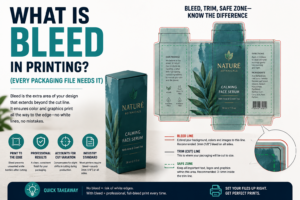
For digital: CMYK color mode, 300 dpi minimum, 0.125-inch bleed. For offset and flexo: same resolution, but your supplier will provide a press-specific file specification sheet. Always request one before submitting final artwork. Setting up a digital file for an offset press is a common and expensive mistake to catch at the proof stage.
Does digital printing work for eco-friendly packaging materials?
Yes. Digital printing is compatible with FSC-certified corrugated and recycled content boards. Most digital suppliers can print on recycled SBS board without issues. For natural kraft with recycled content, results vary — run a sample. The eco-friendly packaging cost guide covers material selection across print methods.
Picking the right custom packaging printing method isn’t complicated once you know the total cost math. It just requires running the numbers before you accept a quote, not after. The brands that consistently get good packaging at fair prices aren’t doing anything special — they’re comparing total order cost, not per-unit sticker prices. Five minutes of math at the quote stage saves real money on every order you run.