
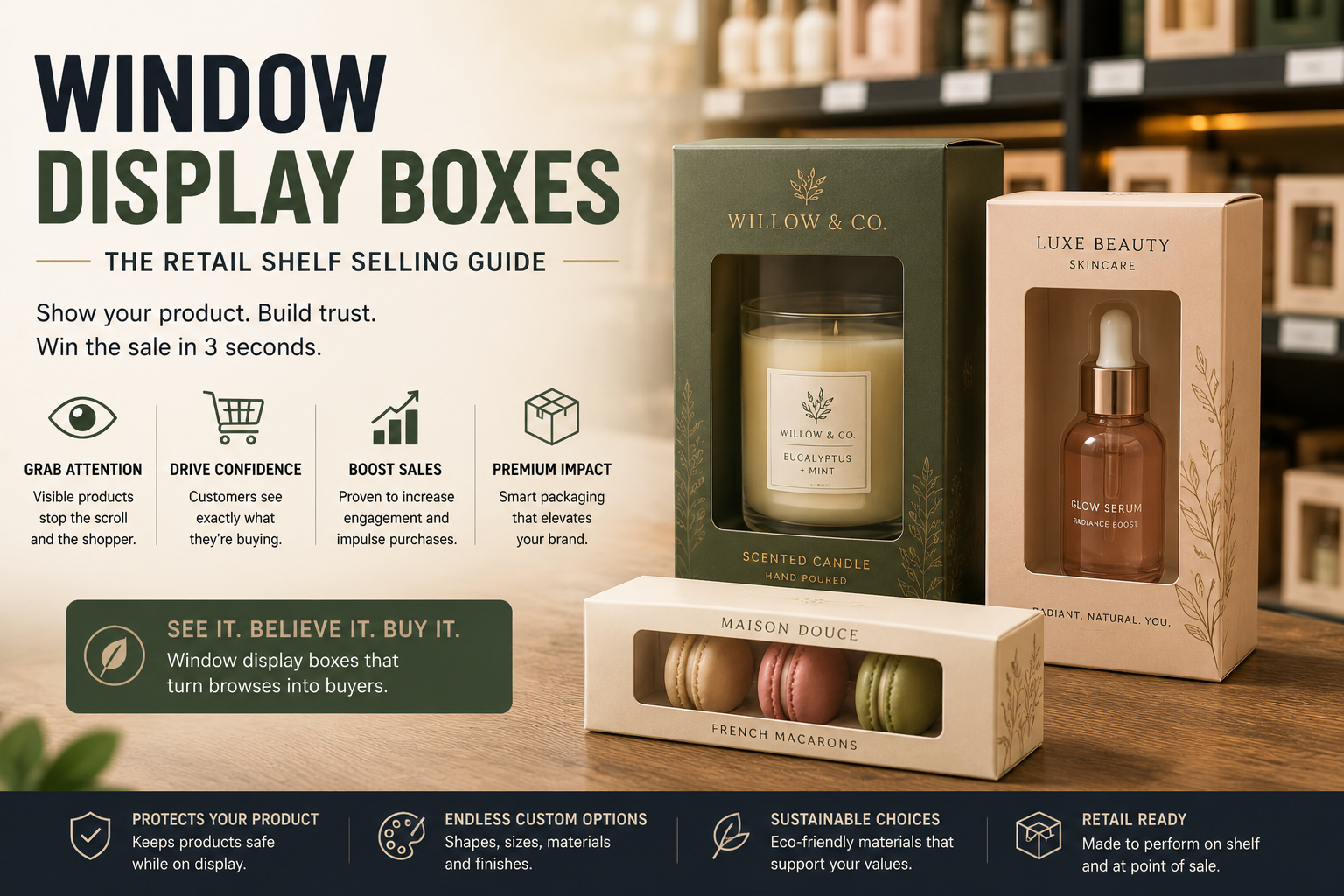
Shoppers decide what to pick up within three seconds. That’s the number from retail research. It’s consistent across categories. In those three seconds, your packaging has to compete with everything next to it. Window display boxes change that competition. They put the product itself in front of the customer. Not a photo. Not a promise. The actual thing.
The logic is simple. But most brands using window display boxes underestimate how much the design decisions inside that window matter. A bad window experience — a poorly lit interior, a product that looks better in a photograph than through film — can hurt as much as help. This guide covers how window display boxes work at retail, when to use them, and how to design them so they actually sell.
Why Window Display Boxes Work (The Shelf Psychology)
Retail is a decision environment built entirely on uncertainty. The customer can’t use the product before buying it. Every box is a promise. The question for any retail brand is: how do you make your promise more credible than the one next to it?
A visible product answers that question directly. Research on consumer decision-making shows that customers register products within one to two seconds of encountering a category block. In that time, shape, color, and visible content all process faster than text. Window display boxes put the actual product in that first impression.
There’s also a trust mechanism at work. When a customer can see exactly what they’re buying, their confidence goes up. Uncertainty drops. Impulse conversion goes up. This is why window display boxes dominate food, confectionery, beauty, and gifts — all categories where the visual quality of the product is directly tied to the buying decision.
Window display boxes aren’t just about visibility. They’re about trust transfer. The product’s quality speaks directly to the customer before the box is even touched.
Counter Display vs. Shelf Display Window Boxes
Window display boxes come in two primary formats. They serve different retail environments and have different structural requirements.
Shelf display window boxes. These sit on standard retail shelving. They stack, face out, and compete for eye-level positioning. The structural priority is rigidity. The box has to hold its shape under its own weight and under units stacked behind it. Print coverage and finish quality matter because the front face competes for attention from across an aisle.
Typical use: folding cartons for beauty, food, supplements, candles. Any product sold from a standard retail shelf. Our retail packaging boxes include shelf-display configurations for these categories.
Counter display window boxes. These sit on a counter, point-of-sale display, or tabletop fixture. They’re typically smaller. They don’t need to support stacking load. They’re viewed from directly above or at close range. The structural priority shifts toward presentation over compression strength. Fine interior presentation detail becomes visible at that distance.
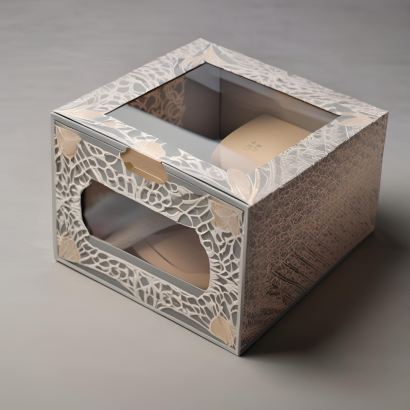
Typical use: jewelry, small accessories, cosmetics samples, confectionery, gift items. Anything sold from a counter or point-of-purchase location. Decorative die-cut styles — like a lace window display box — fall in this category, where the fine detail in the cutout only reads at close range anyway.
I’ve worked with brands that spec shelf display structural requirements for counter boxes — and vice versa. The result is either an overbuilt, expensive box sitting on a counter, or a shelf box that deforms under load. Know which retail environment you’re designing for before briefing a supplier.
What Makes Window Display Boxes Actually Stop the Eye
Having a window doesn’t guarantee attention. Here’s what actually drives shelf performance.
The product has to be visually distinctive at the window size. If the window is small and the product is complex, the customer can’t register what they’re seeing. The three-second rule works against you. Match the window size to the product’s visual argument. A single beautiful candle needs a large window. A complex pattern needs to be close to the surface and well-lit.
Window placement drives gaze sequence. Shoppers scan left-to-right at shelf level. If your window is on the right side of the box face, it gets registered later. Center placement generally performs better for shelf display. Counter display is different. The customer looks down, so the top or front face is what they see first.
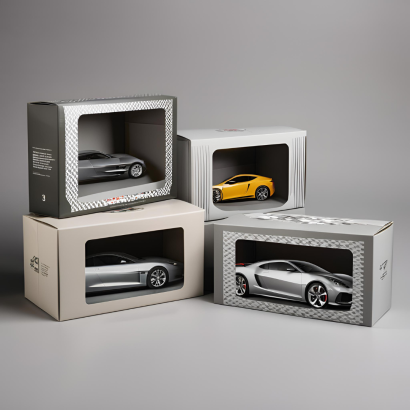
Interior depth and color matter more than most brands realize. A product floating in an empty white box doesn’t look premium. It looks abandoned. The best window display boxes control the interior: colored backing panels, tissue, molded inserts, or tight product fit that fills the cavity. The interior through the window is the actual product experience. Spec it that way.
Film clarity is non-negotiable. A hazy window undermines the entire purpose. PET film is the standard for good reason. If samples from a supplier look slightly cloudy, reject them. Every point of haze reduces the trust-transfer effect.
Window Display Box Design Rules That Convert
These are the decisions that separate window display boxes that lift conversion from ones that don’t.
Size the window for the product’s best feature. If your product’s selling point is its color, show that. If it’s texture, the window needs to convey it. If it’s shape, a silhouette die-cut showing the product outline can be more powerful than a flat rectangular window.
Leave breathing room between the window and the print. A minimum of 8mm of clean board around the window frame keeps the design from looking cluttered. Running printed elements flush against the window is one of the most common first-order errors. The result looks accidental rather than designed.
Design the interior as part of the package. Choose an interior color that complements the product. Use an insert or tray to position the product consistently. Every unit should look the same through the window. Variation between units destroys the premium signal the window is supposed to create.
Don’t compete the window with too much print. A busy exterior competes with the window for attention. The window should be the hero of the front face. Supporting copy and branding belong on secondary panels — or as a frame that directs the eye toward the product.
Test with your actual product inside. No mockup substitutes for holding the real box with the real product in it. Light conditions, the product’s surface, and the film clarity interact in ways that don’t show on screen. Skipping this step is one of the packaging mistakes that cost brands the most money on window box orders.
What Products Benefit Most from Window Display Boxes
Window display boxes perform best when three conditions are met. The product is visually appealing. The buying decision is visual. The customer has time to look.
Strongest categories:
- Candles and home fragrance. Color, texture, and wick presentation are strong visual signals. Candle brands consistently report that window boxes outperform solid boxes at shelf.
- Beauty and cosmetics. Palettes, lip kits, skincare sets. The color payoff is the selling point. A window shows it directly.
- Confectionery and specialty food. Chocolates, macarons, artisan cookies. The product’s visual appeal is the marketing.
- Jewelry and accessories. The customer wants to see the piece before buying. A window box replaces the need to open the package.
- Gifts and gift sets. Gift buyers want confidence before they commit. A visible product provides it — a decorative lace window box does this well for wedding favors, where the box itself is part of the presentation.
Weaker fit:
- Commodity products where price or claims drive the decision (supplements, hardware, functional goods)
- Products with inconsistent appearance between units
- Products sensitive to light or moisture without UV-blocking film specified
- DTC-only formats that ship in outer mailers where the window serves no purpose in transit
Research on how packaging shapes repeat purchase behavior shows that the point-of-sale first impression sets expectations for everything that follows. Window display boxes at retail create that first impression before the box is even picked up.
Window Display Boxes vs. Standard Retail Boxes: When Is the Premium Worth It?
The window patching process adds cost. Film material, die-cutting precision, and the patching step all increase per-unit price. At 1,000+ unit volumes, the premium is usually $0.15–0.40 per unit depending on window size and film spec.
The question isn’t whether the window adds cost. It’s whether it adds more value than cost. For a product where visual confidence drives the purchase decision, the conversion lift justifies the premium. For a functional product where the buying decision is based on claims on the box — not the appearance of the product — the window adds cost with no return.
A simple test: if you had to choose between a better product photo on the front and a window showing the actual product, which does more work at shelf? If the answer is the window, the premium earns back. If the answer is the photo, stay with solid board and put the budget into print quality.
Browse our window display box configurations to compare formats before requesting a quote.
Five Questions Before You Brief a Supplier on Window Display Boxes
1. What retail environment is this box going into? Shelf display versus counter display determines structural requirements. Get this right before any other spec decision.
2. What is the product’s best visual feature? That feature should be centered in the window. Everything else is secondary.
3. What does the interior look like? Specify interior color, insert, or tissue before sampling. Don’t assume.
4. What window film matches your sustainability story? If you’re using kraft board and making eco claims, PET film undercuts the story. Specify compostable PLA or acetate. The eco-friendly packaging cost guide covers where the sustainability math holds up across different material combinations — worth reading before you brief a supplier on film spec.
5. What’s your MOQ and launch volume? Window boxes have slightly higher setup costs than solid cartons. Confirm the economics at your specific volume before committing.
Pricing and MOQs vary by specification. Request a custom quote for accurate details.
FAQ
What are window display boxes?
Window display boxes are retail packaging with a die-cut opening covered by transparent film. They let shoppers see the product inside without opening the package. Used at shelf and counter point-of-sale environments to improve product visibility and drive purchase confidence.
How do window display boxes improve sales?
By reducing purchase uncertainty. When customers see the actual product, their confidence in the purchase increases. This works especially well in categories where visual quality drives the buying decision — food, beauty, candles, and gifts.
What’s the difference between shelf display and counter display window boxes?
Shelf display boxes need to withstand stacking compression and compete for attention from a distance. Counter display boxes are viewed up close, don’t bear stacking loads, and benefit from fine interior presentation detail. The structural and design requirements are different.
What film is used in window display boxes?
PET is the standard for clarity and stiffness. Cellulose acetate is used for premium and compostable applications. Compostable PLA film is available for sustainability-focused brands. The film choice affects cost, clarity, and end-of-life recyclability.
Are window display boxes recyclable?
Standard PET film over paperboard is not easily recycled as a single unit — the mixed materials require separation. Specifying compostable film or a recyclable mono-material film addresses this. Check with your supplier on end-of-life compatibility for your specific substrate and film combination.
How much do window display boxes cost?
More than equivalent solid cartons, due to the patching process. At 1,000+ unit volumes, the premium is typically $0.15–0.50 per unit depending on window size and film spec. At lower MOQs, the cost difference is proportionally higher. Get an itemized quote for your exact dimensions and spec.
Window display boxes earn their keep when the product is worth looking at. That’s the whole criterion. If showing your product creates confidence, use the window. If showing it raises questions or looks like every other product in the category, you’re paying for a window that does nothing. Hold the sample with the real product inside, under the same lighting as your retail environment. That test tells you more than any mockup ever will.