
Every month I talk to ecommerce founders who’ve built a complete packaging spec in their head — the exact box dimensions, the finish, the branded tissue inside — without any idea what it’s going to cost.
Then they get a quote and either panic or overpay.
The custom packaging budget conversation is genuinely confusing. Pricing moves in three directions at once: quantity, print method, and material. Change any one of those and the per-unit cost swings by 40-60%. The number you’ve heard from another founder probably doesn’t apply to your situation.
Here’s how to actually build a custom packaging budget ecommerce brands can plan around — with real numbers, not ballpark ranges.
What Drives Custom Packaging Cost (And What Doesn’t)
Before getting to the numbers, a quick structure lesson. Most founders think packaging cost is about design complexity. It’s mostly not. The three actual cost levers are:
Quantity. The single biggest variable. Per-unit cost on 100 boxes is often 5-8x higher than per-unit cost on 2,000 boxes. Plate costs and setup fees get amortized across the run. More units = lower unit cost, almost always.
Print method. Digital printing has no plate setup costs. Offset and flexographic printing have significant upfront plate fees — $80-200 per color, or $250-400 for a standard four-color CMYK job. If you’re ordering 200 boxes, plates can cost more than the boxes themselves.
Material. E-flute corrugated runs cheaper than rigid setup boxes. Standard kraft cheaper than soft-touch laminated SBS board. The substrate choice affects both material cost and which print methods are available.
What doesn’t move cost much: number of design elements within a method, number of colors in digital printing (flat fee), or modest changes in graphic complexity. Brands obsess over design complexity when they should be calculating quantity brackets.
The Real Custom Packaging Budget Numbers by Order Size
These are actual market ranges for custom-printed corrugated mailer boxes and folding cartons. Not manufacturer projections — what brands are actually paying:
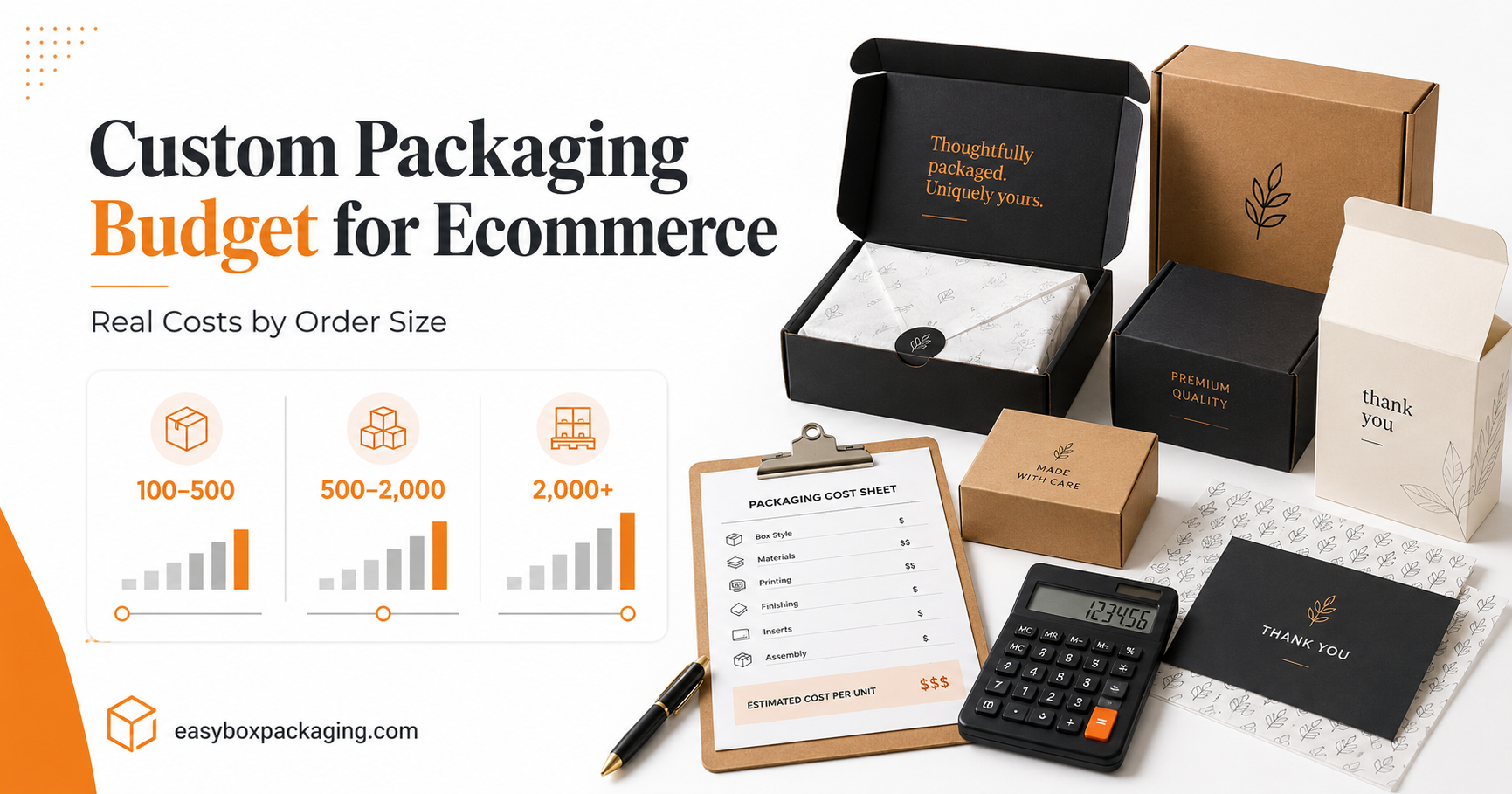
100-500 units: Per-unit cost runs $0.50-$1.50 for standard corrugated mailers, $2-$5 for folding carton or rigid boxes. At this volume, digital printing is almost always the right call. No plate fees. Minimum orders as low as 25 units. Total order cost typically runs $200-$600 for a corrugated mailer run at 100-200 units.
500-2,000 units: Per-unit cost drops to $0.30-$1.00 for corrugated, $1.20-$3.00 for folding carton. This is the transition zone — digital still competitive, but offset starts making sense if you have a stable design and you’re confident you’ll use the inventory. Total order cost runs $500-$2,500 depending on material.
2,000+ units: Per-unit cost reaches $0.20-$0.80 for corrugated mailers. Offset and flexographic become the right tools here. Plate fees spread across a larger run become negligible. At 5,000+ units, some brands see per-unit costs below $0.20 on basic corrugated.
The jump from 500 to 2,000 units doesn’t always double your bill. Per-unit cost drops enough that total cost often only increases 50-70% even though quantity doubled. That’s the math that surprises brands most.
Digital vs. Offset: Which Method Fits Your Custom Packaging Budget
This is the decision that moves cost more than any other. Getting it wrong — usually going offset on a low-volume run — is the most common custom packaging budget mistake ecommerce brands make.
Digital printing:
- No plate fees or setup costs
- File prep: $100-180 one-time per SKU
- Minimum orders: 25-50 units at most suppliers
- Per-unit premium: 30-50% higher than offset at equivalent volumes
- Best for: Orders under 500 units, new products being tested, seasonal SKUs
Offset printing:
- Plate costs: $80-200 per color, $250-400 total for standard CMYK
- Better per-unit pricing at 1,000+ units
- Consistent color across long runs
- Best for: Stable designs at 1,000+ units, brands with predictable reorder cycles
Flexographic printing:
- Common for corrugated at high volumes (3,000+)
- Plate costs higher: $200-1,500 per color
- Best per-unit price at large corrugated runs
- Best for: Brands running 3,000+ unit batches with established designs
The crossover math usually works like this: for a two-color corrugated mailer, digital beats offset on total cost up to about 800-1,000 units. Above that, depending on color count and material, offset becomes competitive. For a four-color CMYK job on SBS board, digital stays competitive up to 1,500-2,000 units because plate costs are significant.
If a supplier quotes you offset pricing on a 200-unit run, they’re either not set up for short-run digital or they’re hoping you don’t know the difference. Under 500 units, push for digital.
Building a Budget by Monthly Order Volume
The mistake in planning is treating packaging as a fixed line item. It’s not. It scales with your order volume — and the per-unit cost trajectory is steep enough that your packaging unit economics look totally different at 100 orders a month versus 500.
A working framework for early-stage brands:
Under 100 orders/month: Stay plain or go minimal. Stock mailers with a custom sticker or tissue insert. Total cost per shipment: $0.15-$0.40. This is the most common phase where brands over-invest in custom packaging before they have the volume to amortize setup costs. Our phase guide to affordable custom boxes maps out exactly when each upgrade makes sense.
100-300 orders/month: A digital short run makes sense. Budget $0.80-$1.50 per mailer for custom-printed corrugated. Your monthly packaging spend at 200 orders: $160-$300. Don’t go to offset plates yet — you’ll likely tweak the design within six months.
300-600 orders/month: This is where custom mailer boxes with interior printing become cost-effective. Plan $0.60-$1.20 per unit. Test branded tissue or a custom insert card at $0.15-$0.30 per unit. Monthly packaging budget at 400 orders: $300-$600 all-in.
600+ orders/month: Now you can run offset or flexo at 1,500-3,000-unit batches and see per-unit costs drop to $0.40-$0.75 for corrugated. At this scale, the unboxing investment makes economic sense. Branded packaging directly affects repeat purchase rates — and at 600+ orders a month, even a 5% improvement in retention is meaningful revenue.
Hidden Costs That Blow the Budget
The quoted per-unit cost isn’t the total cost. Several add-ons catch brands off guard:
Sampling: Most suppliers charge $50-$250 for physical samples before a production run. Non-negotiable if you’re buying 1,000+ units. Worth it every time.
Setup and file prep: Even in digital printing, file preparation and prepress can add $100-200 to an order. Ask if this is included before comparing quotes.
Shipping: Custom packaging is heavy. Freight from a supplier can add $0.05-$0.20 per unit on large orders. If you’re comparing quotes, confirm whether shipping is included.
Inserts: A simple insert card adds $0.10-$0.25 per unit. Custom-molded foam inserts add $0.50-$2.00 per unit. Interior branded tissue: $0.10-$0.20 per pack. These make sense when your product price point justifies them — a $15 product in a $0.50 box with $0.15 tissue is fine. A $150 product deserves more thought.
Plate storage fees: If you go offset, some suppliers charge annual plate storage fees of $50-$150. Worth checking before a long-term supplier commitment.
Common packaging cost mistakes in the budget phase: quoting one box style and then changing structure mid-order, ordering volume you can’t store, and not budgeting for the first-run design tweak.
When to Spend More Than Your Volume Justifies
The order-volume framework above is a starting point, not a rule. There are cases where spending up makes sense even at low volume.
High-ticket products. If you’re selling a $200+ product, the box is part of the premium signal. A $3-$5 per-unit packaging cost is 1.5-2.5% of product revenue. That’s defensible.
Gifting occasions. If your product is frequently purchased as a gift, the unboxing moment matters differently than it does for routine purchases. A $50 candle in a $0.80 plain mailer is a miss. Budget $2.50-$4.00 per unit and do it right.
Content-forward brands. If your Instagram presence depends on unboxing content — either yours or your customers’ — treat packaging as content production cost, not just shipping infrastructure. The economics shift.
Sustainability priorities. If your customer base cares about eco-credentials, the cost of eco-friendly custom packaging is often closer to standard than brands expect — especially for FSC-certified corrugated, which typically runs 8-15% higher than non-certified board. Not zero cost, but worth running the math before writing it off.
New product launches. A first impression in a new category is worth protecting. Spending $2-$3 per unit on 250 launch units to create a strong first impression often pays back faster than the math suggests, especially if you’re targeting press or influencer seeding.
What a Realistic Custom Packaging Budget Looks Like at Different Scales
Here’s how this plays out at real order volumes:
50 orders/month: Plain mailers ($0.20/unit) + custom sticker ($0.05) + branded tissue ($0.12). Total per shipment: $0.37. Monthly packaging budget: roughly $20.
250 orders/month: Digital-printed custom corrugated mailer ($1.10/unit) + insert card ($0.15). Monthly: $312.
500 orders/month: Digital or short offset custom mailer ($0.85/unit) + tissue ($0.15) + insert ($0.15). Monthly: $575.
1,500 orders/month: Offset-printed corrugated mailer ($0.55/unit) + full interior print ($0.15) + tissue ($0.15). Monthly: $1,275.
These are real numbers for a single SKU ecommerce custom packaging budget. If you run multiple SKUs or product lines, multiply accordingly — but per-unit cost should drop with aggregated volume. You can browse our ecommerce packaging options to get a feel for structure types before requesting quotes.
The Sampling Step You Shouldn’t Skip
Before committing to any production run over $500, order physical samples. Brands still skip it because the sample costs $150 and they’re eager to move. Don’t.
The gap between screen approval and production reality is significant — especially on kraft and uncoated materials. Colors shift. Structural score lines sit differently than in a digital mock-up. The actual board tells you things no screen preview can.
Run samples on kraft in particular. The screen-to-press shift on natural kraft is meaningful. Much easier to fix at the $150 sample stage than after a $1,500 production run.
For brands shipping nationally from a fulfillment hub, the International Safe Transit Association publishes testing standards worth asking your supplier about before a large run. You can browse their resources at ista.org. ISTA 2A and 3A transit simulations are the most common benchmarks for ecommerce corrugated spec verification.
We work with brands across all these stages — from 25-unit test runs to 10,000-unit quarterly orders. The brands that manage packaging spend well share one habit: they price out the next tier before they commit to the current one. Running the math on what 500 units would cost before committing to 200 takes five minutes and often changes the decision.
Frequently Asked Questions
What percentage of COGS should I budget for packaging?
Most DTC ecommerce brands target 1-4% of product cost for packaging. Lower-ticket products can go lower if per-unit packaging cost stays under $0.50. Premium products ($100+) often run packaging at 2-5% of product cost. The most important number is absolute per-unit cost versus your shipping economics — if packaging plus shipping exceeds 15% of revenue, revisit the spec.
Is it cheaper to source packaging locally?
For plain commodity corrugated, local suppliers often win on freight and lead time. For custom-printed branded packaging at lower volumes — under 500 units — national digital print suppliers usually have lower minimums and better per-unit pricing. Compare total landed cost including freight before choosing. The answer isn’t always obvious.
The single most expensive thing you can do with a custom packaging budget is order at the wrong quantity tier. Too few units and you’re paying digital per-unit rates when you could be spreading offset plate costs across more boxes. Too many and you’re tying up cash in inventory that might change before you use it. Get the volume math right first. Then pick the finish. Design choices matter — but they’re the last thing to optimize, not the first.