
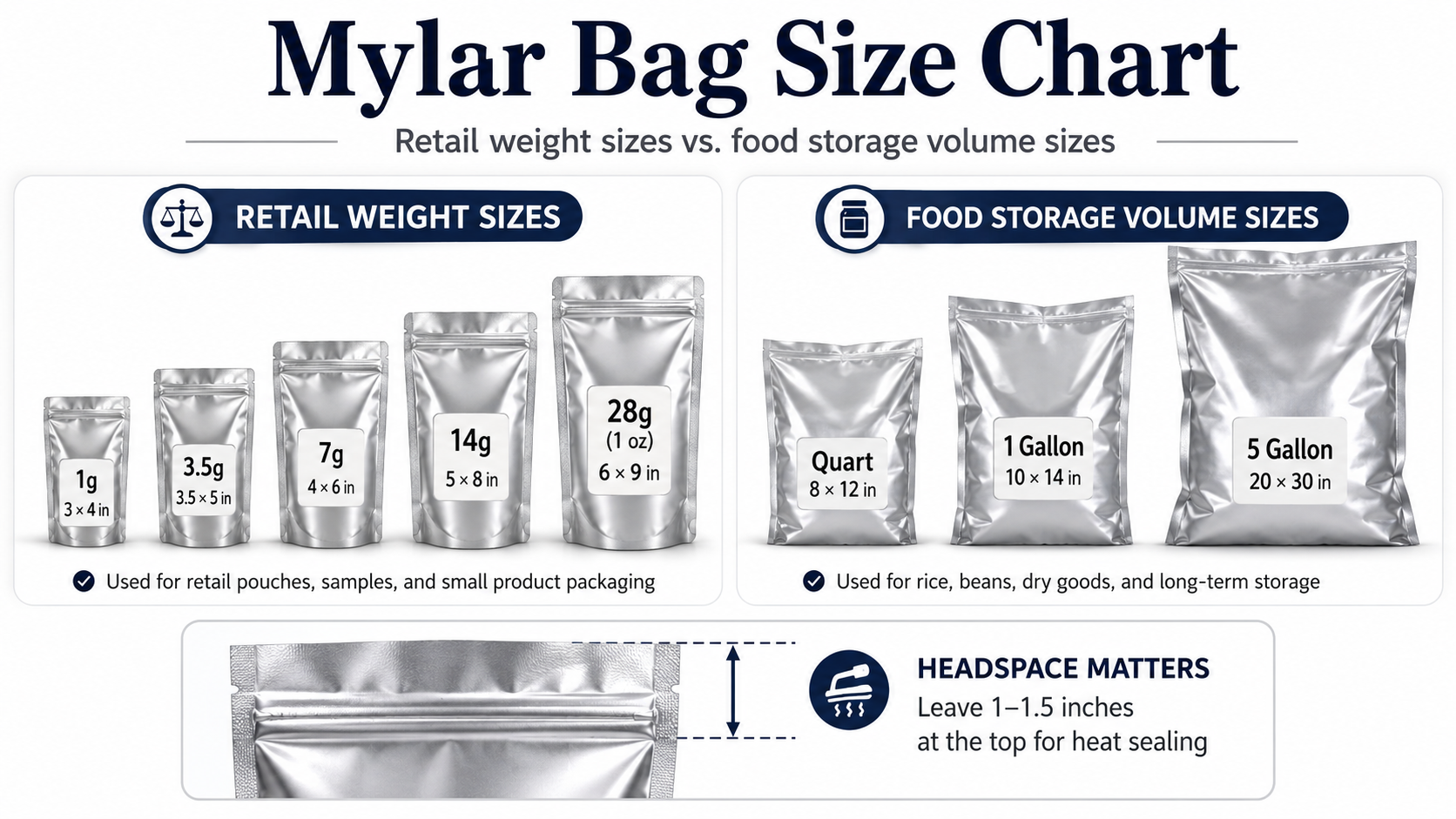
Mylar bags scale by two different logics depending on what’s going inside. Retail pouches scale by weight — grams and ounces. Food storage bags scale by volume — quarts and gallons. Mixing those up is the most common sizing mistake we see. Below is the chart split both ways, plus the one measurement most people forget: headspace. For sizing on other packaging types, our full box size guide covers the rest.
Mylar Bag Size Chart
| Size | Dimensions (inches) | Dimensions (cm) | Typical Use |
|---|---|---|---|
| 1 gram | 3 × 4 in | 7.6 × 10.2 cm | Sample sizes, single pre-rolls |
| 3.5 grams (eighth) | 3.5 × 5 in | 8.9 × 12.7 cm | Highest-volume retail size |
| 7 grams (quarter) | 4 × 6 in | 10.2 × 15.2 cm | Regular retail purchases |
| 14 grams (half oz) | 5 × 8 in | 12.7 × 20.3 cm | Two-week retail supply |
| 28 grams (1 oz) | 6 × 9 in | 15.2 × 22.9 cm | Bulk retail, discounted product |
| Quart (food storage) | 8 × 12 in | 20.3 × 30.5 cm | Spices, nuts, small dry goods |
| 1 Gallon (food storage) | 10 × 14 in | 25.4 × 35.6 cm | Rice, beans, single-meal bulk |
| 5 Gallon (food storage) | 20 × 30 in | 50.8 × 76.2 cm | Long-term bulk storage, bucket liners |
Quarter-pound, half-pound, and full-pound retail bags exist too. Those run roughly 8×10, 10×12, and 13×15 inches. The sizes above cover what people actually search for most.
The Measurement Everyone Forgets: Headspace
A mylar bag’s listed dimensions are its full flat size, not the usable fill space. Heat sealers need room to work. Plan on losing 1 to 1.5 inches off the top to the seal itself.
Fill a bag to the labeled edge and the seal has nowhere to grab. It either fails right away, or it fails quietly and lets air back in over the following months. That second kind is worse. You won’t know your rice or beans went stale until you open the bag a year later.
The fix is simple math, not guesswork. Buy a bag 1.5 inches taller than your fill line requires, every time. A 3.5g product that fills 3.5 inches of a bag needs a 5-inch bag, not a 4-inch one. That’s exactly why the standard eighth-ounce size runs 3.5 × 5 instead of 3.5 × 4.
Retail Weight Sizes vs. Food Storage Volume Sizes
These two categories get confused constantly. The confusion is understandable, since it’s the same material doing two very different jobs.
Retail pouches, 1g through 1 pound, prioritize a tight, presentable fit around a small product. Food storage bags, quart through 5 gallon, prioritize barrier strength over a long shelf life. That’s why they typically run thicker. A 5-gallon bag built for a year of pantry storage usually sits at 4 to 5 mil. A small retail pouch can run thinner, since it’s protecting product for weeks, not years.
That thickness difference matters more than most size charts mention. A thin bag at a 5-gallon size won’t hold up to a bucket liner’s weight and handling. A thick bag at 1-gram size is just wasted material cost. Matching mil to use case is as much a part of “sizing” as the length and width numbers. Most charts leave thickness out entirely.
Sizing up “just in case” is one of the more common packaging mistakes we see. It shows up here too. An oversized retail pouch looks under-filled on a shelf. An oversized storage bag just wastes barrier material for no protective benefit. Buy for the product you have, not the one you might sell someday.
Custom Sizes and Thicknesses
Standard sizes cover most orders. Plenty of products don’t fit neatly into gram tiers or gallon jugs, though. Subscription bundles, multi-item kits, and oddly shaped dry goods are common exceptions. When that happens, standard mil thickness and standard dimensions stop being useful. They start being a constraint instead.
Easy Box Packaging cuts mylar bags to whatever dimension and barrier thickness the product actually needs. That covers a nonstandard retail pouch or an oversized storage bag equally well. For CBD and hemp brands specifically, there’s a second constraint on top of size and mil thickness: compliance labeling. Our custom CBD packaging boxes are built with that label real estate accounted for from the start, rather than squeezed onto a standard pouch after the fact. I’ve seen brands try to force a product into the nearest stock size instead. It usually ends up either too loose to look intentional, or too tight to seal cleanly. A custom cut solves both problems in one step. It’s priced by spec, not treated as a special request. The same logic applies across our packaging line. We walked through similar size-versus-fit tradeoffs in our pizza box sizing guide, and the principle holds for any product category.
Frequently Asked Questions
What size mylar bag do I need for 3.5 grams? A 3.5 × 5-inch bag is the standard fit and the highest-volume size in the retail market. Leave the usual 1-inch headspace for sealing.
Is a 5-gallon mylar bag the same as a 5-gallon bucket? Not exactly. A 20 × 30-inch bag lines a standard 5-gallon bucket with enough excess to gather at the top. Once sealed, the bag holds slightly less than a full 5 gallons.
Can I reuse a mylar bag after opening it? Not for long-term storage. Once a heat seal is cut open, the oxygen barrier is gone for good. Reusing it with a chip clip or a fold-over is fine for short-term use. It won’t protect against a year of pantry storage the way a fresh seal will.
The Bottom Line
Picking the right mylar bag size comes down to one question: does your product follow weight or volume? Weight for retail, volume for food storage. Once you know that, the right size is usually obvious from the chart above. When it isn’t, that’s a sizing and thickness problem worth solving with a custom cut instead of a compromise. Get a quote and get the exact dimensions your product needs.