
The question brands ask when they start thinking about wholesale custom boxes for ecommerce is usually a version of this: “How do I get the cost per unit down?”
It’s the right question. But most brands go looking for the wrong answer.
“Wholesale” in custom packaging doesn’t work the way it does in retail. There’s no distributor sitting between you and the factory. You’re dealing with the manufacturer directly whether you order 100 units or 10,000. What changes at scale isn’t who you’re buying from — it’s the print technology, the setup cost structure, and where the supplier’s break-even point shifts.
This guide covers the volume math that actually determines your price, what to get right before you scale, and the inventory mistake that costs ecommerce brands more than anything else in packaging.
What “Wholesale” Actually Means in Custom Box Pricing
When brands search for wholesale custom boxes, they want one thing: a lower price per unit.
The mechanism behind that price drop isn’t a discount. It’s a change in production method.
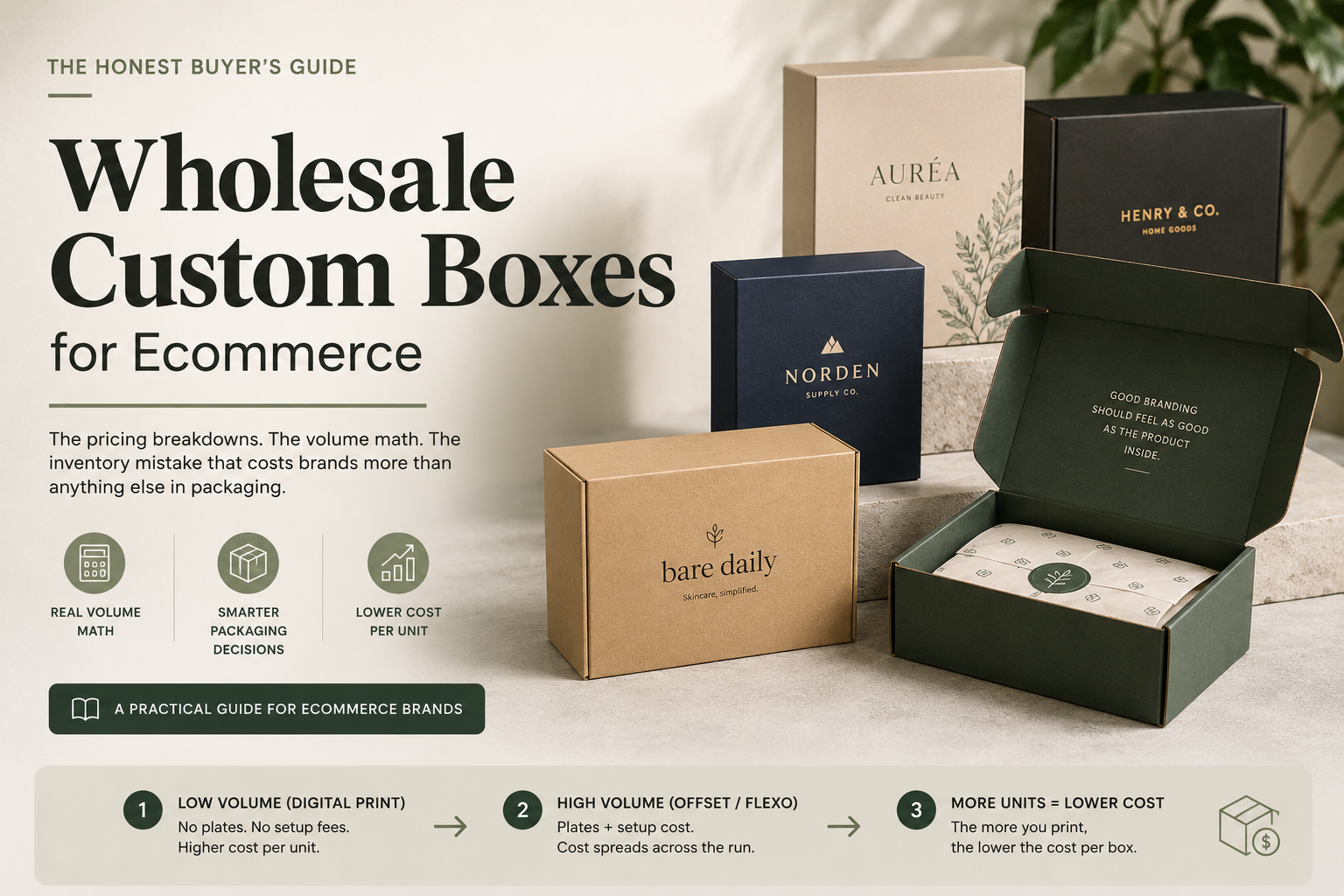
At low volumes — roughly under 300 units — most suppliers use digital printing. No plates, no setup costs, shorter lead times. The flexibility is worth the higher per-unit cost. At higher volumes, the economics shift to offset or flexo printing. Plates cost money upfront, but that fixed cost gets spread across a large run. The more units printed, the lower the plate cost per box.
That’s the real math behind wholesale pricing in custom packaging:
- 100–300 units: Digital printing — $3.00–5.00/unit (corrugated mailer, standard spec)
- 500–1,000 units: Crossover zone — offset becomes viable, $1.60–2.40/unit
- 2,500 units: Offset in full effect — $0.90–1.30/unit
- 5,000+ units: $0.60–0.95/unit depending on spec and color count
These ranges shift based on box type, wall thickness, number of colors, and finishing. But the shape of the curve stays consistent. The biggest price drop happens between 300 and 1,000 units. After 2,500 units, the per-unit savings slow considerably.
If you’re ordering fewer than 500 units, you’re not in wholesale territory — you’re in digital run territory. That’s fine. The right volume to push for bulk pricing is somewhere between 500 and 1,000 units, depending on your cash flow and how stable your design is.
The Inventory Trap
Here’s the scenario I’ve watched happen more than once: a brand runs the unit-cost math, decides 5,000 units is meaningfully cheaper than 1,000, and places the larger order. Six months later, they rebrand. Or change their product dimensions. Or run a seasonal promotion that needs a different box. And they’re sitting on 3,500 units they can’t use — packaging they already paid for.
At $1.20 per unit, that’s $4,200 in unusable inventory. At $1.80 per unit for a more complex spec, it’s over $6,000.
The rule I’d apply before any wholesale order: only go to high volumes if you’re confident the design, dimensions, and branding are locked for at least 12 months. If you’re still testing your product or evolving your brand, digital printing at 200–300 units is the right call — even if the per-unit cost is higher. The flexibility is worth the premium.
Before scaling, ask yourself three things:
Is your product spec stable? If dimensions might change — you’re reformulating a food product, releasing updated hardware, expanding to different sizes — don’t scale the box yet.
Is your brand locked? Logo changes, color updates, or copy changes on the box mean a full reprint. If a rebrand is anywhere in the next 12 months, wait.
Do you have storage? 5,000 flat-packed corrugated mailer boxes need 40–60 square feet of dry, climate-controlled space. If you’re running from a garage or shared 3PL without dedicated storage, confirm that reality before committing.
What to Lock Down Before You Scale Your Order
Wholesale quantities amplify whatever you get right — and whatever you get wrong.
Dimensions. Inner dimensions need to account for your product plus any inserts, tissue, or fill. Outer dimensions affect your dimensional weight, which affects shipping cost. Test with real product and real fill before finalizing. A box that seems fine on paper can be wrong in practice.
Wall thickness and flute. For corrugated, flute type and wall construction (single-wall, double-wall) affect both protection and weight. B-flute is most common for mailers and retail corrugated. E-flute gives a cleaner print surface. Get samples right before scaling — a spec that works at 200 units is still the wrong spec at 5,000 if it fails in transit.
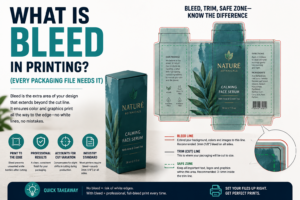
Print file accuracy. At wholesale volumes, your file is the master. Any error — color mode mismatch, font not embedded, bleed edge missing — gets reproduced across every unit. Ask your supplier to run a prepress check before the production run starts, not after 5,000 boxes are printed.
Color consistency. If you’re using Pantone spot colors for brand-critical elements, a reputable supplier should match them consistently across a large run. If you’re printing CMYK, request a physical press proof on your actual production stock before approving. A PDF proof on screen is not a color approval.
Supplier’s QC process. Before committing to a large order, ask directly: how do you handle quality control on runs over 1,000 units? A good supplier will describe a sampling method — checking units at the start, middle, and end of the run. A vague answer is information worth having before you place the order.
The brands that understand how packaging drives repeat purchases know that at wholesale volumes, a consistency failure across 5,000 units costs more than money — it costs the brand signal you’re trying to build.
How Quality Control Works Differently at Scale
Small digital runs and large offset or flexo runs have different QC dynamics — and knowing the difference helps you ask the right questions.
With digital printing, every unit comes off the same machine. Variation is minimal because there’s no ink loading to manage, no plate wear. Unit #1 looks like unit #300.
With offset and flexo at wholesale volumes, real variables exist:
Press registration. Colors can shift slightly if the press misregisters between color passes. This shows up as a hairline offset where two colors meet. The fix is tighter trapping in your artwork file.
Ink density drift. On a long run, ink viscosity can change. Professional suppliers manage this, but a run of 5,000 will have slightly more variation than a run of 500.
Cutting and scoring tolerance. Per TAPPI packaging standards, die-cut tolerances on corrugated runs are typically ±1–2mm. For most packaging that’s invisible. For boxes with tight insert fits — cosmetics, electronics, rigid inserts — it matters. A 2mm variation in the opening can mean an insert that doesn’t seat correctly.
What you can do: request a statistical sample from your supplier — typically 10–20 units pulled randomly from throughout the run. Check color, structure, cutting, and print quality against your approved proof. Most professional suppliers include this on large orders as standard.
Domestic vs. International Suppliers at Wholesale Volumes
At smaller quantities, domestic suppliers win on lead time and communication. At wholesale volumes, the math gets more complicated.
International suppliers — primarily in China, Vietnam, and increasingly Mexico — often have lower base manufacturing costs. But the total cost of an international wholesale order includes:
- Ocean freight (typically $2,000–4,000 for a full container)
- Import duties (packaging imports may be subject to tariffs — verify current rates before budgeting)
- Customs broker fees ($200–500 per shipment)
- Lead time: 8–14 weeks from artwork approval to US delivery
That 8–14 week lead time is the real constraint. If you’re running low and need a replenishment order, overseas suppliers can’t help you on short notice. Domestic suppliers typically turn large corrugated orders in 3–5 weeks.
The math depends on volume and planning horizon. For high-volume, stable SKUs where you’re planning 6+ months ahead, international manufacturing can reduce unit costs meaningfully. For most ecommerce brands under 10,000 units per year, the logistics complexity and lead-time risk make domestic manufacturing the more practical call.
If you’re deciding how to allocate your packaging budget across order volumes and growth stages, the custom packaging budget guide breaks down the tradeoffs in detail.
How to Get Better Pricing on a Wholesale Order
Negotiation on wholesale custom box orders isn’t about haggling. It’s about structuring the deal to reduce the supplier’s risk — which creates room for better pricing on yours.
What suppliers care about: A confirmed large order, clean artwork, and a clear timeline. Uncertainty is expensive for them. Holding paper stock, allocating press time, managing last-minute changes — all of that costs money. The easier you make the production process, the more flexibility they have on price.
Committing to a reorder timeline. A supplier who knows you’ll order 5,000 units every six months will price differently than one treating you as a one-off customer.
Submitting clean, print-ready artwork. Every prepress correction the supplier makes costs them time. Arriving with a properly set-up file and a documented color spec is a real negotiating advantage.
Choosing a simpler structural spec. Full-color litho-laminated corrugated is excellent but more expensive to produce than a straightforward kraft mailer with single-color flexo printing. If price is the constraint, simplify the spec before negotiating.
Avoiding late changes. Changes after production starts are expensive for everyone. Locking down the spec before anything goes to press is the most direct way to protect your pricing.
Common Wholesale Box Ordering Mistakes
Avoiding common packaging mistakes at scale means knowing which ones hit harder at wholesale volumes:
Ordering without a physical sample. A digital mock-up is not a sample. For large runs, always get a die-cut, printed, folded, and glued physical proof on your actual production material. This adds a week to the timeline but prevents far bigger problems.
Assuming print is consistent across suppliers. Each press has different color profiles, paper stock, and ink formulations. A box that matched your Pantone colors at one supplier may print visibly different at another. Always request a press proof when switching suppliers, even with the same artwork.
Ordering more than 12 months of inventory. Beyond that horizon, something will change — product dimensions, brand colors, promotional copy. The per-unit savings from ordering 10,000 vs 5,000 units rarely justify carrying twice the inventory.
Skipping the sample round on custom mailer boxes. Mailer boxes have more structural complexity than simple shipper cases — auto-lock bottoms, tuck-top closures, interior print registration. At wholesale volumes, a structural issue in the sample becomes a structural issue in 5,000 units.
FAQ: Wholesale Custom Boxes for Ecommerce
What’s the minimum order for wholesale custom box pricing?
Meaningful price breaks typically start at 500–1,000 units with direct manufacturers. Some suppliers offer low MOQs of 50–100 units via digital printing, but these are priced as small runs, not wholesale runs.
How long does a wholesale custom box order take?
Domestic suppliers: 4–6 weeks from artwork approval to delivery. International suppliers: 8–14 weeks including ocean freight. Plan your inventory timeline around production lead times, not around when you want to run out.
What’s the difference between a wholesale box supplier and a custom box manufacturer?
For ecommerce brands, very little in practice. When you buy custom boxes, you’re already buying at or close to the manufacturer level. A “wholesale box supplier” selling generic stock boxes is a different product — those are plain brown boxes, not branded custom packaging.
Can I mix different box styles in one wholesale order?
Yes, but each style typically has its own MOQ and pricing. Combining orders of the same material and print process can sometimes reduce per-unit costs. Confirm with your supplier whether combined orders qualify for the same pricing tier.
How do I ensure color consistency across a large print run?
Use Pantone spot colors for brand-critical elements. Request a physical press proof on your production material before the run starts. Ask your supplier for their stated color tolerance — reputable suppliers should be able to give you a Delta E target.
What happens if units in my wholesale order are defective?
Reputable suppliers replace or credit defective units if defects exceed a stated tolerance, typically 0.5–2% of the run. Get this in writing before placing the order, and document any defects with photos immediately on delivery.
What is dimensional weight and why does it matter for wholesale boxes?
Dimensional weight (DIM weight) is how carriers calculate shipping charges for lightweight but bulky packages. The formula: (L × W × H) ÷ 139 for UPS/FedEx domestic. If DIM weight exceeds actual weight, you’re billed on DIM weight. At wholesale volumes, even a box 1 inch too large across thousands of shipments adds up fast.
The Wholesale Box Decision
The unit-cost math for wholesale custom boxes for ecommerce is the easy part. The harder math is everything around it: inventory risk, design stability, lead time, and quality at scale.
The brands that get this right don’t just ask “how do I get boxes cheaper?” They ask “what does my business need to look like before ordering at scale makes sense?” If your product, brand, and volume are stable — place the order. If not, a smaller digital run is the smarter call, even at a higher per-unit cost.
Easy Box Packaging works with ecommerce brands across the volume spectrum — from first runs at 250 units to recurring wholesale orders at 5,000+ with offset printing, physical QC sampling, and structural prototyping. Check out our ecommerce packaging options or start with a quote to see where your volume lands on the pricing curve.
If you’re still evaluating print methods for your wholesale run, our guide to custom packaging printing methods covers digital vs. offset vs. flexo in plain language.