
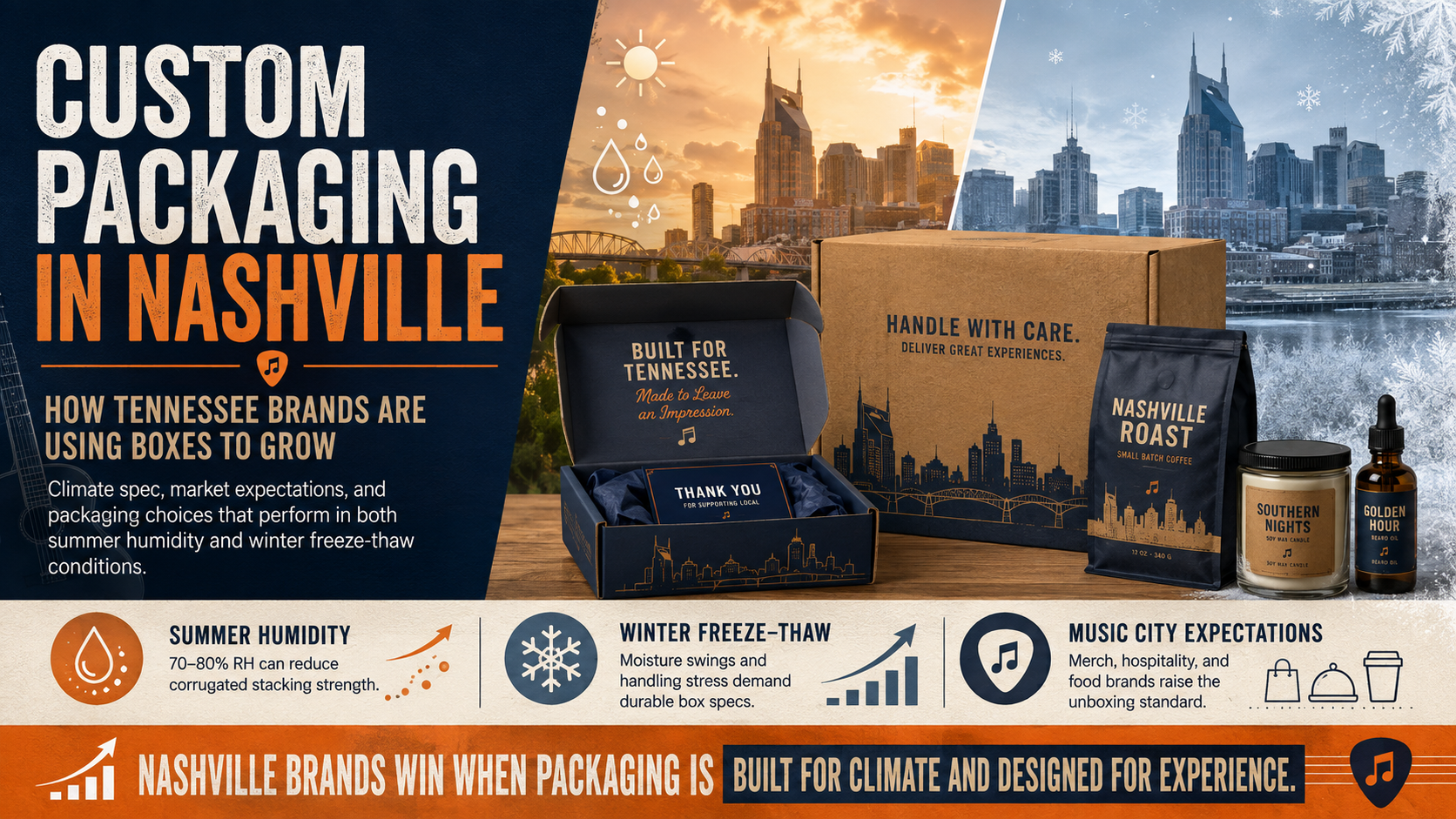
Nashville’s packaging challenge isn’t obvious until you’ve shipped through a Tennessee summer. July humidity regularly hits 70–80% relative humidity, which degrades corrugated ECT stacking strength in ways that show up in real shipments — not just lab tests. Then winter brings ice storms, not snow, and the freeze-thaw cycles start. That dual-season stress is what separates custom packaging Nashville Tennessee brands that spec correctly from the ones learning the hard way in August and January.
Add the Music City factor: Nashville is one of the fastest-growing DTC markets in the Southeast, with a consumer base shaped by premium music merchandise, high-end hospitality, and a food brand scene that ships nationally. The packaging standard here is higher than a typical mid-size US city. Brands arriving with a generic brown shipper find they’re competing against an unboxing expectation that the entertainment and hospitality industries spent decades building.
Here’s what’s actually working for custom packaging in Nashville — the climate spec, the market signals, and the decisions that matter most before you order your first run.
Custom Packaging Nashville Tennessee: The Dual-Season Climate Problem
Most packaging guides focus on one climate challenge per region. Nashville gives you two, in opposite directions.
Summer humidity. Nashville summers are genuinely humid. Average July relative humidity runs 70–80%, with heat index readings well above 100°F on peak days. Corrugated ECT stacking strength — the measure of how much compression load a box handles before buckling — degrades dramatically at high humidity. At 85% RH, corrugated can lose close to half its dry-condition stacking strength. For Nashville brands storing corrugated inventory in non-climate-controlled warehouse space through summer, or shipping heavy products stacked multiple units high, the structural spec needs to account for this. Moisture-resistant board sizing is not a premium upgrade here — it’s the correct spec for humid-season fulfillment.
Ice-storm winters. Nashville doesn’t get consistent deep snow, but it gets ice. December through February brings repeated freeze-thaw cycles — temperatures crossing the 32°F threshold multiple times over days. That cycle is harder on standard hot-melt tape adhesive than steady cold. Hot-melt loses bonding strength below 40°F and essentially fails below 20°F. Nashville packages sitting on front steps during an ice event go through several freeze-thaw cycles before anyone brings them inside. Self-locking corrugated construction — auto-lock bottoms, tuck-top mailer boxes — removes the tape dependency entirely. The box holds its form through temperature swings without relying on adhesive bond.
The brands that get this right spec for both: moisture-resistant board sizing for summer structural performance, self-locking construction for winter adhesive reliability. Neither requires premium pricing at scale — they’re spec decisions, not material upgrades. The packaging mistakes that cause the most damage in dual-season markets are almost always structural — and almost always preventable at the brief stage.
What Nashville’s Brand Ecosystem Expects
Nashville’s DTC scene is not generic mid-market. The city’s consumer base has been shaped by proximity to industries that take packaging seriously: music, hospitality, food and beverage, entertainment. The unboxing expectation is higher here than in comparably sized markets.
The brand categories driving Nashville’s custom packaging demand:
Music merchandise. Nashville is the music capital of the country. Record labels, independent artists, music publishing houses, and merchandise brands all ship from here. Vinyl records, artist merchandise, signed items, press kits — these categories have specific packaging requirements that a generic corrugated shipper fails at. A vinyl record shipped in the wrong outer box arrives warped. A premium artist merchandise box that arrives crushed is a customer service problem, not just a packaging one. The music industry has set a high bar for what a shipped product should look and feel like on arrival.
Tennessee food and beverage. Tennessee produces more whiskey per capita than any state in the country, and the craft food and beverage scene has expanded beyond spirits to include hot chicken brands, specialty sauces, artisan coffee, and small-batch food products shipping direct-to-consumer nationally. These brands have food-safe board requirements, weight ratings for bottled product, and thermal management needs for temperature-sensitive items in Nashville’s summer climate.
Healthcare brands. Nashville is the largest per-capita healthcare company city in the United States. HCA Healthcare, Envision Healthcare, and dozens of health-tech startups are headquartered here. Healthcare-adjacent consumer brands — supplements, wellness products, medical devices — represent a significant share of Nashville’s DTC packaging market, with specific cleanliness and compliance requirements.
Premium lifestyle and tourism brands. Broadway, the Gulch, and Nashville’s growing boutique hotel scene have produced a set of retail and DTC brands with premium presentation standards. Gift packaging, hotel amenity sets, and experience-driven products shipping from Nashville need packaging that reflects the premium positioning of the brands behind them.
Custom Packaging Nashville Tennessee: The Food and Beverage Spec
Tennessee’s food and beverage brand ecosystem is large enough to warrant its own spec breakdown. The requirements here differ materially from standard ecommerce corrugated.
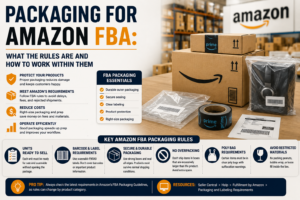
Food-safe board is non-negotiable. Any corrugated that contacts or directly contains a food or beverage product requires food-safe board stock — FSC-certified kraft or SBS with food-safe coatings. I’ve seen this spec missed on a significant share of first-time food brand orders: the brand assumes it’s standard, the supplier quotes standard corrugated, and the mismatch surfaces at the sample stage. Fix it in the brief. This also affects Amazon FBA eligibility for brands selling through that channel.
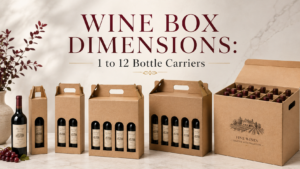
Weight ratings for bottled product. A case of six 750ml whiskey bottles weighs over 10 lbs before packaging materials. Single-wall corrugated at standard ECT ratings is not sufficient for the compression load that generates in stacked distribution. ECT-32 minimum for anything going on pallets; double-wall for multi-case pallet configurations. Chipboard partitions or corrugated cell packs prevent bottle-to-bottle contact and breakage during transit.
Heat and humidity considerations for specialty food. Nashville summers can hit 95°F+ with high humidity. Chocolate, certain condiments, and specialty food products are sensitive to sustained heat and humidity in transit. For brands shipping temperature-sensitive products in summer, the corrugated shipper is part of the thermal management system. Insulated corrugated liners or reflective coatings may be necessary alongside the standard corrugated spec.
Sustainability certification for food brands. Tennessee food brands selling into national markets — particularly natural food retailers and premium grocery — increasingly face customer expectations around FSC certification and recyclable packaging. The cost difference from virgin corrugated is minimal at standard volumes. The brand signal is meaningful for the food category’s sustainability-conscious buyer segment.
Nashville Neighborhoods: What the Packaging Signal Says by Area
Nashville’s geographic spread means where your customers are shapes what your packaging should communicate.
The Gulch / Downtown corridor: Nashville’s most design-forward consumer zone. High-income, design-literate, premium expectations. Packaging here competes against the hospitality and entertainment industries’ high visual standards. Matte lamination is the baseline; soft-touch for premium positioning; rigid box for high-value items. This segment notices packaging construction quality as a proxy for product quality.
East Nashville: Artisan-leaning, sustainability-conscious, independent brand sensibility. Kraft corrugated with minimal print coverage and recycled content performs well here. Excessive packaging — oversized boxes, plastic void fill, non-recyclable coatings — gets negative reactions from this consumer segment. The intentional minimalism that works in Fremont or Fishtown works here too.
12 South / Hillsboro Village: Boutique retail crossover. Brands selling through 12 South boutiques alongside their DTC channel need retail-ready corrugated — packaging that functions cleanly as both a shipper and a display unit. Design for both use cases in the original brief, not after you’ve committed to a single-purpose production run.
Franklin and Brentwood: High-income suburbs, premium brand expectations. Similar to Bellevue outside Seattle or the Main Line outside Philadelphia. Rigid box and premium corrugated finishes are appropriate. This segment expects quality construction and considers a well-engineered structural detail a signal that the brand is serious.
Nashville’s Interstate Logistics Position
Nashville sits at the intersection of I-24, I-40, and I-65 — three major corridors. Memphis (I-40 west, 3 hours) is one of the busiest freight hubs in the country. Atlanta (roughly 4 hours south) anchors the broader Southeast. Louisville (I-65 north, 2.5 hours) connects to Midwest distribution networks. Charlotte and the Carolinas are accessible via I-40 east.
This positioning means Nashville brands can reach a wide geographic footprint from a single fulfillment location. Ground shipping from Nashville covers Atlanta, Charlotte, St. Louis, Cincinnati, and Chicago within 1–2 days. That distribution advantage makes the packaging investment case stronger here than in less centrally positioned markets: when you’re already winning on delivery time, the box is what distinguishes your brand from the warehouse it came from.
Understanding how packaging drives repeat purchases matters in any distribution-advantaged market — because when delivery speed is competitive, the unboxing experience becomes the primary brand touchpoint. Nashville’s logistics position sets up that dynamic well for brands willing to spec their packaging accordingly.
Custom Packaging Nashville Tennessee: What the DTC Standard Looks Like
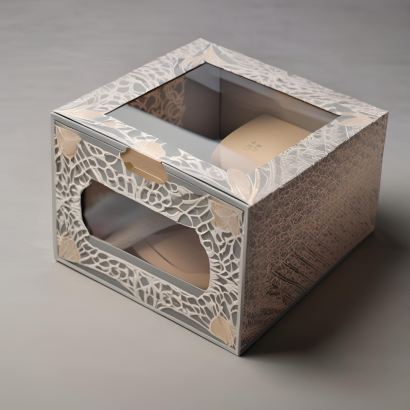
Across Nashville’s DTC categories — food and beverage, music merchandise, wellness, premium lifestyle — the custom mailer box is the dominant shipping format. Self-locking construction handles Nashville’s dual-season climate: no tape dependency for ice-storm winters, good moisture protection for humid summer transit. The six-panel closed structure performs better on porches in January and in non-climate-controlled summer warehouse storage than tape-sealed RSC shippers.
What differentiates Nashville’s stronger packaging from the generic version:
Interior print. Nashville’s premium consumer base responds to the interior of a mailer box as a brand moment. A printed lid interior — brand message, product artwork, or a deliberate color field — signals that the brand thought about the customer’s experience rather than just the shipping task. This is where earned media gets generated. I’ve watched Nashville brands with a single interior print detail get tagged in unboxing content that their generic-box competitors never see, at an incremental cost of roughly $0.15–$0.20 per unit.
Sustainable material choices. East Nashville and younger Nashville consumers respond to FSC-certified board and recycled content in ways that directly affect repeat purchase behavior and social sharing. The sustainable packaging choice doesn’t require sacrificing print quality or finish — recycled-content corrugated takes full-color digital print and lamination cleanly. Understanding what eco-friendly packaging actually costs versus conventional alternatives makes the decision straightforward once the numbers are on the table.
Format discipline. Nashville DTC operations typically run a primary mailer box in one or two sizes for core SKUs, with a heavier corrugated RSC shipper for bulk or heavy-product orders. The mailer handles the brand experience. The RSC handles the structural load. They’re not the same box and shouldn’t be designed as if they are.
Getting the Spec Right for Tennessee Shipping
Across custom packaging Nashville Tennessee brands need to get right before the first order:
Self-locking construction over tape closures. Nashville’s December–February ice-storm pattern creates the same freeze-thaw tape failure problem as Denver in winter. Auto-lock bottoms and tuck-top mailer designs eliminate that dependency entirely.
Moisture-resistant board for heavy or stacked products. Nashville’s summer humidity hits the range where unconditioned corrugated loses meaningful stacking strength. For heavy products or inventory stored in non-climate-controlled facilities through summer, moisture-resistant board sizing is the right spec.
Food-safe board for any consumable product. Tennessee’s food, beverage, and supplement brands need food-safe board stock. Ask for it explicitly — it’s not the default corrugated spec and won’t be included unless specified in the brief.
Finish appropriate to your neighborhood and category. The Gulch and Franklin premium consumer base warrants matte lamination or soft-touch. East Nashville’s sustainability-forward base warrants kraft and recycled content. The wrong answer is applying a blanket spec without thinking about who’s actually opening the box.
FAQ: Custom Packaging in Nashville, Tennessee
What packaging construction handles Nashville winters best?
Self-locking construction — tuck-top mailer boxes, auto-lock bottoms — removes tape from the equation. Nashville’s December–February ice storms create repeated freeze-thaw cycles that degrade standard hot-melt tape adhesive. Self-locking corrugated holds its form through temperature swings without any tape dependency.
Does Nashville’s summer humidity really affect corrugated?
Yes. At 70–80% relative humidity — which Nashville regularly hits in July and August — corrugated ECT stacking strength degrades significantly from dry-lab conditions. For heavy products, stacked units, or inventory in non-climate-controlled summer storage, moisture-resistant board sizing is the right call.
Do Tennessee food brands need different packaging specs?
Yes. Food-safe board is non-negotiable for any corrugated contacting a consumable product. Weight ratings for bottled and canned beverages require ECT-32 minimum and often double-wall for pallet distribution. Temperature-sensitive products — chocolate, certain condiments — may need insulated or reflective packaging for Nashville’s summer heat.
What’s the minimum order for custom packaging in Nashville?
Digital printing runs start at 50–100 units with no plate setup costs — the right range for early-stage Nashville brands testing formats. Offset printing makes sense at 500–1,000+ units when per-unit cost becomes the priority. Domestic suppliers typically deliver to Nashville in 3–5 weeks, making digital the practical choice for brands still iterating on design.
How does Nashville’s music merchandise category affect packaging specs?
Vinyl records, signed artist merchandise, and press kit packaging have specific requirements a generic corrugated shipper fails at. Vinyl requires corrugated that holds flat geometry in transit — mailers and sleeves designed for record dimensions. Artist merchandise needs premium finishes that reflect the artist or label’s positioning. Getting these specs wrong generates customer service costs and damages the brand.
Does it matter where in Nashville I’m based for packaging decisions?
For packaging spec, no — the climate is the same across the metro. For packaging positioning, yes. East Nashville consumers respond to different packaging signals than Gulch or Franklin consumers. Match your finish, material, and sustainability choices to your actual customer rather than a default answer.
How does custom packaging Nashville Tennessee compare to other Southeast cities?
Nashville shares the dual-season climate challenge — hot humid summers, freeze-thaw winters — more with Philadelphia and the Mid-Atlantic than with Atlanta or Charlotte, which have milder winters. The premium DTC consumer expectation is closer to Atlanta’s Buckhead or Charlotte’s SouthPark than to a typical mid-size Southeast market. Budget and spec accordingly.
Nashville Has the Market — The Box Is How You Work With It
The brands getting custom packaging Nashville Tennessee right aren’t fighting the climate — they’ve spec’d for it. Moisture-resistant board for summer, self-locking construction for winter, food-safe stock for Tennessee’s substantial food and beverage brand population. These aren’t upgrades. They’re the baseline spec for a market that delivers through ice storms and stores inventory through August.
Get those fundamentals right and the packaging stops being a logistics problem. Then the finish choices, the interior print, the sustainability signal — those start doing actual brand work. That’s when a Nashville DTC brand uses its packaging the way the music and hospitality industries here have used presentation for decades: as part of what people remember about the experience.
Easy Box Packaging works with DTC brands throughout Tennessee — from Nashville food and beverage producers to Music Row merchandise brands to wellness brands shipping from the broader Tennessee metro. See our ecommerce packaging options to talk through what your products and your market specifically need.
For Southeast regional context, the Atlanta packaging guide covers Georgia’s comparable premium DTC market and the humidity considerations that affect corrugated spec across the region. And for a look at how a similarly dual-season market handles the same summer humidity and winter freeze-thaw challenge, the Philadelphia packaging guide covers the East Coast approach to the same structural problem.