
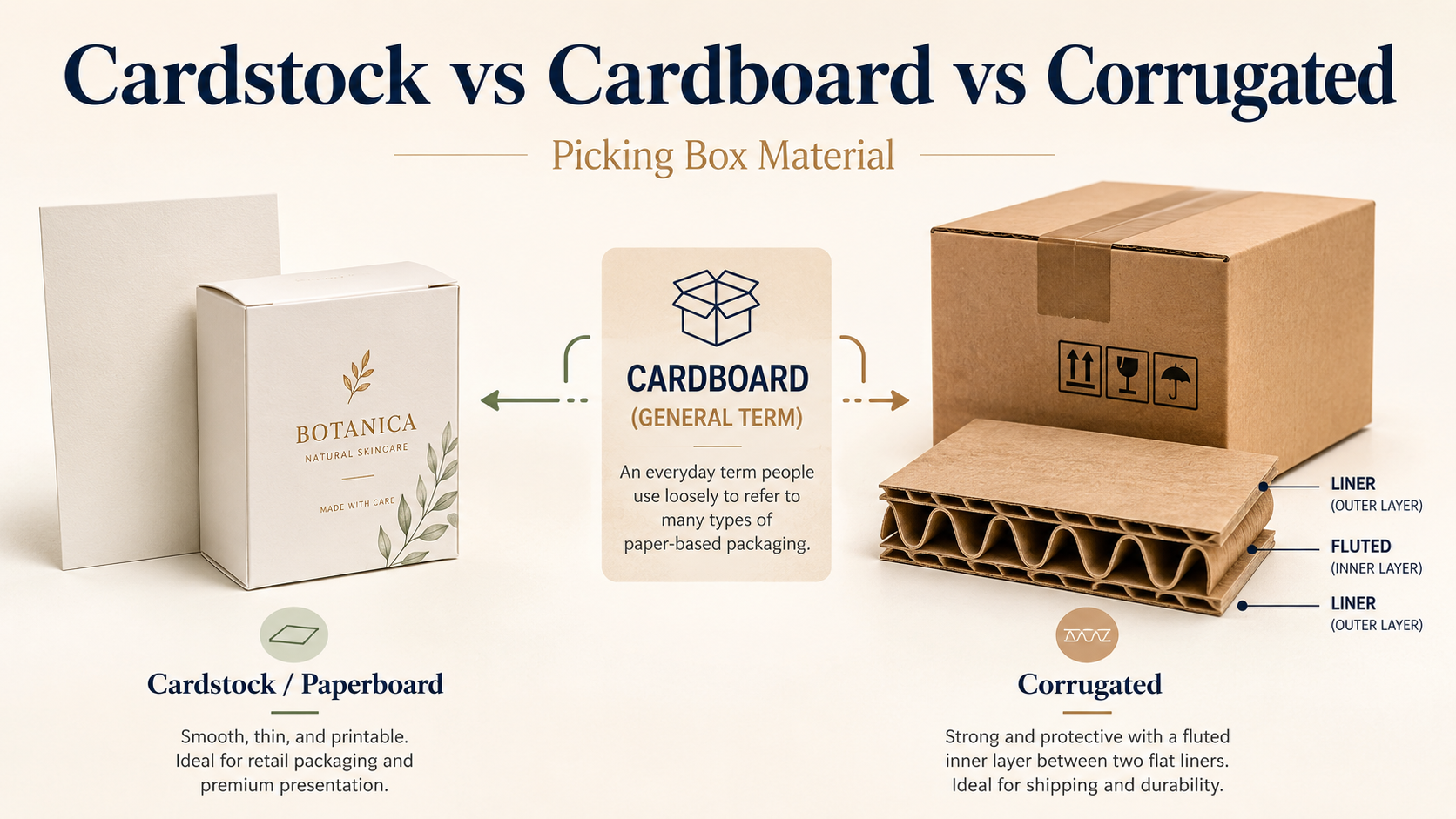
Cardstock, cardboard, and corrugated aren’t the same thing. Cardstock, also called paperboard, is a single dense sheet. Cardboard is a casual term. People use it to mean either paperboard or corrugated. Corrugated is a three-layer structure. It has two flat liners with a fluted layer sandwiched between them. That fluting is what gives shipping boxes their strength.
Knowing the difference matters before you request a quote. It’s the difference between getting a delicate gift box and getting a shipping-ready mailer. It can also save you a round of back-and-forth. Nobody has to guess what you actually meant.
What Cardstock (Paperboard) Actually Is
Cardstock is a single, dense sheet of pressed paper fibers. It has no layers and no fluting. Think of a cereal box, a shoebox, or a folding carton for cosmetics.
Paperboard comes in a range of thicknesses, usually measured in GSM or PT. It’s smooth and flat, which makes it great for print. Brands that want sharp art and fine detail often pick paperboard for that reason.
Paperboard isn’t built for heavy hits or drops. It works well for light products and store shelves. It’s not built for a rough trip through the mail. Skip it for anything fragile or heavy that has to go through a carrier’s belts and trucks.
Paperboard also comes coated or uncoated. Coated stock adds a smooth gloss or matte finish over the base sheet. That coating helps colors pop and keeps out light moisture. Uncoated stock feels more raw. It takes ink a bit differently too, which some brands like for a rustic look.
What “Cardboard” Usually Means
Here’s where most mix-ups start. “Cardboard” isn’t an exact trade term. It’s a catch-all word people use for any stiff paper stock.
Sometimes “cardboard” means paperboard, like a cereal box. Sometimes it means corrugated, like a shipping box. The two materials look similar from a distance. They behave very differently under pressure. Even the surface can feel similar to the touch. That’s part of why the mix-up happens so often.
I’ve seen a first-time brand ask for “a cardboard box” for a heavy item. They wanted tough, shipping-grade strength. The printer quoted thin paperboard instead. That’s the more literal read of “cardboard” in plain speech. The mismatch caused a delay. Both sides had to clear up specs first. A short chat up front would have skipped that step entirely.
When you ask for a quote, describe your product instead of just naming a material. Mention the weight, how fragile it is, and how far it will travel. You can work out rough material needs yourself, based on those three facts. Easy Box Packaging can also walk you through material options. Just share what you’re shipping or selling on a shelf. Our customized cardboard boxes are built this way by default — the material spec (kraft, corrugated, or rigid) follows from what you’re packing, rather than shipping as one fixed board type.
What Corrugated Actually Is
Corrugated board has three layers. Two flat sheets sandwich a fluted layer between them. That fluted layer makes small air gaps that run through the board.
Those air gaps are what make corrugated tough. They soak up hits and fight off crushing under weight. That’s why almost every box you get in the mail is corrugated, not plain paperboard.
Corrugated strength gets rated with a test called the edge crush test, or ECT. It’s a real test, not a sales term. A sample gets squeezed on its edge until it fails. The result gets shown in pounds per inch. Higher ECT numbers mean better stack strength. That ECT number is the real basis behind any “this box holds X pounds” claim.
Corrugated also comes in different flute sizes. Bigger flutes add more cushion and bulk. Smaller flutes save space and print more clean. Flute choice is its own call. It’s separate from the choice to use corrugated at all.
Some brands pick corrugated for how well it prints, too. A well-coated outer sheet can carry full-color art almost as well as paperboard. It still keeps the fluted layer’s strength underneath.
Corrugated also comes in single-wall, double-wall, and triple-wall versions. Single-wall is the standard for most retail and mailer boxes. Double-wall and triple-wall stack more fluted layers together, built for heavy freight or export crates. Most brands shipping through a parcel carrier only need single-wall. Save the heavier options for bulk or industrial loads.
Cardstock vs Cardboard vs Corrugated: Quick Comparison
| Material | Structure | Strength | Typical Use |
|---|---|---|---|
| Cardstock (paperboard) | Single dense sheet | Low impact resistance | Folding cartons, retail packaging, tags |
| “Cardboard” (casual term) | Could mean either material above | Varies, depends what’s meant | Ambiguous — clarify before ordering |
| Corrugated | Two liners + fluted medium | High impact/stacking resistance | Shipping boxes, mailers, bulk protection |
Common Mistakes When Choosing Box Material
The first mistake is using “cardboard” when requesting a quote, without specifying which material you actually mean. That’s one of the quieter packaging mistakes that kill the unboxing moment. A mismatched material shows up the moment a box arrives damaged or feels flimsy.
The second mistake is picking corrugated just to be safe. That happens even for a light item that doesn’t need it. Corrugated costs more than paperboard, most of the time. That extra cost buys no real gain for a product that never needed it.
The third mistake is picking paperboard for something that has to go through the mail. Paperboard alone often can’t take stacking, drops, or rough handling. A pretty box that shows up crushed hurts a brand. It hurts more than a plain box that shows up whole.
The fourth mistake is ignoring flute size once you’ve picked corrugated. Two “corrugated” boxes at the same weight can act very differently. It comes down to flute size. Ask your printer which flute fits your product’s weight and how far it will ship.
A fifth mistake is assuming your first material choice is set for good. Plenty of brands start with paperboard for a light product. They switch to corrugated later, once orders grow and damage claims start to add up. Switching materials as your product or shipping needs change is normal. It’s not a sign something went wrong at launch.
A sixth mistake is picking single-wall corrugated for something that really needs double-wall, like heavy or oddly-shaped items. Single-wall handles most standard products fine. Heavier or bulky items can punch through single-wall over a long shipping route. Rough handling along the way makes that worse.
Which Should You Choose?
Selling a light item that customers pick up in-store, or open gently at home? Paperboard usually fits, and it prints well. Shipping anything through the mail, especially something with weight or that’s easy to break? Reach for cardboard boxes built on corrugated, not thin paperboard.
Building custom mailer boxes that need to make it through the mail in one piece? Corrugated with the right flute size guards the product and the unboxing moment together. Want kraft-style looks for a rustic or green feel? Kraft comes in both paperboard and corrugated forms. Check which one you need from the kraft packaging options before you order.
Not sure which one fits? Describe your product’s weight and how far it will travel. That’s usually enough for a printer to point you to the right pick. Getting this right the first time matters. A box that survives shipping in one piece makes a strong first impression. That’s part of why packaging drives repeat purchases down the line.
Want a closer look at corrugated on its own? Our guide on why corrugated wins for ecommerce breaks down the cost tradeoffs in more depth.
Cardstock vs Cardboard vs Corrugated: FAQ
Is cardstock the same as cardboard? Not quite. Cardstock, also called paperboard, is a single dense sheet. “Cardboard” is a loose term people use, sometimes for paperboard, sometimes for corrugated.
What’s the difference between cardboard and corrugated? Cardboard usually means paperboard, a single flat sheet. Corrugated has three layers, including a fluted middle layer that adds strength and cushion.
Is corrugated stronger than cardstock? Yes, in most cases. The fluted layer in corrugated soaks up hits and resists crushing. It beats a single dense paperboard sheet of the same weight.
What is ECT in packaging? ECT stands for edge crush test. It rates a corrugated board’s edge strength, shown in pounds per inch. It’s the basis for stack-strength claims.
Which material is cheaper, paperboard or corrugated? Paperboard usually costs less than corrugated. It uses one layer instead of three. Corrugated costs more, but it gives far more shipping strength.
Can paperboard be used for shipping at all? Sometimes, for light, sturdy items shipped short distances. For most parcel shipping, corrugated is still the safer, more solid choice.
Get a free quote — dieline and design support included.